adhesive applicator
An adhesive applicator is the specific component or subsystem within a coating machine that directly applies the adhesive material onto the substrate surface. This critical part determines the coating pattern, thickness, and uniformity, and its design varies significantly based on the adhesive type, desired coating weight, and production speed. This article provides a detailed technical overview of adhesive applicator technologies, including their working principles, common types, process parameters, and selection criteria for various industrial applications.
Adhesive applicators can be broadly divided into contact and non-contact types. Contact applicators physically touch the substrate, using a blade, roll, or die to meter and apply the adhesive. Non-contact applicators, such as spray nozzles, deposit adhesive without touching the substrate, minimizing stress on delicate materials. Within these categories, the most widely used adhesive applicators include slot dies (precision extrusion through a narrow slit), comma blades (rigid blade metering), gravure rolls (engraved cylinder transfer), roll coaters (multi-roll transfer), and spray systems (atomized droplet deposition). Each applicator type has a distinct operating window in terms of viscosity, coat weight, speed, and coating quality. The selection of an adhesive applicator is one of the most important decisions in coating line design, as it directly affects product quality, material utilization, and production efficiency.
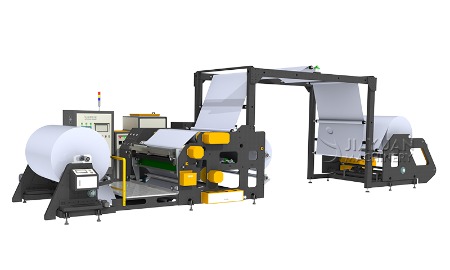
Adhesive coating machine
Slot die applicators are the premier choice for high-precision adhesive coating, achieving thickness uniformity within ±1% and coat weight variation of ±1-2%. They operate by feeding adhesive through an internal manifold that distributes flow uniformly across the web width, then extruding it through a narrow slot (typically 0.1-1.0 mm gap). The adhesive forms a stable bead between the die lips and the substrate, and the coating thickness is determined by the ratio of flow rate to line speed. Slot dies are compatible with hot melt, solvent-based, and water-based adhesives across a wide viscosity range (100-50,000 cP) and can achieve coat weights from 2 to 200 gsm at speeds up to 600 m/min. Their closed design minimizes solvent evaporation and contamination, making them highly efficient and environmentally friendly. However, slot dies require precise temperature and gap control, and they are more expensive than simpler applicators.
Comma blade applicators are widely used for water-based and solvent-based adhesives, offering excellent coat weight uniformity (±1-2%) at moderate speeds (up to 200 m/min). The comma-shaped rigid blade is set at a precise gap above the substrate, and the adhesive is supplied as a pool upstream of the blade. The blade scrapes off excess adhesive, allowing only the required thickness to pass. Comma blades can handle viscosities from 100 to 50,000 cP and coat weights from 1 to 200 gsm. They are easy to clean and change over, making them popular for short runs and diverse product mixes. However, they are sensitive to speed and rheology changes, and the open bead can lead to solvent evaporation and skin formation. Gravure applicators use an engraved cylinder to pick up adhesive from a pan, with a doctor blade wiping excess from the cylinder surface. They excel at thin coatings (0.5-10 gsm) and high speeds (up to 400 m/min) with uniformity within ±2-3%. Gravure applicators are ideal for low-viscosity adhesives and are commonly used for silicone release coatings and primers.
Roll coaters are the most versatile applicators, with configurations ranging from two-roll to four-roll systems. In a reverse roll coater, the metering roll rotates opposite to the applicator roll, creating high shear that precisely meters the adhesive. This design achieves coat weight uniformity within ±1-2% and handles viscosities up to 50,000 cP. Kiss coaters, a simpler roll applicator, use a light contact between the substrate and the applicator roll, applying very thin coatings (0.5-10 gsm) on delicate substrates. Spray applicators use hydraulic or pneumatic pressure to atomize adhesive into fine droplets, enabling non-contact coating on uneven surfaces. They are often used for low-coat-weight applications on nonwovens and textiles, but have lower transfer efficiency (40-70%) and higher overspray losses.
Critical process parameters for adhesive applicators include flow rate, temperature (for hot melts), gap or clearance, and speed ratio (for roll coaters). The flow rate must be precisely controlled by a gear pump or metering system to maintain a constant coating weight, with closed-loop feedback from coat weight gauges. Temperature control is essential for hot melts to maintain viscosity within ±0.5°C, and for water-based adhesives to prevent premature drying. The gap between the applicator and backup roll (for blade and roll coaters) must be set to micron-level accuracy, often using automatic gap actuators and laser sensors. The speed ratio between rolls in reverse roll coaters significantly affects coating weight; typical ratios range from 0.5 to 1.5. Modern adhesive applicators are integrated with PLC-based control systems that adjust these parameters in real-time based on line speed and gauge readings, ensuring consistent product quality across long production runs and reducing material waste.