adhesive coater
An adhesive coater is a specialized industrial machine used to apply a precise, uniform layer of adhesive onto a continuous web of substrate material such as paper, film, foil, or fabric. This equipment is essential in the production of tapes, labels, medical dressings, packaging materials, and various laminated products. This article provides a detailed overview of adhesive coater types, working principles, process parameters, and application considerations for manufacturing professionals.
The fundamental operation of an adhesive coater involves unwinding a substrate from a roll, passing it through a coating station where adhesive is applied, and then rewinding the coated material. The coating station can employ various mechanisms depending on the adhesive type and desired coating characteristics. Roll coaters are among the most common, using counter-rotating rolls to transfer adhesive from a reservoir to the substrate through a film-splitting process. Gravure coaters use an engraved cylinder to pick up adhesive from a pan, with a doctor blade removing excess adhesive so that only the adhesive in the engraved cells is transferred to the substrate. The choice of coating method affects coat weight, uniformity, speed, and the range of adhesive viscosities that can be processed.
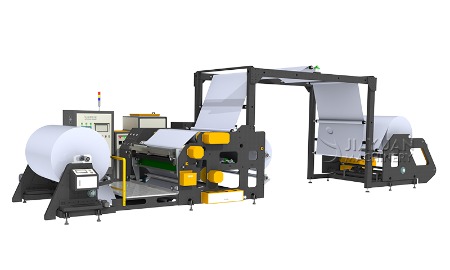
Adhesive coating machine
Adhesive coaters are broadly classified by the type of adhesive they handle. Hot melt coaters process 100% solid thermoplastic adhesives that are heated to a molten state (typically 100-200°C), applied to the substrate, and solidify upon cooling without requiring drying. This results in compact, energy-efficient lines capable of high speeds up to 300-600 m/min. Solvent-based coaters use adhesives dissolved in organic solvents, which are applied and then dried in long ovens to evaporate the carrier. These systems are slower (50-200 m/min) and consume significantly more energy but can produce very thin coatings and handle heat-sensitive substrates. Water-based coaters are similar to solvent-based systems but use water as the carrier, offering lower VOC emissions and reduced environmental impact.
Key process parameters in adhesive coating include coat weight (typically measured in grams per square meter, or GSM), coating speed, adhesive viscosity, and drying conditions. Coat weight is determined by the combination of adhesive flow rate and line speed, with precise control achieved through gear pumps and closed-loop feedback systems. For roll coaters, the gap between rolls and the roll speed ratio influence coating thickness. For gravure coaters, the cell volume and pattern of the engraved roll determine the applied adhesive amount. Drying is a critical step for solvent-based and water-based coaters, requiring careful control of temperature, airflow, and residence time to ensure complete removal of the carrier without damaging the substrate or causing defects such as blistering or uneven solid deposition.
Adhesive coaters find applications across numerous industries. In the packaging sector, they are used to produce pressure-sensitive tapes, labels, cartons, and flexible packaging materials. The medical industry relies on adhesive coaters for manufacturing wound dressings, surgical tapes, transdermal patches, and medical device components. Other applications include automotive components, construction materials, electronics, and graphic arts. The selection of an adhesive coater depends on factors such as production volume, required precision, substrate characteristics, adhesive chemistry, and environmental regulations. Manufacturers must also consider capital costs, operating expenses, floor space requirements, and maintenance needs when choosing between different coater technologies.