adhesive lamination
Adhesive lamination is a process that bonds two or more substrate layers together using an adhesive, creating a composite structure with enhanced properties such as strength, barrier, flexibility, or aesthetics. It is a fundamental operation in the production of flexible packaging, labels, tapes, medical devices, and industrial materials. This article provides a comprehensive technical overview of adhesive lamination, including its types, adhesive selection, process equipment, key parameters, and quality considerations.
Adhesive lamination involves applying a layer of adhesive onto one substrate (the carrier or primary web) and then bringing a second substrate (the face or secondary web) into contact under pressure, forming a permanent bond. The process can be performed inline with the coating line (wet lamination) or offline as a separate operation (dry lamination). In wet lamination, the adhesive is applied and immediately laminated before drying, relying on the adhesive's tack to hold the layers. In dry lamination, the adhesive is first coated and dried (or cured) on one substrate, and then laminated to the second substrate using heat and pressure to reactivate or soften the adhesive. Dry lamination is more common for pressure-sensitive adhesives (PSAs) where the adhesive is coated onto a release liner and later transferred to the face material. The choice of lamination method depends on the adhesive type, substrate sensitivity, line speed, and final product requirements.
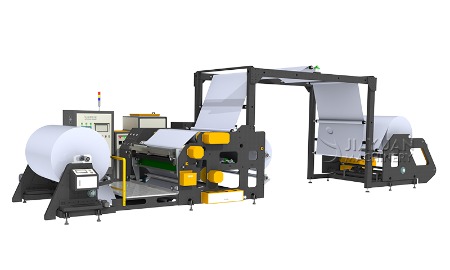
Adhesive coating machine
The adhesive used for lamination must be selected based on the substrates, the end-use environment, and the desired bond strength. For flexible packaging, solvent-based, water-based, or solventless (100% solids) adhesives are used, with the latter gaining popularity due to zero VOC emissions. For tape and label applications, PSAs are the standard, offering instant bonding upon pressure. In medical laminates, skin-friendly, breathable, and non-irritating adhesives are required. The adhesive coat weight for lamination varies; for packaging, it may be 2-10 gsm, while for tapes it can be 15-40 gsm. The adhesive must wet both substrates adequately and form a cohesive bond that can withstand delamination forces, temperature variations, and chemical exposure. Compatibility testing is essential to avoid interactions between adhesive and substrate additives (e.g., plasticizers migrating from PVC films) that can weaken the bond.
The lamination equipment typically consists of a laminating station with one or more nip rolls. The two webs (coated substrate and second substrate) are brought together at the nip, where pressure is applied to ensure intimate contact and to remove air bubbles. The nip pressure, roll temperature, and nip gap are critical parameters. For hot melt or heat-activated adhesives, the nip rolls may be heated to activate the adhesive. For solventless adhesives, the lamination may occur at room temperature but with sufficient pressure to ensure flow and wetting. In many coating lines, the lamination station is integrated after the coating head and drying oven; for transfer coating, the adhesive is first coated onto a liner, dried/cooled, and then laminated to the face stock. The speed of lamination must match the line speed, and tension control is critical to prevent wrinkles or misalignment. Some laminators include a pre-heating section for the substrates to improve adhesive flow, and a cooling section after the nip to set the bond. Edge trimming may be performed after lamination to clean up the edges.
Quality control in adhesive lamination involves checking for bond strength (peel or delamination tests), visual appearance (no bubbles, wrinkles, or streaks), and dimensional stability (no shrinkage or curl). Peel adhesion is measured by peeling the two layers apart at a constant angle and speed, typically 180° or 90°, and the force required is recorded. The mode of failure (adhesive failure at interface or cohesive failure within adhesive) is also noted; cohesive failure is preferred as it indicates stronger bonding. Bubble formation is a common defect caused by trapped air or insufficient nip pressure; it can be mitigated by using a nip with a rubber-covered roll that conforms to the web, and by controlling web tension to avoid flutter. Wrinkles occur when the two webs have different tensions or are misaligned; edge guides and tension control are essential. In addition, the bond strength may be tested after aging (heat, humidity, or chemical exposure) to ensure durability. The lamination process parameters are documented and controlled via PLC systems, with alarm limits for pressure, temperature, and speed deviations. Regular maintenance of nip rolls (cleaning and surface inspection) ensures consistent lamination quality.
Applications of adhesive lamination are vast. In flexible packaging, lamination combines films (e.g., PET/PE, OPP/PE) to provide barrier properties for food and pharmaceutical packaging. In labels, lamination of the PSA-coated liner to the face stock produces self-adhesive labels. In tapes, double-sided tapes are produced by laminating a carrier film between two PSA layers. In medical products, lamination creates multi-layer wound dressings with an absorbent layer and a skin-contact adhesive layer. In automotive, lamination bonds decorative films or acoustic materials to interior parts. The trend toward lightweight, sustainable packaging is driving innovations in adhesive lamination, such as using bio-based adhesives and thinner films without compromising bond strength. Additionally, inline lamination with coating lines is becoming more efficient, enabling just-in-time production and reducing handling. Overall, adhesive lamination is a versatile and critical process that adds value by combining the best properties of different materials into a single composite structure.