automotive adhesive coating
Automotive adhesive coating refers to the application of adhesives onto various automotive components and substrates, including interior trim, exterior parts, structural panels, and noise-vibration-harshness (NVH) materials. Adhesives are increasingly replacing mechanical fasteners in vehicles to reduce weight, improve durability, and enhance design flexibility. This article provides a comprehensive technical overview of automotive adhesive coating technologies, adhesive types, application methods, process requirements, and quality standards in the automotive industry.
Adhesives in automotive applications are used for bonding plastics, metals, composites, glass, and textile materials. Specific uses include interior trim attachment (headliners, door panels, instrument panels), exterior part bonding (spoilers, emblems, weather strips), structural bonding (hem flanges, roof panels, chassis components), and NVH damping (mats and foams). The adhesives must withstand extreme temperatures (-40°C to +120°C), humidity, UV exposure, and chemical resistance (fuels, oils, windshield washer fluids). Coating methods vary widely: spray coating for large areas, roll coating for films and tapes, slot die for precision strips, and brush or extrusion for structural adhesives. The production environment often involves robotic application in a controlled assembly line, with line speeds ranging from 1 to 10 m/min for batch processing, to 30-60 m/min for continuous roll-fed materials. The coat weight depends on the application; for PSA tapes, 20-50 gsm; for structural adhesives, 100-500 gsm; for spray-applied damping coatings, up to 2000 gsm.
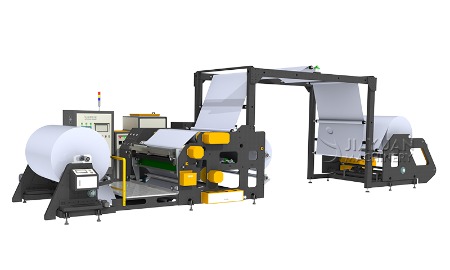
Adhesive coating machine
Automotive adhesive coating employs a diverse range of adhesive chemistries. Pressure-sensitive adhesives (acrylic and rubber-based) are used for tapes and films for trim attachment, providing instant bonding and easy handling. Hot melt adhesives (polyolefin and EVA) are used for interior panel bonding and headliner lamination, offering fast setting and low VOC. Water-based adhesives (acrylic dispersions and polyurethane dispersions) are applied by spray for interior trim and textile bonding, with low VOC but requiring drying. Solvent-based adhesives (contact adhesives and polyurethanes) are used for high-strength bonding of laminates and exterior parts, though they are being phased out due to emissions. Structural adhesives (epoxies, polyurethanes, and acrylics) are used for load-bearing applications, often applied in bead form by robotic dispensers, and require heat curing or ambient curing. Reactive adhesives (moisture-curing polyurethanes) are used for bonding glass and body panels. The selection depends on the substrate, load, environment, and assembly speed. The adhesive coating equipment must be compatible with the adhesive's rheology and curing mechanism; for instance, structural adhesives often use static mixing nozzles and precise metering.
Application methods for automotive adhesive coating are diverse to accommodate different product geometries and production volumes. Spray coating is used for large-area applications, such as bonding headliner foam to backing, using airless or air-assisted spray guns, often with robotic manipulators to ensure uniform coverage. Coat weight is controlled by spray pressure, flow rate, and pattern overlap. Roll coating is used for continuous production of adhesive tapes and films, where slot die or gravure coaters apply PSA onto a carrier and liner. For structural adhesives, robotic dispensing with gear pumps or piston pumps applies continuous beads or dots onto the substrate; the bead profile (width and height) is monitored by laser sensors. For interior trim attachment, hot melt glue guns or wheel applicators apply the adhesive in stripes or spirals. Lamination presses are used to bond large panels under heat and pressure. Curing ovens, induction heaters, or UV lamps are used for thermoset or UV-curable adhesives. The process is often integrated with the assembly line, with precise timing to allow for positioning and curing before the next step.
Process control in automotive adhesive coating is critical for safety and quality. Coat weight and bead geometry must be within tight tolerances to ensure bond strength and avoid adhesive squeeze-out (cosmetic defect). Temperature and humidity control are essential for water-based and moisture-curing adhesives. The application equipment must be cleaned regularly to prevent nozzle clogging and ensure consistent output. Inline inspection systems, such as cameras and laser scanners, verify adhesive placement and detect misses or irregularities. Bond strength is tested by peel, shear, and tensile tests on sample coupons, often with accelerated aging. The adhesive must also meet flammability, fogging, and emissions standards (e.g., VDA 278, ISO 12219). The coating line is often part of an automated production cell with programmable logic controllers (PLC) and human-machine interfaces (HMI) that store recipes for different vehicle models and parts. Traceability of adhesive batches and application parameters is required for quality documentation and recall preparedness. Regular calibration of pumps, guns, and sensors ensures accuracy.
Applications of automotive adhesive coating are expanding as vehicles become lighter and more electric. Interior trim bonding reduces rattles and improves acoustics. Structural adhesives enable thinner steel panels and mixed-material construction (aluminum to steel, or composites). Acoustic coating of dampening materials reduces cabin noise. Adhesive-coated films are used for paint protection and window tinting. With the rise of electric vehicles (EVs), battery pack assembly uses thermal interface adhesives and structural bonding to ensure thermal management and crash safety. The trend toward sustainable materials drives development of bio-based and recyclable adhesives. Additionally, pre-coated tapes and films are becoming popular for ease of assembly and consistent quality. The adhesive coating industry in automotive is evolving with digitalization, where application systems are connected to the factory network for real-time monitoring and predictive maintenance. In summary, automotive adhesive coating is a critical manufacturing process that ensures vehicle durability, safety, comfort, and lightweight construction, requiring a high level of precision, robustness, and compliance with stringent industry standards.