cleaning coating head
Cleaning the coating head is one of the most critical maintenance tasks in adhesive coating operations. The coating head—whether a slot die, comma blade, gravure cylinder, or roll coater—is the component that directly applies the adhesive onto the substrate, and any residue, carbonized material, or contamination on its surfaces will cause coating defects such as streaks, die lines, pinholes, or uneven coat weight. This article provides detailed, step-by-step cleaning procedures for various coating head types, along with best practices for safe and effective cleaning.
For slot die coating heads—the most common in high-precision hot melt PSA applications—cleaning must be performed with extreme care to avoid damaging the precision-ground lip surfaces. The slot die lips are typically ground to a flatness of 0.2-0.5 μm per 100 mm, and any scratch or nick will cause a permanent streak defect. The cleaning procedure begins by reducing the die temperature to 150°C for EVA-based adhesives or 120°C for PUR adhesives. The die bolts are gently closed, and the die is removed from the machine (if removable) and placed on a clean table. The die halves are carefully dismantled by loosening the bolts in a cross pattern, and the shim (if any) is removed. Using a soft brass scraper and wooden sticks, the softened adhesive is removed from both die faces and the manifold. For carbonized residue that does not come off easily, the parts are soaked in a hot melt die cleaner (a high-temperature solvent) for 30-60 minutes, or heated in an oven to 200°C (if safe) and then scraped. Never use metal scrapers or abrasive materials that can damage the precision-ground surface. After cleaning, the die halves are reassembled with the correct shim thickness, and the bolts are torqued in the specified sequence and values.
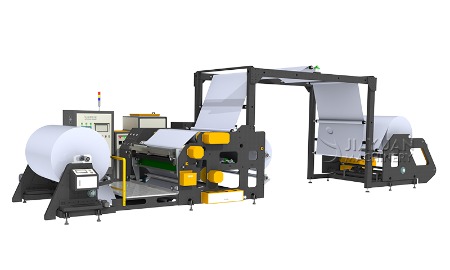
Adhesive coating machine
For intermittent or minor cleaning of the slot die without full disassembly, the line can be stopped, the die raised, and a brass scraper or soft wooden stick used to gently wipe the lip while the adhesive is still molten. For persistent contamination, a full die cleaning is necessary. Some modern slot dies feature self-cleaning die lips that prevent build-up of unwanted materials, reducing the frequency of manual cleaning. However, even with self-cleaning designs, periodic manual cleaning is still required. The use of purging compounds before shutdown can also reduce the amount of residue that accumulates, making cleaning easier. After cleaning the slot die, it is important to purge the system with fresh adhesive to remove any remaining cleaning compound before resuming production.
Cleaning comma blade coating heads requires a different approach. The comma blade is a rigid, curved blade that meters the adhesive onto the substrate. Over time, adhesive builds up on the blade edge and on the backup roll, causing streaks and coat weight variations. The blade should be cleaned regularly by stopping the line, relieving the blade pressure, and using a soft scraper or cloth with an appropriate solvent (for solvent-based or water-based adhesives) to wipe the blade edge and the backup roll surface. For hot melt comma blades, the blade is heated to soften the adhesive, then scraped with a brass tool. The blade should be inspected for wear; a worn blade tip (increased radius) causes coat weight drift and requires regrinding or replacement. The backup roll surface must be kept clean and smooth; any adhesive buildup on the roll can transfer to the substrate, causing defects.
Cleaning gravure coating heads involves the engraved cylinder and the doctor blade. The engraved cylinder's cells can become clogged with dried adhesive, reducing coat weight and causing pattern defects. The cylinder should be cleaned with a specialized gravure cylinder cleaner (a solvent-based or alkaline solution) using a soft brush or ultrasonic cleaning, depending on the cylinder size. The doctor blade must be replaced regularly (typically every shift or daily) to maintain wiping efficiency; a worn blade causes streaks and uneven coating. The coating pan should be drained and cleaned after each run to prevent skinning and contamination. For roll coaters, cleaning involves wiping the applicator and metering rolls with solvent-soaked cloths, and inspecting the roll surfaces for scratches or embedded particles.
Safety is paramount during coating head cleaning. For hot melt systems, always wear heat-resistant gloves and safety glasses. Ensure the machine is turned off and follow lockout/tagout procedures. Allow the machine to cool to below 80°C before opening any pressurized parts. Use only approved cleaning agents and methods suitable for the equipment materials. Never use water or standard solvents on hot melt systems, as they can flash to steam or damage seals. For solvent-based systems, ensure adequate ventilation and use explosion-proof equipment. Document all cleaning activities in a logbook, including the date, time, cleaning agent used, and any observations (e.g., die condition, wear). Regular cleaning, performed according to a defined schedule (partial clean every shift, full clean weekly for high-volume lines), is essential for maintaining coating quality and preventing unplanned downtime.