coat weight
Coat weight is the amount of coating material applied per unit area of substrate, typically expressed in grams per square meter (gsm) or ounces per square yard (osy). It is the most critical quality parameter in adhesive coating, as it directly determines the product's performance characteristics such as adhesive strength, tack, peel adhesion, and shear resistance. This article provides a comprehensive technical overview of coat weight measurement, control strategies, factors affecting coat weight, and its importance in adhesive product manufacturing.
Coat weight is a fundamental specification for any coated adhesive product. For pressure-sensitive adhesives (PSAs), typical coat weights range from 15 to 40 gsm for general-purpose tapes and labels, with 20-25 gsm being the most common. Lighter coat weights (5-15 gsm) are used for low-tack applications such as removable notes or medical tapes, while heavier coat weights (40-100 gsm) are used for double-sided tapes, structural bonding, and industrial applications where high adhesion and gap-filling are required. In silicone release coatings, coat weights are much lower, typically 0.5-2 gsm. The required coat weight is determined by the adhesive formulation, substrate surface energy, and end-use performance requirements. Manufacturers must control coat weight within tight tolerances, typically ±2-5% of the target, to ensure consistent product performance and minimize material costs.
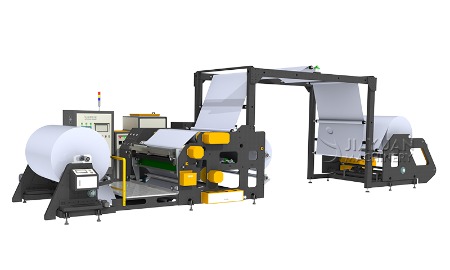
Adhesive coating machine
Measurement of coat weight can be performed online or offline. Online measurement is essential for closed-loop control and is typically achieved using non-contact gauges. Beta-ray gauges (using a radioactive source such as Krypton-85 or Promethium-147) measure the mass per unit area by detecting the attenuation of beta particles through the coated web. X-ray gauges use X-ray fluorescence to measure coating weight, especially for coatings containing elements with high atomic numbers (e.g., fillers). Near-infrared (NIR) spectroscopy can measure coating thickness and composition simultaneously. These gauges are mounted on scanning frames that traverse the web width, providing a cross-web profile of the coat weight. The measurement accuracy is typically ±0.1-0.5 gsm, depending on the gauge type and calibration. Offline measurement involves taking samples and weighing them before and after stripping the coating with a solvent (for soluble adhesives) or using a precision micrometer to measure the thickness if the density is known. Gravimetric analysis is the most accurate method but is destructive and cannot be used for real-time control.
The control of coat weight is achieved through various actuators depending on the coating method. In slot die coating, the coat weight is controlled by adjusting the gear pump speed (flow rate) relative to the line speed; closed-loop control uses the gauge reading to modulate the pump speed. In roll coating, the coat weight is controlled by adjusting the gap between the metering and applicator rolls, or the speed ratio between rolls. In comma blade coating, the blade gap is adjusted via micrometer screws or motorized actuators. In gravure coating, the coat weight is determined by the engraved cell geometry and cannot be changed online; however, the viscosity and solids content can be adjusted to alter the dry coating weight. Modern coating lines employ sophisticated control algorithms such as PID (proportional-integral-derivative) or model predictive control that account for process dynamics, time delays, and interactions between control loops. Cross-web coat weight profile control is achieved by using multiple actuators (e.g., segmented die lip heaters or individual gap adjusters) that correct localized variations across the width.
Several factors affect coat weight stability and uniformity. Adhesive viscosity is a primary factor; changes in temperature, shear rate, or solids concentration cause viscosity variations that alter the flow rate through the coating head and the film splitting behavior. For hot melt adhesives, temperature control within ±0.5°C is essential to maintain constant viscosity. Substrate surface roughness and porosity affect the amount of adhesive that penetrates into the substrate versus remaining on the surface; for porous substrates, the coat weight measured includes both surface and penetrated adhesive, and the penetration depth varies with substrate properties. Line speed fluctuations affect the coat weight inversely; speed increases reduce coat weight if flow is constant, so speed must be precisely regulated. Web tension variations can cause substrate stretching, changing the apparent coat weight per unit area. Environmental factors such as temperature and humidity affect solvent evaporation before measurement (for solvent-based coatings), causing measurement errors. To minimize these effects, coating lines are equipped with tension control, temperature control, and environmental conditioning, and the gauges are calibrated regularly using standard samples.
Coat weight optimization is a key economic driver in adhesive production. Reducing coat weight by even 1 gsm on a wide web (say 1,600 mm) running at high speed can save thousands of tons of adhesive per year, significantly lowering material costs. However, coat weight reduction must be balanced against product performance: too low a coat weight leads to insufficient adhesion, while too high a coat weight adds cost without benefit and may cause oozing or poor convertibility. Therefore, manufacturers often perform design of experiments (DOE) to find the minimum coat weight that meets all performance specifications, using statistical methods such as response surface modeling. Additionally, coat weight uniformity across the web is critical; variations of more than ±2% can cause local weak spots (low coat weight) or handling issues (high coat weight). Advanced coat weight control systems incorporate machine learning algorithms that predict optimal control actions based on historical data and real-time measurements, further improving yield and reducing waste. In summary, coat weight is not just a measurement but a central parameter that links process control, material usage, and product quality in adhesive coating operations.