coating accuracy
Coating accuracy refers to the degree to which the actual coating thickness or coat weight matches the target value, expressed as a tolerance or percentage deviation. It is a critical measure of process capability and directly impacts product quality, material usage, and manufacturing costs. This article provides a comprehensive technical overview of coating accuracy in adhesive coating processes, including its definition, measurement, influencing factors, improvement methods, and industry standards for various applications.
Coating accuracy is typically specified as an absolute tolerance (e.g., ±0.5 gsm) or a percentage of the target (e.g., ±2%). For high-precision applications, such as medical patches or optical films, tolerances as tight as ±1% of target are required, while for general-purpose packaging tapes, ±3-5% may be acceptable. The accuracy is influenced by the coating method, the control systems, the adhesive rheology, and the substrate properties. Slot die coating offers the highest accuracy, achieving ±1-2% variation in coat weight and thickness, thanks to its closed, precision volumetric metering. Reverse roll coating and comma blade coating can achieve ±2-3% accuracy under controlled conditions. Gravure coating, because its coat weight is determined by the fixed cell geometry, can be very repeatable but may have systematic offsets due to cell wear and viscosity changes, typically achieving ±2-4% accuracy. Spray coating has the lowest accuracy, often ±5-10%, due to overspray and droplet size variations.
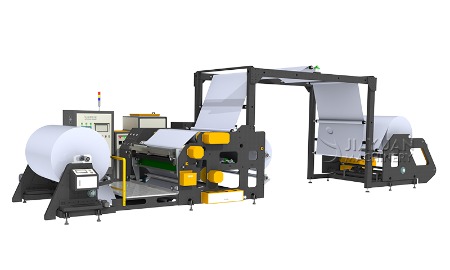
Adhesive coating machine
Measurement of coating accuracy requires reliable and calibrated gauges with sufficient resolution. The accuracy of the gauge itself must be at least one order of magnitude better than the required coating tolerance. For example, if the coating tolerance is ±0.5 gsm, the gauge must have a measurement uncertainty of <0.05 gsm. Beta-ray and X-ray gauges typically offer such precision. However, the overall accuracy also depends on the measurement location, scan speed, and data averaging methods. Cross-web profiling is essential to capture variations across the width, as edge effects and die wear often cause localized deviations. Statistical analysis of the measurement data, such as calculating the standard deviation and process capability indices (Cp, Cpk), quantifies the coating accuracy. A Cp of 1.33 (four-sigma) is considered acceptable for many adhesive processes, while critical applications may require Cp >1.67 (six-sigma). Modern coating lines often include online SPC software that continuously computes these indices and alerts operators if the process becomes less capable.
Several factors degrade coating accuracy, and understanding them is key to improvement. Viscosity fluctuations are a primary cause; temperature changes of even 1°C can alter viscosity by 2-5% for many polymers, leading to proportional coat weight changes. Therefore, precise temperature control of the adhesive, the coating head, and the supply lines is essential. Pump pulsation from gear pumps or piston pumps can cause cyclic thickness variations; using high-precision gear pumps with smooth drive systems and incorporating pulse dampeners can minimize this. Die lip wear or contamination causes local gap changes; regular cleaning and inspection are required. Substrate thickness variations can also affect the apparent coat weight if the gauge measures total mass without subtracting the substrate; using differential gauging or pre-measuring substrate weight can compensate. Web speed variations, especially during acceleration or deceleration, must be compensated by fast-responding flow control. Additionally, environmental changes in humidity can affect water-based adhesives by altering evaporation rates before measurement, leading to control errors. Advanced control algorithms that incorporate feed-forward compensation based on measured disturbances (e.g., temperature, speed) significantly improve accuracy.
Improving coating accuracy involves both hardware and software enhancements. On the hardware side, using high-accuracy gear pumps with minimal slip, precision-ground dies with thermal expansion control, and high-resolution actuators for gap adjustment are essential. On the software side, model predictive control (MPC) outperforms simple PID control by predicting the effect of process changes and taking preemptive action. Cross-web profile control uses multiple actuators to correct localized variations, often implemented with iterative learning control (ILC) that learns the correction patterns over repeated production runs. Regular calibration of gauges and sensors using certified reference materials is mandatory. Additionally, statistical process control with real-time alarms helps identify when the process is drifting out of tolerance, allowing immediate intervention before non-conforming product is produced. Many manufacturers also implement design of experiments (DOE) to determine the sensitivity of coating accuracy to various input parameters, enabling them to establish robust operating windows that minimize sensitivity to normal fluctuations.
Industry standards for coating accuracy vary by sector. In the medical device industry, FDA guidance and ISO 13485 require stringent process validation, often demanding that coating accuracy be proven through worst-case studies and that the process operates within specified tolerances with high confidence (e.g., 95/99). In the automotive and aerospace sectors, PSA tape manufacturers must provide certification of coat weight and thickness, with tolerances as tight as ±2%. In the label industry, typical acceptable variation is ±3-5% for commodity products, but premium labels may require ±2%. Economic considerations also play a role: improving accuracy from ±3% to ±1% may require significant investment in advanced control systems and sensors, but the savings in material waste (especially for expensive adhesives) can justify the investment on high-volume lines. For example, reducing coat weight variation from ±3% to ±1% on a 1,600 mm wide line running at 300 m/min with a 25 gsm coating can save over 100 tons of adhesive per year. Therefore, optimizing coating accuracy is not only a quality issue but also a strategic financial decision for manufacturers.