coating curing
Coating curing is a chemical process in which applied adhesive layers undergo crosslinking reactions to form a three-dimensional polymer network, transforming from a thermoplastic or viscous state into a thermoset or high-performance solid with superior mechanical, thermal, and chemical resistance. Unlike drying, which simply removes volatile carriers, curing involves irreversible chemical changes that substantially enhance the adhesive's cohesive strength, heat resistance, solvent resistance, and durability. This article provides a comprehensive technical overview of coating curing mechanisms, curing technologies (thermal, UV, electron beam, and moisture), equipment configurations, process parameters, and quality control for adhesive coating applications.
Curing is essential for many high-performance adhesive systems, including structural acrylics, epoxies, polyurethanes, certain silicone PSAs, and crosslinkable rubber-based adhesives. The curing reaction can be initiated by heat (thermal curing), by ultraviolet or electron beam radiation (radiation curing), or by atmospheric moisture (moisture curing). Thermal curing is the most traditional method, where the coated web passes through a high-temperature oven (typically 80-200°C) for a residence time of 1 to 10 minutes, depending on the adhesive chemistry and coating thickness. The reaction kinetics follow the Arrhenius equation; higher temperatures accelerate curing but may degrade the substrate or adhesive. UV curing uses high-intensity UV lamps (mercury, LED, or excimer) to initiate photopolymerization in acrylate-based adhesives, offering near-instantaneous curing (0.1-2 seconds) at ambient temperatures, which is ideal for heat-sensitive films. Electron beam (EB) curing generates free radicals directly without photoinitiators, enabling curing of thick, pigmented, or opaque coatings. Moisture curing relies on humidity-reactive groups (e.g., isocyanates, silanes) that crosslink over time, often requiring a humidification tunnel.
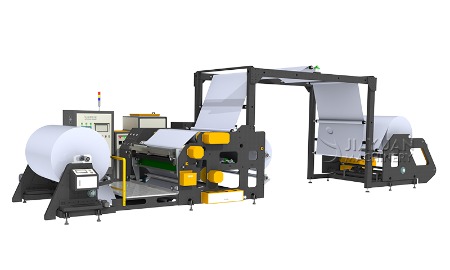
Adhesive coating machine
The selection of a curing system depends on the adhesive chemistry, substrate heat sensitivity, line speed, and desired final properties. Thermal curing ovens are commonly integrated with drying ovens in solvent-based and water-based lines; after the solvent or water is removed, the web enters a higher-temperature curing zone where crosslinking occurs. The oven is divided into multiple zones with independent temperature control to provide a gradual temperature ramp, avoiding thermal shock. For UV curing, the system consists of one or more UV lamps mounted across the web width, with reflectors to focus the radiation. The required dose (mJ/cm²) and irradiance (mW/cm²) depend on the photoinitiator and coating thickness; typical doses range from 200 to 1000 mJ/cm². UV-LED systems are replacing mercury lamps due to longer life, lower heat emission, and instant on/off capability. EB curing uses a high-voltage accelerator (150-300 keV) to generate electrons that penetrate the coating; it is highly efficient but requires shielding and is capital-intensive. Moisture curing involves a humidification chamber where the web is exposed to controlled humidity (e.g., 40-80% RH) and temperature for a period, which may be several minutes to hours, limiting line speed.
Key process parameters for coating curing include temperature (for thermal), dose and irradiance (for UV/EB), humidity (for moisture), and residence time. For thermal curing, the temperature profile must be optimized to achieve the required degree of crosslinking without overheating the substrate. The degree of cure can be monitored by differential scanning calorimetry (DSC) or by measuring the gel content (extractable fraction). For UV curing, the dose is controlled by lamp power and line speed; a radiometer measures the dose at the web surface. The spectral output of the lamp must match the photoinitiator's absorption spectrum. For EB, the accelerating voltage determines the penetration depth, and the current controls the dose. In all cases, the curing process must be validated to ensure consistent crosslinking, as under-cure leads to poor cohesion and over-cure can cause embrittlement. Inline monitoring using NIR or Raman spectroscopy can measure the degree of cure in real-time, allowing feedback control of power or temperature.
Curing defects and troubleshooting are important to understand. Under-cured adhesive may have low shear strength, poor solvent resistance, and excessive tack. Solutions include increasing oven temperature, extending residence time, or increasing UV dose. Over-cured adhesive may become brittle, discolored, or lose adhesion to the substrate; reducing temperature or dose is necessary. Skin formation in thermal curing occurs when the surface cures faster than the bulk, trapping unreacted components; a gradual temperature ramp prevents this. For UV curing, oxygen inhibition at the surface can cause tacky surfaces; using nitrogen inerting or high-irradiance lamps mitigates this. Moisture curing can be sensitive to ambient humidity; too low humidity slows curing, too high may cause foaming. The curing system must be regularly maintained: thermal ovens require burner and fan maintenance, UV lamps need periodic replacement (typically 1000-2000 hours), and EB windows must be kept clean. Proper curing is essential for products such as automotive structural tapes, electronic adhesives, and medical patches that require high reliability under extreme conditions.
The trend in coating curing is toward energy-efficient and environmentally friendly methods. UV and EB curing are increasingly preferred over thermal because they consume less energy, emit no VOCs, and allow higher line speeds. However, they are limited to transparent coatings and require specific chemistries. Dual-cure systems (e.g., thermal + UV) are used for thick or pigmented coatings where one method alone is insufficient. The development of low-temperature thermal curing catalysts allows curing at 80-100°C, enabling use on heat-sensitive substrates. In addition, microwave and induction curing are emerging for specialty applications. In summary, coating curing is a vital step that significantly enhances adhesive performance, and the selection and control of the curing process must be carefully matched to the adhesive formulation, substrate, and production requirements to achieve optimal product quality and manufacturing efficiency.