coating die
A coating die is a precision-engineered tool used in slot die coating to apply a uniform layer of liquid or molten material onto a moving substrate. It is the core component of the coating head, responsible for distributing the coating fluid uniformly across the web width and delivering it through a narrow slot to form a stable coating bead. The design and condition of the coating die directly determine the coat weight uniformity, edge quality, and defect-free performance of the coating line. This article provides a comprehensive technical overview of coating die design, materials, operation, maintenance, and troubleshooting.
The coating die consists of an upper and lower body that, when bolted together, form an internal manifold and a narrow slot. The manifold (typically a coat-hanger or T-shaped design) distributes the fluid from the inlet port uniformly across the width. The fluid then passes through a pre-land section and exits through the slot formed by two precision-ground lips. The lip gap (the distance between the upper and lower lips) is typically set using shims of specified thickness. The die length (coating width) can range from 200 mm to over 2000 mm. The die material is usually tool steel (e.g., AISI 4140, H13) or stainless steel, hardened to 45-60 HRC, and sometimes coated with a wear-resistant layer (e.g., chrome, tungsten carbide) for abrasive adhesives. The die is heated for hot melt applications using cartridge heaters or oil circulation, with temperature zones to ensure uniform thermal expansion. The die is mounted on a positioning mechanism that allows adjustment of the die gap (distance from die lips to substrate) and the die angle relative to the web.
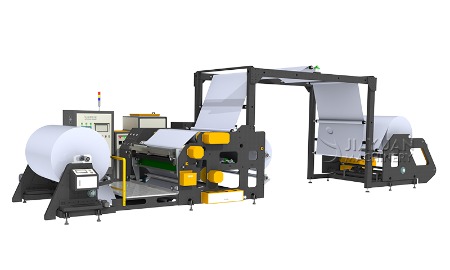
Adhesive coating machine
The design of the coating die is critical for achieving uniform flow. The manifold must be sized so that the pressure drop across the slot is much larger than the pressure drop along the manifold, ensuring equal flow across the width. The coat-hanger manifold has a variable cross-section that decreases from the center to the ends, compensating for the extraction of fluid along the slot. The land length (the distance from the manifold to the lip exit) affects the pressure drop and the shear rate; longer lands create more uniform flow but higher pressure. The lip flatness and surface finish are paramount; the lips are ground to a flatness of 0.2-0.5 μm per 100 mm and a surface roughness of Ra <0.05 μm. The lip edge must be sharp and free of nicks. The die is often supplied with a set of shims of various thicknesses to adjust the lip gap for different coat weights and fluid viscosities. Some advanced dies feature thermal actuators (heated bolts) that allow fine-tuning of the lip gap across the width for real-time profile correction.
Operation of the coating die requires careful setting of the lip gap, die gap (distance from lips to substrate), and die angle. The lip gap is set using a shim of the desired thickness (typically 0.1-1.0 mm). The die gap is set to about 0.2-0.5 mm for low-viscosity fluids and 0.5-1.0 mm for high-viscosity fluids, typically about 1.5 to 2 times the lip gap. The die angle (the angle between the die face and the substrate) is usually set between 0 and 15 degrees to establish a stable coating bead. The fluid flow rate is controlled by the pump, and the die is pre-heated to the application temperature. During startup, the die is brought to temperature, purged to remove air, and the flow is started at low speed. The bead is visually inspected for stability and any edge defects. The die position is adjusted to achieve a uniform bead and coat weight. In closed-loop control, the coat weight gauge provides feedback to adjust the pump flow or die gap.
Maintenance of the coating die is essential for consistent performance. The most frequent task is cleaning the die lips to remove dried or carbonized adhesive that causes streaks. This is done with brass scrapers, wooden sticks, or soft cloths, and sometimes with purging compounds. The die body should be disassembled for a full cleaning periodically (e.g., weekly to monthly), depending on the adhesive. The shim must be replaced if damaged. The lip surfaces must be inspected for scratches or nicks; minor scratches can be polished out, but deeper damage requires professional re-grinding. The die bolts should be torqued to the specified values using a torque wrench to avoid warping. Die temperature sensors should be calibrated. A spare die is often recommended for critical lines to minimize downtime during cleaning. Troubleshooting common die issues includes checking for blocked manifold (causing center-thin or edge-thin), uneven lip gap (causing profile variation), and die swell effects at the edges. In summary, the coating die is a precision tool that demands meticulous care in design, operation, and maintenance. Its quality directly influences the uniformity and defect-free nature of the coated product, making it a focal point for quality assurance in adhesive coating lines.