coating drying process
The coating drying process is the removal of volatile solvents or water from a coated adhesive layer after application, leaving a solid, non-tacky film ready for lamination, rewinding, or further processing. Drying is a critical step in solvent-based and water-based coating lines, affecting product quality, line speed, energy consumption, and environmental emissions. This article provides a comprehensive technical overview of the coating drying process, including the principles of heat and mass transfer, drying curve, oven design, process control, and common drying defects.
The drying process involves two simultaneous steps: heat transfer from the oven to the coating to raise its temperature, and mass transfer of the evaporated solvent or water from the coating surface to the bulk air stream. The rate of drying depends on the solvent volatility, the coating temperature, the air velocity, and the humidity (or solvent concentration) of the drying air. For a given coating, the drying curve typically shows three stages: an initial warm-up period, a constant-rate period where the surface is wet and the evaporation rate is limited by the external mass transfer (air velocity and temperature), and a falling-rate period where the surface is dry and the evaporation rate is limited by internal diffusion of solvent through the coating. Most adhesive coatings dry in the falling-rate period, where the drying rate decreases as the solvent concentration in the coating drops. The goal is to achieve the target residual solvent (or water) content within the available oven length and at the maximum line speed, without degrading the substrate or the adhesive.
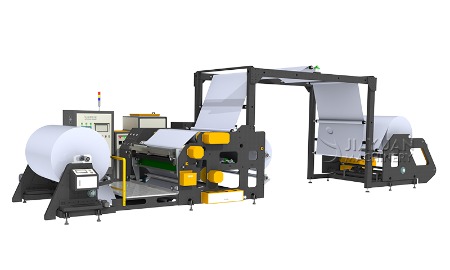
Adhesive coating machine
Oven design for coating drying is tailored to the type of adhesive and substrate. For solvent-based adhesives, the oven is typically a multi-zone convection oven with hot air impingement or floatation. The temperature profile is carefully controlled: the first zone is at a moderate temperature (e.g., 60-80°C) to prevent blistering and skinning; subsequent zones increase to 120-180°C to accelerate evaporation. The oven length for solvent-based lines is typically 30-60 meters, with solvent vapor concentration kept below 25% of the lower explosive limit (LEL) for safety. Solvent recovery or thermal oxidation systems are integrated. For water-based adhesives, the oven is shorter (10-25 m) with higher air velocity and temperatures up to 150°C to overcome the high latent heat of water evaporation. The air must be dried (low humidity) to increase the driving force. For hot melt coatings, no drying is required; cooling via chill rolls solidifies the adhesive. Some lines use infrared (IR) heaters to provide rapid heat input, especially for thick coatings or heat-sensitive substrates, but IR is typically combined with convection for uniform heating. The oven is equipped with exhaust fans, supply fans, and dampers to control airflow and temperature. The web tension in the oven is carefully managed to prevent sagging or flutter.
Process control of the drying oven is critical for product quality and energy efficiency. The primary control parameters are the temperature setpoints for each zone, the supply air velocity, and the exhaust rate. The oven temperature profile is adjusted based on the line speed, the coat weight, and the solvent/water content. For a given adhesive and substrate, the optimal profile is determined experimentally; it must achieve complete drying without causing defects. Inline sensors, such as NIR spectrometers, measure the residual solvent or moisture content in real-time, providing feedback to adjust oven temperature or line speed. Some advanced systems use a "profiling" oven where the temperature and airflow can be varied across the web width to compensate for non-uniform coating or substrate properties. The oven's energy efficiency can be improved by heat recovery systems, where exhaust heat is used to preheat incoming air. The drying process also affects the adhesive's final properties; incomplete drying leaves residual solvent, causing adhesion loss or plasticization, while over-drying can degrade the adhesive (oxidation, crosslinking) or the substrate (embrittlement).
Common drying defects and their remedies include: blistering (bubbles) caused by too rapid heating in the first zone, often resolved by lowering the initial temperature or increasing the airflow to remove surface solvent slowly; skinning (dry skin with trapped solvent underneath) prevented by a more gradual temperature ramp; webbing (uneven drying patterns) due to non-uniform airflow, corrected by adjusting air nozzles or dampers; curling or shrinkage of the substrate due to high temperature or uneven moisture removal, mitigated by using cooler zones or pre-drying conditioning; and solvent retention (off-odor, low adhesion) requiring higher drying temperature or longer residence time. The drying process must also be monitored for solvent concentration in the exhaust to ensure safety and compliance with emission limits. Regular maintenance of the oven includes cleaning burners, checking fan bearings, calibrating thermocouples, and cleaning air filters. In summary, the coating drying process is a complex heat and mass transfer operation that requires careful design, precise control, and diligent monitoring to achieve high-quality, defect-free adhesive products while meeting energy and environmental targets. Optimization of drying parameters is a key area for improving line productivity and reducing costs.