coating equipment
Coating equipment encompasses the full range of machines and systems used to apply a liquid, paste, or molten material onto a continuous web substrate in a roll-to-roll process. This equipment is fundamental to the production of adhesive tapes, labels, packaging films, medical products, and many other coated materials. This comprehensive guide covers the major categories of coating equipment, their working principles, key components, selection criteria, and industry applications, providing a thorough reference for manufacturing professionals and engineers.
Industrial coating equipment can be broadly classified by the coating application method, which determines the precision, speed, and material compatibility of the system. The most common categories include roll coaters (which use rotating cylinders to transfer coating), slot die coaters (which extrude coating through a precision slit), gravure coaters (using engraved cylinders), comma blade coaters (using a rigid blade to meter the coating), and spray coaters (which atomize the coating into droplets). Each method offers distinct advantages: roll coaters are versatile and cost-effective, slot die coaters provide the highest precision, gravure coaters excel in thin, uniform coatings, comma coaters offer excellent control for water-based adhesives, and spray coaters are ideal for delicate or three-dimensional substrates. The selection of coating equipment depends on factors such as adhesive type, required coat weight, line speed, substrate characteristics, and environmental regulations.
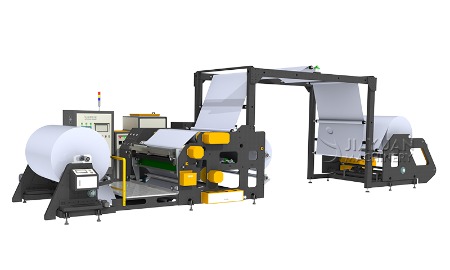
Adhesive coating machine
A typical coating equipment system consists of several integrated modules beyond just the coating head. The unwind station feeds the raw substrate from a roll with controlled tension and splicing capability. Surface treatment stations (such as corona or flame treaters) may be included to enhance substrate wettability and adhesion. The coating head is the core module where the adhesive is applied, with precise metering and distribution systems. Following the coating head, a drying or curing section removes solvents, water, or solidifies hot melt adhesives using ovens, chill rolls, or UV lamps. Additional stations may include laminators for combining layers, slitters for cutting the web, and inspection systems for quality control. Finally, the rewind station winds the finished coated product into rolls, often with turret rewinders for continuous operation. Modern coating equipment incorporates PLC-based control systems, servo drives, and closed-loop feedback for coat weight and tension regulation, enabling high-speed, high-precision production with minimal waste.
Key performance parameters for coating equipment include coat weight accuracy, line speed capability, coating width range, and material efficiency. Coat weight accuracy is typically specified as a percentage variation (e.g., ±1-2%) or absolute tolerance (e.g., ±0.2 gsm), with slot die and reverse roll coaters achieving the best results. Line speeds range from 30 m/min for precision solvent-based coating to over 600 m/min for high-speed hot melt lines. Coating width varies from 300 mm for specialty products to 2,000 mm or more for packaging and label production. Material efficiency measures how much of the coating material ends up on the product versus being wasted; closed systems like slot die achieve >98% efficiency, while open systems like roll coaters may have 80-95% efficiency depending on design. Other critical parameters include viscosity range (typically 50-50,000 cP for most equipment), solvent compatibility, and ease of cleaning and changeover.
The choice of coating equipment is also influenced by environmental and safety considerations. Solvent-based adhesives require explosion-proof equipment, solvent recovery or thermal oxidizer systems, and strict ventilation, significantly increasing capital and operating costs. Water-based systems have lower VOC emissions but require energy-intensive drying ovens. Hot melt systems have zero VOC emissions and low energy consumption but require precise temperature control and heated components. Many jurisdictions are phasing out solvent-based equipment in favor of water-based or hot melt alternatives due to air quality regulations. Additionally, modern coating equipment is designed with quick-change features to reduce downtime between product runs, such as removable coating heads, quick-release doctor blades, and automated roll loading systems. The trend toward Industry 4.0 has introduced predictive maintenance, remote diagnostics, and data analytics into coating equipment, improving overall equipment effectiveness and reducing scrap rates.
Coating equipment finds applications across a vast range of industries. In the adhesive sector, it produces pressure-sensitive tapes, labels, double-sided tapes, and laminating adhesives for flexible packaging. The medical industry uses coating equipment for wound dressings, transdermal patches, surgical tapes, and drug-delivery systems, often requiring cleanroom-compatible designs and ultra-precise coat weight control. The electronics industry relies on coating equipment for optical films, protective coatings, and battery electrode manufacturing, where precise thin-film deposition is critical. Other applications include automotive interior components, construction materials, graphic arts, and specialty papers. The global market for coating equipment is estimated at over $3 billion annually, with strong growth driven by e-commerce packaging, healthcare demand, and sustainable material development. Manufacturers must carefully evaluate their production requirements, adhesive chemistry, and regulatory environment when selecting coating equipment, often working with equipment suppliers to conduct feasibility trials and optimize process parameters before full-scale investment.