coating filter
A coating filter is a device used in the adhesive supply system to remove contaminants, gels, and undissolved particles from the coating fluid before it reaches the coating head. Filtration is essential for preventing coating defects such as streaks, pinholes, and die lines, and for protecting the coating equipment from damage. This article provides a comprehensive technical overview of coating filters, including filter types, selection criteria, installation, maintenance, and best practices for achieving high-quality adhesive coatings.
Contaminants in adhesives can originate from raw materials (fillers, pigments, polymer particles), the manufacturing process (crosslinked gels, carbonized material), or the environment (dust, fibers). Even particles as small as 20-50 microns can cause defects in a thin coating layer. Gels (partially crosslinked polymer agglomerates) are particularly troublesome because they deform and stretch, creating long streaks. Filtration is the primary method to remove these particles. The filter is typically placed after the pump and before the coating head, at the point of highest pressure. In some systems, a pre-filter is used at the melt tank or supply tank to remove larger particles before the pump. The filter element can be a screen (mesh), a depth filter, a candle filter, or a magnetic filter (for metallic particles). The choice depends on the adhesive chemistry, viscosity, solids content, and the required filtration micron rating.
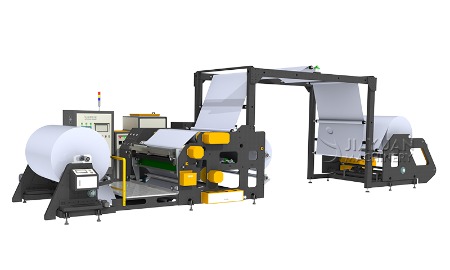
Adhesive coating machine
Mesh filters (screens) are the most common in hot melt coating. They consist of a woven wire cloth (stainless steel or nickel alloy) with a specified mesh opening size, typically ranging from 50 to 200 mesh (approximately 300 to 74 microns). The mesh is held in a housing that can be quickly opened for cleaning or replacing the screen. For finer filtration, multiple screens can be used in sequence (e.g., 100 mesh followed by 200 mesh). Depth filters use a porous medium (e.g., sintered metal, ceramic, or fiber) that traps particles throughout the thickness, offering higher dirt-holding capacity. Candle filters are cylindrical elements with a pleated structure for high flow rates and fine filtration (down to 5 microns). For water-based adhesives, cartridge filters with cellulose, polypropylene, or nylon media are common. The filtration micron rating must balance particle removal with pressure drop; finer filtration increases pressure drop and may reduce flow rate. The filter housing must be designed for the operating pressure and temperature, with proper seals and gaskets. Some filters have a bypass valve to prevent excessive pressure drop that would starve the coating head.
Installation and operation of the coating filter are straightforward but require careful monitoring. The filter should be installed as close as practical to the coating head to minimize the chance of re-contamination. A pressure gauge before and after the filter is essential to monitor the differential pressure (delta P), which increases as the filter traps particles. When the delta P reaches a predetermined limit (e.g., 10-15 bar), the filter must be cleaned or replaced. For hot melt systems, the filter housing is heated to maintain adhesive temperature; the pressure drop measurement must account for viscosity changes with temperature. The filter should be purged of air before use to avoid air bubbles entering the die. Regular inspection of the filter element for damage (tears, corrosion) is required. Many lines use a duplex filter arrangement, with two filters in parallel, allowing one to be changed while the other remains in service, ensuring continuous operation.
Maintenance and changeover of coating filters are critical to avoid process interruptions. The frequency of filter change depends on the adhesive cleanliness and production time; it can range from daily to weekly. For high-volume lines, automatic back-flushing or self-cleaning filters are available, which clean the element by reversing flow, reducing manual intervention. The used filter element must be disposed of properly, especially if it contains hazardous materials. When changing the filter, the operator must follow lockout/tagout procedures to prevent accidental activation of the pump. After replacement, the system must be purged to remove air and any contamination introduced during the change. The filter change is often combined with a die cleaning to ensure no debris has passed through. Proper documentation of filter changes, including delta P readings and date, helps track adhesive quality and predict filter life. In summary, the coating filter is a simple but indispensable component that significantly improves coating quality and protects equipment. Selecting the right filter type and micron rating, monitoring pressure drop, and implementing a robust change schedule are essential practices for any adhesive coating operation.