coating head
The coating head is the central module of any coating machine, responsible for applying the coating material onto the substrate with the required thickness, uniformity, and pattern. It comprises the applicator mechanism (e.g., die, blade, roll, or spray nozzle) along with all supporting components such as mounts, adjustment actuators, fluid supply manifolds, and temperature control systems. This article provides an in-depth technical examination of coating head design, types, operational principles, and key considerations for selection and maintenance in industrial adhesive coating applications.
Coating heads are classified according to their application method, with each type offering a unique combination of precision, speed, viscosity range, and cost. The primary categories include slot die heads (precision extrusion through a slotted die), comma blade heads (rigid blade metering), gravure heads (engraved cylinder with doctor blade), roll coating heads (sets of rotating rolls with metering nips), and spray heads (atomizing nozzles). The slot die head is the most advanced, featuring an internal manifold (typically coat-hanger or T-shaped) that distributes fluid uniformly across the width, followed by a slot formed by two precision-ground lips. Comma blade heads consist of a profiled blade mounted on a pivotable holder, with micrometer screws for gap adjustment. Gravure heads include an engraved chrome-plated cylinder, a pan for fluid pickup, and a doctor blade assembly. Roll coating heads range from simple two-roll arrangements to complex four-roll systems with separate drive motors for each roll. Spray heads include airless, air-assisted, and rotary atomizers with dedicated fluid and air supply controls.
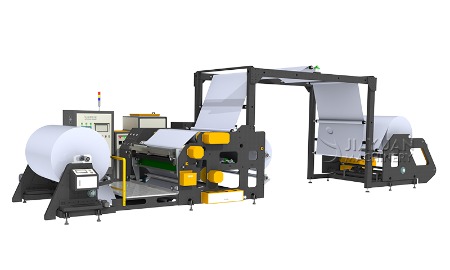
Adhesive coating machine
The design of a coating head directly influences coating quality, and several critical parameters must be optimized. The internal geometry of a slot die, for example, must ensure that the pressure and flow distribution across the width are uniform to avoid edge bead or center-thick defects. The manifold cross-sectional area typically decreases exponentially from the inlet to the ends to compensate for fluid extraction along the slot. The slot length (the distance from the manifold to the lip exit) affects pressure drop and residence time, typically ranging from 10 to 50 mm. The lip flatness and straightness are ground to within 0.2-0.5 μm per 100 mm to achieve coat weight uniformity within ±1%. For comma blades, the blade angle (20-45 degrees) and the radius of the curved tip are critical; a smaller radius reduces streak formation but increases wear. The hardness and surface finish of the backup roll (for blade and roll heads) must be precisely controlled, with chrome-plated rolls having a surface roughness of Ra 0.1-0.2 μm and hardness of 60-65 HRC. Temperature control is integrated into most coating heads, with heated dies for hot melts (using cartridge heaters or oil circulation) and cooled heads for temperature-sensitive adhesives.
Process control features are essential in modern coating heads. Automated gap adjustment systems use stepper motors or piezoelectric actuators to adjust the die lip gap or blade position based on feedback from coat weight gauges, enabling real-time profile control. Closed-loop temperature control maintains setpoint within ±0.5°C using thermocouples and PID controllers. Many slot die heads incorporate thermal expansion actuators (e.g., heated bolts) that locally adjust the lip gap by controlled thermal expansion, correcting cross-web coat weight variations without stopping production. Quick-change mechanisms allow the coating head to be removed and replaced within minutes for cleaning or product changeovers, significantly reducing downtime. Some advanced heads also include purge systems to remove air bubbles, vacuum boxes to eliminate air entrainment, and edge bead reduction systems (air knives or edge guides) to minimize thick adhesive deposits at the web edges. The control system also monitors fluid pressure at the die inlet, flow rate through the gear pump, and any leaks or blockages, providing alarms and corrective actions.
Maintenance of coating heads is crucial for consistent performance. Slot die lips must be regularly cleaned with appropriate solvents and soft tools to prevent dried adhesive buildup, which causes streaks or die lines. The lip land (the flat area at the exit) is susceptible to damage from handling or debris; any nicks or scratches require re-lapping or regrinding. Comma blades wear over time, especially when coating abrasive adhesives, and the blade tip radius increases, causing coat weight drift; they must be replaced or reground periodically. Gravure cylinders require cleaning to prevent cell clogging, and the doctor blade must be replaced at regular intervals to maintain wiping efficiency. Roll coating heads require roll surface inspection and periodic regrinding to maintain surface finish and roundness; worn rolls cause coating unevenness and require replacement or resurfacing. All coating heads need regular calibration of gap sensors, temperature probes, and pressure transducers. Proper maintenance schedules, detailed in equipment manuals, are essential to minimize unplanned downtime and maintain coating quality.
Coating heads are used across virtually all adhesive coating applications, but specific designs are optimized for particular adhesives and substrates. For pressure-sensitive adhesives (PSAs), slot die heads are the standard for high-speed, high-precision hot melt coating, while comma blade heads are common for water-based PSAs. For silicone release coatings, gravure heads are preferred due to their ability to apply ultra-thin, uniform layers. For construction adhesives and heavy coatings, roll coating heads with larger gaps and higher nip pressures are used. Medical adhesive applications often use slot die or comma heads with cleanroom-compatible materials and sterile designs. The ongoing trend toward sustainable packaging and bio-based adhesives is driving innovations in coating head materials (corrosion-resistant alloys for aggressive water-based formulations) and designs that minimize waste and energy consumption. Additionally, the integration of sensors and machine learning algorithms is enabling predictive maintenance and autonomous adjustment of coating heads, further improving quality and productivity in modern coating operations.