coating line
A coating line is a complete, integrated industrial system that combines multiple processing stations to apply a coating onto a substrate in a continuous, roll-to-roll process. It encompasses all essential equipment from unwinding the raw substrate to rewinding the finished coated product, including coating application, drying or curing, lamination, surface treatment, and inspection stations. Coating lines are the backbone of adhesive tape, label, and flexible packaging production, and their design and performance directly impact product quality, production efficiency, and manufacturing costs. This article provides a comprehensive overview of coating line architecture, major components, process integration, and key design considerations.
A typical adhesive coating line consists of several interconnected modules, each performing a specific function in the production process. The line begins with an unwind station, which holds the raw substrate roll and feeds it into the line with controlled tension. Next is a surface treatment station, such as a corona treater or flame treater, to increase surface energy and improve adhesion. The core of the line is the coating station, where the adhesive is applied using any of the technologies discussed previously (slot die, roll, gravure, comma, etc.). Following the coating station is the drying or cooling section, which removes solvents (for solvent-based systems) or water (for water-based systems), or solidifies the adhesive (for hot melt systems). Additional stations may include laminating, slitting, and inspection systems, culminating in a rewind station that winds the finished coated roll.
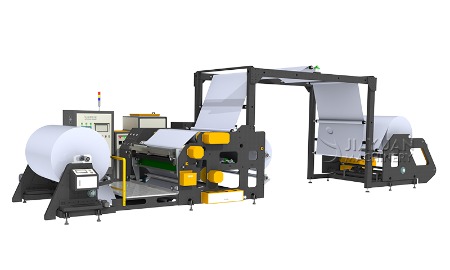
Adhesive coating machine
The design of a coating line is highly application-specific, with the configuration determined by the adhesive type, substrate material, required coat weight, production speed, and quality requirements. For hot melt adhesive lines, the drying section is replaced by a cooling drum and chill rolls, and the line is significantly shorter because no drying oven is required. Solvent-based lines require long drying ovens (30-60 m) with multiple temperature zones, solvent recovery systems, and explosion-proof components, making them the most complex and expensive. Water-based lines have shorter ovens (10-30 m) and lower explosion risk, but still require significant energy for water evaporation. The line speed can range from 30 m/min for high-precision solvent-based coatings to 600 m/min for hot melt PSA lines. The web width typically ranges from 300 mm to 2,000 mm, with wider lines offering higher productivity but requiring more precise mechanical design.
Integration of control systems is critical in a modern coating line. A central PLC (programmable logic controller) coordinates all machine sections, synchronizing speeds, tensions, and temperatures. The coating station's gear pump or metering system is slaved to the line speed to maintain constant coat weight. Tension control is maintained through load cells and dancer rolls across the entire line, with individual zone tension setpoints. The drying oven's temperature and airflow are controlled based on the solvent load and line speed. Modern lines also incorporate web inspection systems (such as cameras or laser scanners) for real-time defect detection, enabling immediate corrective action and quality documentation. Industry 4.0 features such as remote monitoring, predictive maintenance, and data analytics are increasingly integrated, allowing manufacturers to optimize uptime and reduce waste.
Key design considerations for a coating line include line speed capability, drying capacity, coating precision, and ease of maintenance. The line must be designed to minimize web breaks and defects, with smooth web paths and proper roller alignment. The coating station must provide precise and reproducible coat weight, with quick-change features for product changeovers. The drying section must be capable of removing the carrier solvent or water at the maximum line speed without causing substrate damage or coating defects. Environmental and safety considerations are paramount: solvent-based lines require solvent recovery or thermal oxidation systems to meet VOC emission regulations, and all lines must have proper ventilation and fire suppression systems. The floor space and energy consumption are major cost factors, with solvent-based lines consuming 5-10 times more energy than hot melt lines of similar width and speed.
Coating lines are deployed across numerous industries for adhesive products. In the tape industry, lines produce packaging tapes, masking tapes, double-sided tapes, and specialty tapes. In the label industry, lines produce self-adhesive label stock, with coating stations and laminating sections integrated. The medical sector uses coating lines for wound dressings, surgical tapes, and transdermal patches, often requiring cleanroom environments and precise coat weight control. The packaging industry uses coating lines for flexible packaging laminates, heat-seal coatings, and cold-seal adhesives. Other applications include protective films, graphic arts materials, and industrial laminates. The selection and configuration of a coating line are major capital decisions, requiring careful analysis of production requirements, adhesive chemistry, substrate properties, and regulatory constraints. Advances in coating technology, control systems, and sustainable energy solutions continue to drive the evolution of coating lines toward higher efficiency, lower environmental impact, and greater product versatility.