coating machine for adhesive
Coating machines for adhesive are sophisticated industrial systems that apply adhesive layers onto substrates in a controlled, continuous manner. These machines are critical for manufacturing a vast array of products including tapes, labels, packaging films, medical dressings, and industrial laminates. This guide provides a comprehensive overview of adhesive coating technologies, machine configurations, application considerations, and selection criteria for production professionals.
Coating machines for adhesive encompass a diverse range of equipment designs, each suited for specific adhesive types, substrate materials, and production requirements. The most common coating methods include roll coating (where adhesive is transferred between rotating rolls), gravure coating (using an engraved cylinder), slot die coating (employing a precision die with a narrow slot), comma blade coating (using a blade to meter adhesive onto a substrate), and spray coating. Each method offers distinct advantages in terms of coat weight range, precision, speed capability, and adhesive viscosity compatibility. Laboratory-scale coaters are also available for research and development, quality control, and small-batch production, allowing manufacturers to test new adhesive formulations and coating parameters before committing to full-scale production.
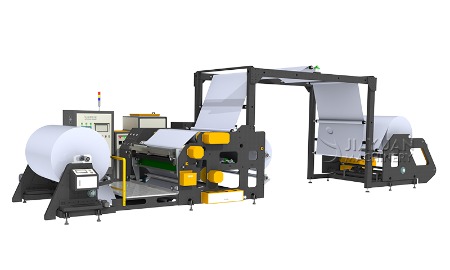
Adhesive coating machine
Hot melt adhesive coating machines are among the most widely used types, processing 100% solid adhesives that are melted and applied without solvents. These machines offer high production speeds (300-600 m/min), compact footprints (no drying ovens required), and low VOC emissions. They are ideal for pressure-sensitive adhesive tapes, labels, packaging, and nonwoven hygiene products. Solvent-based adhesive coating machines use organic solvents as carriers, enabling the application of adhesives that cannot be melted or dispersed in water. These systems require extensive drying and solvent recovery equipment, making them more capital-intensive and energy-consuming, but they excel in producing ultra-thin coatings and handling heat-sensitive substrates. Water-based adhesive coating machines use water as the carrier, offering a balance between performance and environmental compliance. They are commonly used for paper, film, and nonwoven applications where low VOC emissions are required.
The selection of a coating machine for adhesive depends on several critical factors. The adhesive chemistry dictates the machine type: hot melt requires heating systems and melt tanks; solvent-based requires explosion-proof components and solvent recovery; water-based requires drying ovens and corrosion-resistant materials. The substrate material affects the coating method choice, as some methods are better suited for thin films, while others work well with paper or fabric. Production speed requirements influence the machine's mechanical design, with high-speed lines requiring robust unwind/rewind systems, tension control, and precision coating heads. Coat weight and uniformity specifications determine the required precision of the coating head and control systems, with slot die coating offering the highest precision (±1-2% variation). Environmental regulations increasingly favor hot melt and water-based systems over solvent-based alternatives due to VOC emission restrictions.
Modern coating machines for adhesive incorporate advanced automation and control technologies to ensure consistent quality and maximize productivity. Closed-loop coat weight control systems use beta or X-ray gauges to measure the coated web and adjust adhesive flow in real-time. Servo-driven tension control systems maintain consistent web tension throughout the machine, preventing stretching, wrinkling, or breakage. Programmable logic controllers (PLC) manage all machine functions, providing operators with intuitive interfaces for monitoring and adjusting process parameters. Some machines also feature automatic die lip adjustment for profile control, corona treatment stations for substrate surface activation, and chill roll lamination for hot melt coatings. The integration of Industry 4.0 technologies, including remote monitoring, predictive maintenance, and data analytics, is becoming increasingly common in advanced adhesive coating lines.