coating machine installation
Coating machine installation is the process of physically placing, assembling, and connecting all components of a coating line at the buyer's facility, followed by testing and commissioning to ensure the equipment operates according to specifications. Proper installation is critical for achieving optimal performance, preventing premature failures, and ensuring the safety of operators and maintenance personnel. This article provides a comprehensive technical overview of coating machine installation, including pre-installation planning, site preparation, mechanical assembly, utility connections, control system integration, commissioning, and acceptance testing.
The installation process begins long before the equipment arrives at the facility, with thorough pre-installation planning. The buyer and the equipment supplier must coordinate on the site layout, ensuring adequate floor space for the entire line, including clearance for operator access, maintenance, and material handling. Key considerations include the dimensions of the coating line (length, width, height), the location of control panels, and the routing of utility lines (electrical, compressed air, cooling water, exhaust ducts). The floor must be level and capable of supporting the weight of the equipment, with reinforced foundations for heavy modules such as drying ovens or chill roll stands. Environmental conditions, including temperature, humidity, and dust levels, should be controlled to suit the adhesive type and substrate. The buyer must also prepare for the delivery of heavy equipment, arranging for truck access, crane or forklift availability, and temporary storage for crates. A detailed installation schedule, including milestones and responsibilities, should be agreed upon with the supplier to minimize production downtime and avoid conflicts with other facility activities.
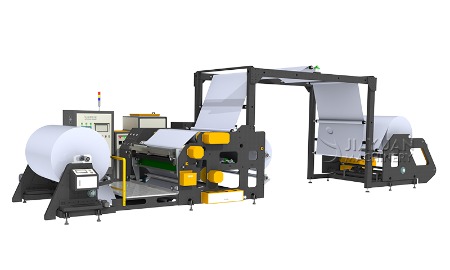
Adhesive coating machine
Mechanical assembly is the core of the installation process. The coating line is typically delivered in modular sections: unwind stand, coating head, drying oven or chill roll section, laminating station, and rewind stand. Each module must be carefully lifted and positioned using appropriate rigging equipment, following the supplier's lifting instructions to avoid damage. The modules are then bolted together on a common base frame or floor-mounted, with precise alignment to ensure that the web path is straight and rolls are parallel. Roll alignment is critical for proper web tracking and tension control; laser alignment tools are often used to achieve tolerances within ±0.1 mm. The coating head (e.g., slot die, comma blade, gravure) must be mounted with high precision relative to the backup roll, with the die lip gap set according to the supplier's specifications. All mechanical connections, such as drive shafts, belts, and chains, are installed and tensioned. The assembly is checked for squareness, parallelism, and proper bolt torque. After mechanical assembly, the machine is manually rotated (if possible) to check for any binding or interference, and all safety guards and interlocks are installed.
Utility connections are the next critical step. The electrical system must be connected to the facility's power supply, with proper voltage, phase, and frequency matching the machine's requirements. Circuit breakers, transformers, and emergency stop circuits are installed according to local codes and the supplier's schematics. The control system (PLC, HMI, drives) is wired and connected to all sensors, actuators, and motors. Compressed air lines are connected to pneumatic components such as brakes, cylinders, and air knives, with appropriate filtration and pressure regulation. Cooling water supply and return lines are connected for chill rolls and any heat exchangers. For solvent-based lines, exhaust ducting is connected to the drying oven and solvent recovery system, ensuring proper airflow and negative pressure. For hot melt lines, the melt tank and heated hoses are connected to the coating die, and any required venting or gas lines are installed. All utilities are checked for correct pressure, flow, and temperature, and any leaks are rectified. The control system is then powered up, and basic I/O checks are performed to verify that all sensors and actuators respond correctly.
Commissioning follows the mechanical and utility installation. This phase involves starting the machine in stages, first with no substrate and then with a dummy web, to check all functions: web tension control, edge guiding, drive synchronization, coating head positioning, and drying or cooling system operation. The control system software is loaded with the initial parameters, and the operator interface is configured. Calibration of all sensors (load cells, thermocouples, pressure transducers, coat weight gauges) is performed using certified reference standards. The line is then run with the actual substrate and adhesive at low speed, gradually increasing to the nominal speed while monitoring performance. Critical parameters such as coat weight uniformity, web temperature, and adhesive solidification are measured and compared with specifications. Any deviations are corrected by adjusting control loops, gaps, or temperatures. The supplier's engineers work alongside the buyer's operators to fine-tune the process. After successful operation at rated speed for a defined period (e.g., 4 hours), site acceptance testing (SAT) is conducted, where the line must produce product meeting all quality criteria. Upon successful SAT, the line is formally handed over to the buyer, and the supplier provides training to operators and maintenance staff. Proper documentation, including as-built drawings, maintenance manuals, and spare parts lists, is delivered. Post-installation, the supplier typically offers a warranty period during which any defects are rectified. A well-executed installation ensures that the coating machine achieves its design performance, minimizes teething problems, and provides a solid foundation for reliable, long-term production.