coating pump system
A coating pump system is a critical component of any adhesive coating line, responsible for accurately and consistently delivering the coating material from the supply tank to the coating head. The pump must provide a stable, pulsation-free flow at a precisely controlled rate, as any variation in flow directly translates to variation in coat weight. This article provides a comprehensive technical overview of coating pump systems, including pump types, selection criteria, control strategies, and maintenance practices.
The most common pump used in adhesive coating, especially for hot melt and solventless systems, is the external gear pump. Gear pumps are positive displacement pumps that use two meshing gears (one driven by a motor, the other idler) to trap fluid in the spaces between the gear teeth and the pump casing, and then transport it from the inlet to the outlet. The flow rate is proportional to the rotational speed of the gears, making them ideal for precise metering. They can handle viscosities from 1 to over 100,000 cP, and operating pressures up to 200 bar or more. For hot melt adhesives, the pump is heated to the application temperature and is often made from hardened tool steel or corrosion-resistant alloys to withstand wear. For water-based and solvent-based adhesives, seal-less gear pumps with magnetic coupling are used to avoid leaks. Other pump types include piston pumps (for very high pressures or low flow rates), peristaltic pumps (for laboratory or small-scale applications), and progressive cavity pumps (for highly viscous or shear-sensitive fluids). The selection of the pump type depends on the fluid viscosity, required flow rate, pressure, temperature, and the need for precise metering and pulsation-free flow.
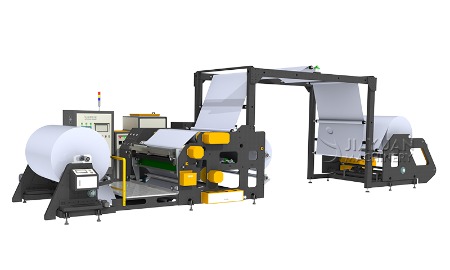
Adhesive coating machine
Key specifications for a coating pump system include flow rate range (e.g., 0.5 to 500 liters per hour), maximum operating pressure, temperature capability, pump speed range (RPM), and motor power. The pump must be sized to deliver the required flow at the maximum line speed and coating weight. For example, a slot die coating line with 1600 mm width, 25 gsm coat weight, and 300 m/min line speed consumes about 720 liters per hour of adhesive (at density 1.0 g/cm³). The pump is typically driven by a servo motor with a gearbox to provide precise speed control, often with an encoder feedback for closed-loop speed regulation. The pump outlet is connected to the coating head via heated hoses (for hot melt) or standard pipes. An important feature is the inclusion of a pressure relief valve or bypass loop to protect the pump and the die from overpressure. The pump is integrated into the line's PLC control system, with the pump speed slaved to the line speed to maintain constant coat weight. In closed-loop control, the coat weight gauge provides feedback to adjust the pump speed dynamically.
Control and accuracy of the coating pump system are paramount. The pump flow rate must be calibrated using a known fluid and measured with a flow meter. The relationship between pump RPM and flow rate (mL/rev) is known from the pump's specifications, but viscosity and slip can affect accuracy; positive displacement pumps minimize slip. The pump speed controller must have a resolution of at least 0.1 RPM to achieve fine control. For high-precision applications, a gear pump with a built-in temperature sensor and a thermocouple in the pump body helps compensate for thermal expansion. The pump's inlet pressure should be maintained positive (e.g., by a gear pump feed system or by gravity) to prevent cavitation, which causes flow pulsation and air entrainment. Some systems use a variable frequency drive (VFD) instead of a servo motor, but servo is preferred for better dynamic response. The pump control algorithm should include a ramping function for smooth acceleration and deceleration, preventing pressure spikes that could damage the die.
Maintenance of the coating pump system is essential for long-term reliability. Gear pumps are subject to wear from abrasive fillers in the adhesive; the gear teeth and the pump housing can erode, increasing slip and reducing accuracy. Regular inspection of the pump's internal clearance is necessary; typical wear limits are an increase of 0.01 mm in clearance. The pump should be purged with a cleaning compound or compatible solvent after each production run to prevent adhesive solidification. For hot melt pumps, they must be kept hot during shutdown to avoid freezing and damage. The pump's seals (mechanical or packing) should be checked for leaks and replaced periodically. The motor and gearbox should be lubricated according to the manufacturer's schedule. Many modern pumps incorporate condition monitoring sensors (vibration, temperature, current draw) to predict failures. Spare pumps or a complete pump cartridge are recommended for critical lines to enable quick changeover in case of failure. Proper pump maintenance ensures consistent flow, accurate coat weight, and long service life. In summary, the coating pump system is the heart of the adhesive delivery system, and its selection, control, and maintenance are vital for achieving the precision and reliability required in modern adhesive coating production.