coating roll
Coating rolls are cylindrical components used in roll coating machines to transfer, meter, or support the coating material and substrate. They are the essential elements in roll coaters, reverse roll coaters, gravure coaters, and kiss coaters, determining coating thickness, uniformity, and surface quality through their geometry, surface finish, and relative motion. This article provides a comprehensive technical overview of coating roll types, materials, manufacturing tolerances, surface treatments, and their critical role in adhesive coating processes.
Coating rolls can be classified by their function within the coating station. The applicator roll is the roll that picks up the coating from a pan or metering system and applies it to the substrate. The metering roll (or doctor roll) controls the amount of coating on the applicator roll by creating a precise nip gap. The backup roll provides a supporting surface behind the substrate, pressing it against the applicator or metering roll. In some configurations, transfer rolls are used to transport the coating between rolls. Each roll type has specific surface finish and hardness requirements: applicator rolls often have a chrome-plated, smooth surface (Ra 0.1-0.4 μm) for consistent film splitting; metering rolls may have similar finish or a textured surface for specific coating characteristics; backup rolls are typically rubber-covered (50-90 Shore A) to provide conformable nip pressure without damaging the substrate. The roll diameter ranges from 100 mm to 600 mm, with larger diameters providing better heat transfer and rigidity.
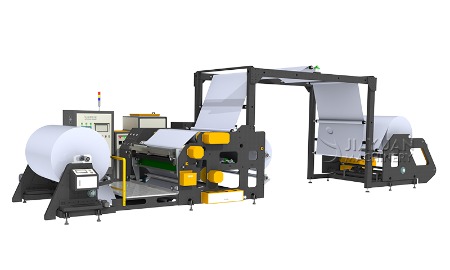
Adhesive coating machine
The performance of coating rolls depends critically on their manufacturing precision and surface condition. Roll runout (eccentricity) must be kept below 5 μm for high-precision coating, as any runout causes cyclic variation in the coating gap, resulting in a periodic thickness variation (barring effect). The roll surface must be perfectly cylindrical with a taper of less than 5 μm per meter, and the surface finish must be uniform across the width to avoid streaks or uneven coating. For chrome-plated steel rolls, the plating thickness is typically 25-50 μm, with hardness of 60-70 HRC. The surface is usually polished to a mirror finish (Ra 0.1-0.2 μm) for solvent-based adhesives, but a slightly rougher finish (Ra 0.4-0.8 μm) may be used for water-based adhesives to improve release properties. Rubber-covered rolls are cast with specific durometers and surface patterns; the rubber thickness is typically 10-25 mm, and the surface is ground to precise tolerances. The hardness of the backup roll affects nip width and pressure distribution; softer rolls provide a wider nip, which is beneficial for porous substrates.
Coating rolls also incorporate internal temperature control systems to maintain consistent coating fluid viscosity and prevent drying or solidification. For hot melt adhesives, the applicator roll is heated (typically 100-200°C) using internal oil circulation or electric cartridge heaters, with temperature uniformity across the roll within ±1°C. For water-based adhesives, the roll may be cooled to prevent premature drying and skinning. Temperature control is achieved through a rotary union that supplies hot or cold fluid to the roll core, with the fluid circulated through spiral or axial channels. The roll surface temperature must be carefully monitored and controlled, as even small temperature variations affect the viscosity and transfer properties of the adhesive. In some designs, the backup roll is also heated or cooled to control substrate temperature and drying behavior.
Wear and maintenance of coating rolls are significant operational concerns. Applicator and metering rolls are subject to abrasion from adhesive fillers, doctor blades, and substrate edges, leading to surface degradation that causes coating defects. Chrome-plated rolls typically have a service life of 1-3 years depending on usage and adhesive type, after which they must be stripped and replated or reground. Rubber-covered rolls suffer from compression set, surface cracking, and chemical degradation from solvents, requiring periodic regrinding (every 6-12 months) or replacement. Regular cleaning is essential to remove dried adhesive buildup; aggressive solvents or mechanical scraping can damage the roll surface, so appropriate cleaning procedures must be followed. Roll bearings and seals must be regularly lubricated and inspected to prevent runout due to bearing wear. Many modern coating lines include roll condition monitoring systems that measure vibration, temperature, and runout, enabling predictive maintenance and minimizing unplanned downtime.
The selection and specification of coating rolls are based on the coating method, adhesive type, substrate, and required precision. For slot die coating, the backup roll must have a highly precise cylindrical surface and minimal runout, as the die gap is set relative to this roll. For reverse roll coating, the speed ratio between the applicator and metering rolls is critical, and their surface finish must be compatible with the desired shear rate. For gravure coating, the engraved cylinder is a specialized coating roll with cellular patterns of specific geometry (typically 50-200 lines per inch, cell depths of 20-100 μm). The choice of roll material (steel, stainless steel, or ceramic-coated) depends on the adhesive's corrosiveness and temperature requirements. Coating rolls are often custom-engineered for each machine and application, with manufacturers providing detailed specifications for diameter, face length, surface finish, hardness, concentricity, and temperature control capabilities. Advances in roll technology include ceramic coatings for extended wear life, dynamic balancing for high-speed operation, and advanced rubber compounds for improved chemical resistance and heat dissipation.