coating sample
A coating sample is a representative specimen of a coated substrate, produced under controlled conditions to evaluate the quality, performance, and uniformity of the adhesive coating. Samples are used for both in-process quality control and final product testing, as well as for customer approval and regulatory compliance. They provide the primary basis for determining whether the coated product meets the required specifications for coat weight, adhesion, appearance, and other functional properties. This article provides a comprehensive technical overview of coating sample preparation, sampling methods, testing protocols, and interpretation of results in the adhesive coating industry.
Coating samples must be representative of the production run. Sampling is typically performed at regular intervals (e.g., every roll, every shift, or per batch) and at specific locations across the web width (left, center, right) to capture any cross-web variations. The sample size and frequency depend on the product's quality requirements and the stability of the process. For high-precision products, sampling may be continuous (online gauges) with periodic offline verification. For standard products, samples may be taken at the start, middle, and end of each roll. The samples must be handled carefully to avoid contamination, folding, or stretching. They are typically cut using a sharp knife or a die cutter to a specified area (e.g., 100 cm²) for gravimetric coat weight measurement. For optical or microscopic analysis, smaller samples are mounted on slides or stubs. The sampling procedure must be documented, including the roll number, sample location, date, and time, to enable traceability.
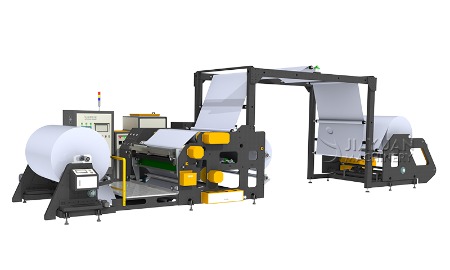
Adhesive coating machine
The primary tests performed on coating samples depend on the adhesive type and the final product application. Coat weight (GSM) is the most fundamental test, measured by gravimetric analysis: weighing the sample, stripping the adhesive with a suitable solvent (or by peeling), and reweighing the substrate. The difference divided by the area gives the dry coat weight. For hot melt adhesives (100% solids), the weight difference is the coat weight directly. For solvent-based and water-based adhesives, the sample must be fully dried before the first weighing. Coat weight can also be measured non-destructively using beta or X-ray gauges, but offline gravimetric is the reference method. Adhesion performance is tested by peel adhesion (180° or 90° peel from stainless steel or other specified substrates), tack (loop tack or probe tack), and shear holding power (static shear). These tests follow standard methods such as PSTC (Pressure Sensitive Tape Council) or FINAT (European label association). For laminates, delamination strength is measured. For release liners, release force is tested. Additionally, optical properties (gloss, haze, clarity, color) are measured for clear films; and dimensional stability, shrinkage, and curl are assessed for various substrates.
Preparation of coating samples for testing requires careful attention to avoid artifacts. For peel adhesion, the sample is conditioned at standard temperature and humidity (typically 23°C, 50% RH) for at least 24 hours before testing. The adhesive is applied to a clean test panel using a standard roller (e.g., a 2 kg rubber roller) with specified speed and number of passes. For shear testing, a specific overlap area and load are applied. For coat weight, the sample area must be precisely cut, and the stripping method must be validated to ensure complete removal of the adhesive without damaging the substrate. For optical measurements, the sample must be free of dust and scratches. All testing equipment must be calibrated and operated according to the relevant standard. The results are recorded and compared with the product specification. Any deviation outside the tolerance triggers a non-conformance report and corrective action.
Interpretation of coating sample results must consider both the measured values and the variability. A single sample may not represent the entire roll; therefore, multiple samples across the width and length are often tested. Statistical analysis, including mean, standard deviation, and range, quantifies the process capability. For example, a coat weight profile across the web with a standard deviation of 0.5 gsm at a target of 25 gsm indicates excellent uniformity (2% variation). If the profile shows a consistent high or low edge, it suggests a die gap or alignment issue. If the peel adhesion is below specification, it may be due to under-curing, too low coat weight, or substrate contamination. If release force is too high, the silicone coating may be under-cured or too thick. The results are used to adjust the coating process parameters, such as temperature, gap, or pump speed, to bring the product back into spec. In addition, samples may be sent to customers for approval or to external laboratories for independent verification, especially for medical or automotive applications where stringent quality standards apply.
The trend in coating sampling and testing is toward more automated and in-line methods to reduce the need for offline testing and speed up quality decisions. However, offline sampling remains essential for validation and for tests that cannot be performed online (e.g., peel, shear). The use of digital imaging and machine learning to analyze coating defects is increasing. Also, the development of portable, non-destructive analyzers (e.g., handheld NIR) allows quick confirmation of coat weight and composition. In summary, coating samples are the primary tool for quality assurance in adhesive coating. They provide the evidence that the product meets specifications and offer insights for process optimization. A systematic approach to sampling, testing, and data analysis is essential for maintaining product consistency and customer satisfaction.