coating temperature
Coating temperature refers to the temperature at which the adhesive is maintained during the application process, from the supply system through the coating head to the moment it contacts the substrate. It is a critical parameter that directly influences adhesive viscosity, wetting behavior, coating uniformity, and final product properties. This article provides a comprehensive technical overview of coating temperature, including its importance for different adhesive types, control methods, effects on coating quality, and best practices for thermal management in adhesive coating lines.
Coating temperature is particularly critical for hot melt adhesives, which are applied as 100% solids in a molten state. Typical hot melt application temperatures range from 120°C to 200°C, depending on the polymer type (e.g., EVA, SBC, polyolefin) and the required viscosity. The temperature must be high enough to reduce the viscosity to a coatable range (typically 500-5,000 cP) but not so high as to cause thermal degradation, oxidation, or charring. For solvent-based and water-based adhesives, coating temperature is usually ambient to moderately elevated (20-60°C) to control viscosity and evaporation rate. In all cases, precise temperature control is essential because viscosity changes of 2-5% per 1°C are common, directly affecting coat weight and uniformity. Therefore, coating temperature is not just a process parameter but a primary determinant of coating quality and reproducibility.
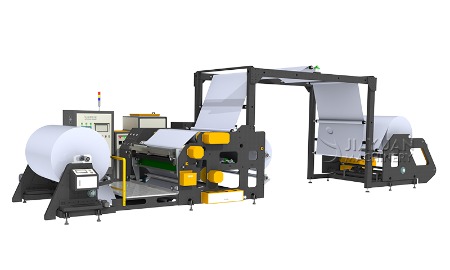
Adhesive coating machine
The effect of coating temperature on viscosity is described by the Arrhenius or WLF equations; for most thermoplastics, a 10°C increase reduces viscosity by 30-50%. This sensitivity means that temperature variations of even ±1°C can cause significant coat weight deviations if not compensated. For example, a slot die coating line running at 300 m/min with a 25 gsm target will see a 0.5-1.0 gsm change for a 1°C drift. Therefore, temperature control systems must maintain setpoint within ±0.5°C across the entire adhesive path, including the melt tank, hoses, and coating head. Temperature uniformity across the coating width is equally important; temperature gradients across the die can cause cross-web viscosity variations, leading to a non-uniform coat weight profile. Modern slot dies incorporate multiple temperature sensors and independent heating zones to ensure uniform temperature distribution. For hot melt systems, thermal oil circulation or electrical cartridge heaters are common, with PID controllers for closed-loop regulation.
Coating temperature also affects the substrate and the coating bead stability. If the adhesive is too hot, it may cause thermal damage to heat-sensitive substrates such as thin films (e.g., PP, PE) or foams, leading to shrinkage, wrinkling, or even melting. Excessive temperature can also accelerate solvent evaporation in water-based and solvent-based systems, causing skinning or viscosity increase in the bead, which can lead to defects like streaks or orange peel. Conversely, if the temperature is too low, the adhesive may be too viscous to flow evenly, resulting in poor wetting, reduced adhesion, or incomplete coating. In roll coating, low temperature increases the hydrodynamic pressure and may cause roll separation or uneven film splitting. Therefore, the optimum coating temperature is determined by balancing rheological requirements with substrate thermal limits and process stability. Manufacturers often conduct thermal mapping studies to identify the safe operating window and establish setpoints that maximize quality and productivity.
Temperature control in coating lines involves multiple components. The melt tank (for hot melt) heats the solid adhesive to the application temperature using jacketed heating or immersion heaters, with agitation to ensure homogeneity. The heated hoses transport the molten adhesive to the coating head, with trace heating and insulation to minimize temperature drop. The coating head itself (die, blade, or rolls) is temperature-controlled; for slot dies, cartridge heaters or oil channels maintain the die body at setpoint, with separate zones for the manifold and lips. For roll coaters, the applicator roll may be heated or cooled via internal fluid circulation using rotary unions. The backup roll may also be temperature-controlled to influence substrate temperature and heat transfer. All these components are integrated into a temperature control network with sensors (thermocouples or RTDs) at critical points, feeding back to PLC-based controllers. Advanced systems use cascade control to compensate for disturbances such as ambient temperature changes or line speed variations that affect heat loss.
Monitoring and documentation of coating temperature are essential for quality assurance and troubleshooting. Continuous temperature recording provides a traceable history that can be correlated with coat weight data and product performance. Deviations beyond acceptable limits trigger alarms and may initiate automatic adjustments, such as increasing heater power or reducing line speed. Periodic calibration of sensors and validation of temperature uniformity (e.g., thermal profiling across the die) are part of routine maintenance. In addition, the temperature of the substrate itself can affect coating quality; some lines include substrate pre-heating or post-cooling stations to optimize adhesive wetting and solidification. For example, pre-heating the substrate can improve wetting of high-viscosity adhesives, while chill rolls after coating rapidly cool hot melt adhesives to prevent blocking. In summary, coating temperature is a multifaceted parameter that demands careful design, precise control, and continuous monitoring to ensure consistent adhesive coating quality and maximize production efficiency.