coating thickness
Coating thickness is the physical dimension of the applied adhesive layer measured perpendicular to the substrate surface, typically expressed in micrometers (µm) or mils (thousandths of an inch). It is a fundamental quality parameter that directly determines adhesive performance, including tack, peel adhesion, shear strength, and optical properties. This article provides a comprehensive technical overview of coating thickness in adhesive applications, covering its definition, measurement techniques, factors affecting thickness, control strategies, and its relationship to coat weight and product functionality.
The coating thickness of an adhesive layer is a critical specification that varies widely by application. For pressure-sensitive adhesives (PSAs) on tapes and labels, typical dry thickness ranges from 10 to 50 µm, with 20-30 µm being the most common for general-purpose products. Low-tack removable adhesives may be as thin as 5-10 µm, while structural bonding tapes and double-sided products often require 50-100 µm or more. In silicone release coatings, thickness is extremely low, typically 0.5-2 µm. The thickness is determined by the coat weight (gsm) divided by the density of the dry adhesive, so for a given adhesive formulation, thickness and coat weight are directly proportional. However, during application, the wet thickness is greater than the dry thickness due to the presence of solvents or water, and shrinkage occurs during drying or cooling. Therefore, understanding and controlling both wet and dry thickness are essential for producing consistent products.
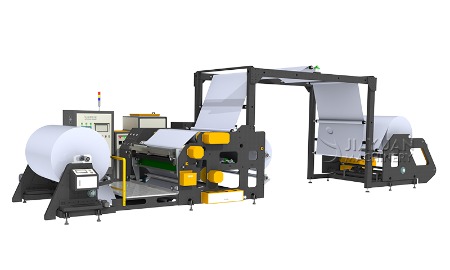
Adhesive coating machine
Measurement of coating thickness can be performed using both online and offline methods. Online measurement is typically achieved with non-contact gauges such as beta-ray, X-ray, or near-infrared (NIR) sensors that measure the mass per unit area (coat weight), which is then converted to thickness using the adhesive density. These gauges are mounted on scanning frames that traverse the web, providing real-time cross-web profiles. For offline measurement, precision micrometers or calipers can measure the total thickness of coated substrate minus the uncoated substrate thickness (differential method). Optical interferometry and confocal microscopy are used for ultra-thin coatings. For adhesive coatings on transparent films, spectrophotometric analysis can determine thickness from interference patterns. The accuracy of thickness measurement is critical; typical tolerances range from ±1-2 µm for standard applications to ±0.5 µm for high-precision medical or optical coatings. Calibration of gauges using standard samples with known thickness and density is essential to maintain measurement reliability.
Several factors influence coating thickness stability and uniformity during production. Adhesive viscosity is a primary factor; variations in temperature, shear rate, or solids content cause viscosity changes that alter the flow behavior in the coating head, directly affecting the applied thickness. In slot die coating, thickness is determined by the ratio of flow rate (pump speed) to line speed, but any variation in the die gap or fluid temperature will change the effective thickness. In roll coating, the gap between the metering and applicator rolls, the speed ratio, and the roll surface properties affect the thickness. Substrate surface roughness and porosity also affect the effective thickness, as adhesive can penetrate into porous substrates, reducing the surface layer thickness. Web tension variations can stretch the substrate, altering the apparent thickness per unit area. Environmental conditions such as temperature and humidity can cause solvent evaporation before measurement (for solvent-based coatings), leading to errors. To mitigate these factors, modern coating lines incorporate precise temperature control, tension regulation, and environmental conditioning systems.
Control of coating thickness is achieved through closed-loop systems that continuously measure the thickness (or coat weight) and adjust the relevant actuator to maintain the target. For slot die coaters, the primary actuator is the gear pump speed; a PID controller compares the measured value with the setpoint and adjusts pump rpm. For comma blade coaters, the blade gap is adjusted via motorized micrometer screws. For roll coaters, the nip gap or roll speed ratio is controlled. Advanced systems also include cross-web profile control, where multiple actuators (e.g., segmented heated bolts on slot dies) correct local thickness variations across the width. The control system must account for process delays (e.g., the time from coating application to the gauge measurement, which may be several seconds depending on the distance), requiring model-based predictive control for optimal performance. Data from thickness measurements are also used for statistical process control (SPC) to monitor capability indices (Cp, Cpk) and trigger alarms when thickness drifts beyond acceptable limits. This ensures that the final product meets customer specifications and reduces scrap.
The relationship between coating thickness and product performance is complex and application-specific. For PSAs, increasing thickness generally increases peel adhesion and tack up to a certain point, beyond which the adhesive may ooze out or fail cohesively. For example, a typical acrylic PSA may show a linear increase in peel strength from 10 to 30 µm, with diminishing returns above 40 µm. For shear resistance, thicker coatings often reduce performance because the adhesive mass deforms more under load. For optical films, thickness uniformity is critical because variations cause color shifts or haze. In medical tapes, thickness affects breathability and skin adhesion comfort. Therefore, the optimal thickness must be determined through extensive testing and is often a trade-off between performance and cost. Manufacturers routinely perform design of experiments (DOE) to define the acceptable thickness range for each product. Additionally, the thickness must be controlled within tight tolerances to ensure consistent converting performance (slitting, die-cutting) and to minimize material consumption. With adhesive costs being a significant portion of the total product cost, reducing thickness by even 1 µm can yield substantial savings on high-volume lines, making precise thickness control a key economic driver in the adhesive coating industry.