coating uniformity
Coating uniformity refers to the consistency of the applied adhesive layer across the entire coated area, both in the transverse (cross-web) and machine (longitudinal) directions. It is a key quality attribute that affects product performance, appearance, and convertibility. This article provides a detailed technical examination of coating uniformity, including its measurement, common causes of non-uniformity, methods for improvement, and the impact of uniformity on final product properties.
Coating uniformity is typically characterized by two components: cross-web uniformity (variation across the width of the web) and machine-direction uniformity (variation along the length of the web). Cross-web uniformity is often the more challenging parameter, as it is affected by die design, edge effects, temperature gradients, and roll alignment. Machine-direction uniformity is primarily influenced by pump pulsation, speed fluctuations, and control loop stability. Typical specifications for uniformity are expressed as a percentage variation, e.g., ±2% of the target coat weight. For high-end products, uniformity better than ±1% is required, while for some industrial tapes, ±5% may be acceptable. Uniformity is measured using scanning gauges that traverse the web width, providing a profile, and fixed-point gauges that monitor the machine direction over time. Statistical parameters such as standard deviation, range, and profile flatness are used to quantify uniformity.
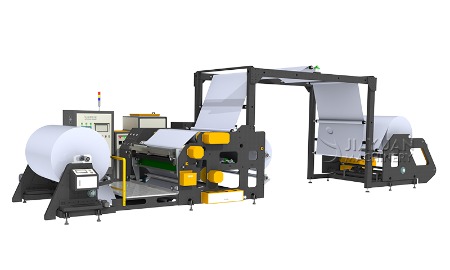
Adhesive coating machine
Cross-web non-uniformity can arise from several sources. In slot die coating, the most common cause is an unbalanced internal manifold or non-uniform die lip gap, leading to higher flow at the center or edges (center-thick or edge-thick profiles). Die thermal expansion due to non-uniform heating can also distort the lip gap. In roll coating, non-uniform roll surface (taper, runout, or surface finish variations) causes thickness variations across the width. Improper roll alignment (skewed rolls) creates a gradient in the nip gap. Edge effects, such as edge bead or neck-in, cause thicker coating at the edges, which is often trimmed off but still contributes to waste. In gravure coating, cell wear across the cylinder or doctor blade wear can cause local variations. Substrate thickness variations or surface energy differences across the width can also affect the amount of adhesive transferred, especially in porous substrates where penetration varies. Machine-direction non-uniformity is typically caused by pump pulsation (especially with gear pumps that have harmonics), speed variations due to motor drive ripples, and control system oscillations (hunting). Environmental factors like temperature swings can change viscosity and flow, while tension variations stretch the substrate, altering the coat weight per area.
Measurement and analysis of coating uniformity are essential for process control. Online scanning gauges provide cross-web profiles that can be displayed in real-time, showing the average coat weight and the variation across the width. Key metrics include the profile range (max-min), standard deviation, and the percentage of points within the tolerance band. For machine-direction uniformity, fixed-point gauges or scanning gauges at a fixed position over time provide time-series data. Advanced systems use Fourier analysis to identify periodic variations due to pump pulsation or roll runout. The uniformity data is often integrated with the control system to automatically adjust actuators, such as lip heaters on slot dies or segmented gap adjusters, to flatten the profile. For example, if the profile shows higher coat weight at the center, the center lip heaters can be activated to locally reduce the gap and lower the flow. This closed-loop profile control can significantly improve cross-web uniformity, reducing the need for edge trimming and improving yield.
Improving coating uniformity requires a systematic approach addressing both equipment and process. Equipment maintenance is crucial: rolls must be regularly inspected for runout, surface finish, and alignment; dies must be cleaned to prevent build-up; and pumps must be checked for wear and pulsation. Process optimization involves adjusting operating parameters such as temperature, gap, speed ratio, and flow rate to find the window that gives the most uniform coating. Design of experiments (DOE) can identify the interactions between parameters and their effects on uniformity. For slot die coating, the die lip gap uniformity is paramount; using thermal expansion actuators to fine-tune the gap profile has become a standard practice. For roll coating, ensuring that the rolls are perfectly parallel and have uniform surface finish is essential. Additionally, using edge guides or air knives can reduce edge beads. In some cases, changing the adhesive formulation to reduce surface tension or modify viscosity can improve wettability and reduce uniformity defects. Operator training is also important, as skilled operators can detect early signs of non-uniformity (e.g., visual streaks or mottle) and take corrective action before the product goes out of spec.
The impact of coating uniformity on product performance is significant. In pressure-sensitive tapes, non-uniform adhesive thickness leads to uneven peel adhesion, with weak spots where the coating is thin and oozing or tacky spots where it is thick. This causes inconsistent bonding and customer complaints. In optical films, even small thickness variations cause color shifts or distortions. In medical patches, non-uniform drug or adhesive layers affect drug delivery rates and skin adhesion, potentially compromising safety. In converting processes (slitting, die-cutting), non-uniform coating can cause jams, misregistration, or poor edges. Therefore, manufacturers invest heavily in achieving high uniformity. The cost of non-uniformity is not just quality defects but also material waste: if the coating has a thick center and thin edges, the manufacturer must set the average coat weight above the minimum requirement to ensure the thin edges meet spec, wasting adhesive at the center. By improving uniformity, the average coat weight can be reduced to the minimum, saving material and reducing costs. Thus, uniformity control is both a quality and an economic imperative in the adhesive coating industry.