coating width
Coating width is the dimension of the coated area measured across the transverse direction of the substrate web. It is a fundamental specification in adhesive coating that determines the usable width of the finished product, material utilization efficiency, and production capacity. This article provides a detailed technical overview of coating width considerations, including measurement, control methods, edge effects, trimming, and its impact on machine design and economics.
The coating width is typically specified as the distance between the two edges of the coated layer on the substrate, measured in millimeters or inches. It is usually slightly less than the total substrate web width to allow for uncoated edges (edge trim) that are later removed. The coating width is determined by the effective width of the coating head—the slot die lip length, the gravure cylinder pattern width, the roll face length, or the blade length. In practice, the coating width must be carefully matched to the intended product width, with allowances for shrinkage, stretching, and slitting tolerances. Standard coating widths for adhesive products range from 300 mm for specialty tapes to over 2,000 mm for large-label and packaging applications, with some custom lines exceeding 3,000 mm for industrial laminates and building materials.
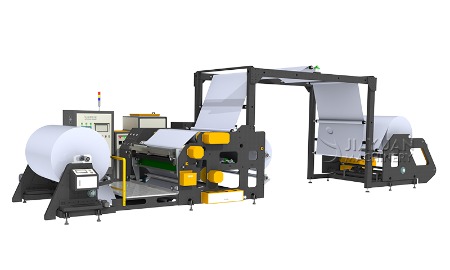
Adhesive coating machine
Control of coating width is achieved through mechanical and process means. For slot die coating, the effective coating width is determined by the die slot length, and edge dams or shims can be used to limit the flow at the edges, creating a defined coating edge. However, the fluid bead at the die exits may expand or contract (die swell or edge draw-in) depending on fluid rheology and speed, causing the actual coating width to deviate from the die width. This effect must be compensated by adjusting the die width or using edge guides. For gravure coating, the engraved pattern width on the cylinder defines the coating width, and the doctor blade wipes the unengraved areas. For roll coaters, the coating width is limited by the roll face length, but edge flow can spread beyond the desired width, requiring edge shields or air knives to confine the fluid. In comma blade coaters, the blade extends across the full web width, and the coating width is controlled by the fluid supply rate and the width of the bead pool, often using side dams to prevent spreading.
Edge effects are a significant concern in coating width control. At the edges of the coating, the fluid tends to bead up or form a thicker deposit due to surface tension effects, resulting in "edge beads" or "picture framing." These edge beads can cause problems in downstream processes, such as sticking in rewind rolls or uneven laminating. To mitigate edge beads, various techniques are employed: edge air knives blow a thin stream of air to reduce the bead thickness; edge guides (narrow slits) restrict flow at the edges; or the coating head is designed with a slightly smaller width than the substrate, with the uncoated edges providing a natural trim allowance. In hot melt slot die coating, the die lips are often machined with a relief at the edges to reduce the local coating weight. The coated edges are typically trimmed off in a subsequent slitting operation, usually 5-15 mm per side, to remove the edge bead and ensure consistent product width. The trim waste is typically recycled (for hot melts) or disposed of, adding material cost.
The coating width directly affects the productivity and economics of a coating line. A wider coating width allows more product to be produced per unit time, increasing output and reducing cost per unit area. However, wider lines require larger and more expensive coating heads, rolls, and drying ovens, and they demand higher precision to maintain uniformity across the width. The capital cost of a coating line scales approximately with the square of the width, because larger rolls and structures require heavier construction and more powerful drives. Additionally, wider webs are more susceptible to tension variations, wrinkling, and web wander, requiring more sophisticated tension control and web guiding systems. The optimal coating width is a trade-off between production efficiency and capital investment, often determined by the largest common product width in the market. For example, label stock is commonly coated at 1,300-1,600 mm to yield multiple label rows after slitting.
Measurement and verification of coating width are essential for quality control. Coating width can be measured online using optical sensors (line scan cameras or LED arrays) that detect the edges of the coated layer by contrasting reflectance or transmission. Laser profilometers can also measure the coating profile across the width, providing both width and thickness data. These sensors are typically mounted after the coating head and before the rewind, with automatic feedback to adjust the coating head position or edge guides if the width drifts. For offline inspection, samples are cut and measured with precision rulers or automated vision systems. The tolerance for coating width is typically ±1-2 mm for standard products, but tighter tolerances (±0.5 mm) may be required for high-value applications such as medical tapes or optical films. Modern coating lines integrate coating width control with the overall process control system, ensuring that width variations are minimized and that any deviations are immediately detected and corrected, reducing scrap and improving yield.