comma coater
A comma coater is a precision coating machine that uses a specially shaped blade (the comma blade) to apply a uniform layer of liquid or viscous coating material onto a moving substrate. Named for its comma-like cross-section (curved at the bottom and straight at the top), this blade meters the coating onto the substrate with exceptional accuracy, making it one of the preferred methods for applying adhesives, particularly water-based and solvent-based formulations, onto films, paper, and nonwovens. This article provides a detailed technical overview of comma coater technology, including its design, working principles, process parameters, advantages, and industrial applications.
The comma coater operates on the principle of a rigid blade metering system. The comma-shaped blade is positioned at a precise, adjustable gap above a backing roll over which the substrate passes. The coating fluid is supplied upstream of the blade, forming a pool or bead in the wedge between the blade and the substrate. As the substrate moves forward, the blade scrapes off excess fluid, allowing only the required coating thickness to pass through the gap. The unique comma profile ensures that the blade edge is oriented at an optimal angle to the substrate, creating a controlled shearing action that results in a highly uniform coating. The gap between the blade and substrate determines the coating thickness, with typical gaps ranging from 10 to 500 μm and achievable coat weights from 1 to 200 gsm.
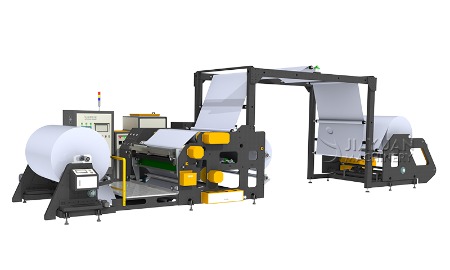
Adhesive coating machine
Comma coaters offer several distinct advantages over other coating methods. They provide exceptional coat weight uniformity, with thickness variation typically within ±1-2%, comparable to slot die coating but at lower capital cost. The rigid blade does not flex under pressure, ensuring consistent metering across the full web width, and it can handle a wide viscosity range from low-viscosity solutions (100 cP) to high-viscosity pastes (50,000 cP). Comma coaters are particularly suitable for water-based and solvent-based adhesives, as the open bead design allows easy cleaning and quick changeover between different formulations. The coating weight can be adjusted dynamically by changing the gap, enabling rapid product changes without requiring tooling changes. Additionally, comma coaters can produce coatings with excellent surface smoothness, making them ideal for optical and high-quality decorative applications.
However, comma coaters also have limitations. The coating bead is an open, free-surface flow, which makes it sensitive to substrate speed, fluid rheology, and environmental conditions. At high speeds (above 150-200 m/min), air entrainment can cause coating defects such as pinholes or air bubbles. The blade must be precisely set parallel to the backup roll; misalignment causes cross-web coat weight variations. The blade also wears over time, requiring periodic regrinding or replacement. Comma coaters are less suitable for very thin coatings (below 1 gsm) or for extremely low-viscosity fluids that may bypass the gap. The backup roll must have a hard, smooth surface (typically chrome-plated) to provide a precise gap reference, and roll runout must be minimized to maintain gap uniformity.
Key process parameters in comma coating include the blade gap, fluid supply rate, substrate speed, and blade angle. The blade gap is the primary control for coat weight, and is typically set using feeler gauges or micrometer screws, with automated gap adjustment in modern machines. The fluid supply rate must match the coating consumption to maintain a stable bead; excessive supply causes weeping, while insufficient supply causes starvation. Substrate speed affects the coating thickness due to hydrodynamic pressure in the bead; the relationship is nonlinear, requiring careful process development. The blade angle (the angle between the blade face and the substrate) typically ranges from 20 to 45 degrees; steeper angles produce higher shear and thinner coatings but increase wear. The backup roll temperature may be controlled to regulate coating viscosity and drying behavior.
Comma coaters are widely used in the adhesive industry for applying water-based and solvent-based adhesives onto paper, film, and nonwoven substrates for tapes, labels, and laminating applications. They are particularly common in the production of self-adhesive labels where the PSA is coated onto a release liner with high precision. The packaging industry uses comma coaters for applying heat-seal coatings, cold-seal adhesives, and varnishes on flexible packaging. Other applications include protective films, medical tapes, and specialty coated papers. Comma coaters are also used in the production of silicone release coatings, where the ultra-thin coating requires exceptional uniformity. Modern comma coaters feature automated gap setting, laser-based gap measurement, and closed-loop coat weight control, enhancing productivity and consistency. The versatility and precision of comma coater technology continue to make it a staple in the converting industry.