continuous coating
Continuous coating is a manufacturing process in which adhesive is applied onto a moving substrate in an uninterrupted manner, typically over extended periods ranging from several hours to multiple days. Unlike batch or intermittent processes, continuous coating lines operate with minimal stops, allowing for high-volume, cost-efficient production of adhesive tapes, labels, packaging films, and other web-based products. This article provides a comprehensive technical overview of continuous coating, including its principles, equipment design, operational strategies, advantages, and challenges.
The essence of continuous coating is the ability to run the coating line without interruption for long durations, facilitated by automatic splicing systems at both the unwind and rewind stations. At the unwind, when the active roll approaches depletion, a splicing mechanism automatically joins the trailing edge of the expiring roll to the leading edge of a new roll, allowing the web to continue moving without stopping. Similarly, at the rewind, a turret rewinder automatically transfers the full roll to an empty core and starts winding a new roll, again without stopping the line. These splicing systems are critical for continuous operation; they must perform reliable splices that can withstand the tension of the line and do not cause defects. In addition, the adhesive supply system must be capable of running continuously, with melt tanks or supply tanks sized to hold enough material for extended runs, and with automated refilling or replenishment systems.
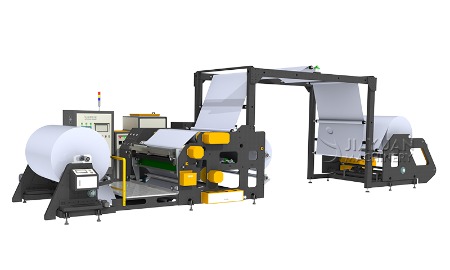
Adhesive coating machine
Continuous coating offers numerous advantages for manufacturers of high-volume products. The most significant is productivity; because the line does not stop for roll changes, the machine uptime can exceed 95%, compared to 70-80% for batch processes. This translates to higher annual output per machine, reducing the unit cost of production. Consistent quality is another benefit; once the coating parameters (temperature, coat weight, speed) are stabilized, the product quality remains highly uniform throughout the run, with minimal variation. The reduction in startups also minimizes scrap, as each startup produces waste due to ramp-up and stabilization. Continuous coating allows for just-in-time production of large orders, reducing inventory levels. Furthermore, the constant web speed simplifies control of drying or curing, as the residence time in ovens is constant, avoiding the temperature adjustments needed during acceleration or deceleration.
Designing a continuous coating line requires careful consideration of reliability and redundancy. All critical components—pumps, heaters, drives—must be robust and have adequate backup. For example, a duplex filter arrangement allows one filter to be changed while the other remains in service, preventing pressure drops that could cause coat weight variations. The drying oven must be capable of operating at constant setpoints for extended periods, with automatic cleaning or purging systems to prevent residue accumulation. The control system must be highly reliable, with redundant PLCs and power supplies. The adhesive supply system must include large melt tanks or day tanks that can hold hours of production, and automated feeding from storage silos or drums. Operator monitoring is essential, but the system should include alarms and automatic shutdown sequences for critical failures. Preventive maintenance is scheduled during planned stops (e.g., weekly or monthly), but many lines now incorporate condition monitoring (vibration, temperature, current draw) to predict failures and schedule maintenance during the next planned stop, minimizing unplanned downtime.
Challenges of continuous coating include the difficulty of product changeovers, as switching to a different adhesive or substrate requires stopping the line, cleaning the coating head and supply system, and re-setting parameters. This can take several hours, reducing overall efficiency for lines running many different products. Therefore, continuous coating is most economical for high-volume, low-variety production, such as standard packaging tapes or labelstocks. For applications requiring frequent changeovers, intermittent or semi-continuous processes may be more suitable. Another challenge is managing web breaks; a break stops the line and requires re-threading, causing significant downtime. Proper web handling, tension control, and splice integrity are essential to prevent breaks. Additionally, the line must have sufficient accumulation capacity (festoons) to allow splicing without speed changes, and the splicer must be able to handle the web tension without damaging the splice. The trend in continuous coating is toward increased automation, including robotic roll handling, automatic cleaning systems, and remote monitoring. Industry 4.0 technologies are being applied to predict and prevent defects, optimize energy consumption, and improve overall equipment effectiveness (OEE). In summary, continuous coating is a powerful method for achieving high-volume, low-cost production of adhesive products, enabled by advanced splicing, reliable equipment, and robust process control.