curing system
A curing system is a set of equipment and processes that induce chemical crosslinking or polymerization in the adhesive layer after application, transforming it from a thermoplastic or viscous state into a thermoset or high-performance solid with enhanced mechanical, thermal, and chemical resistance. Curing is distinct from drying (which removes solvents) and cooling (which solidifies hot melts). This article provides a comprehensive technical overview of curing systems used in adhesive coating, including types, mechanisms, equipment, and process control.
Curing is essential for many high-performance adhesives, including structural acrylics, epoxies, polyurethanes, and certain silicone and rubber-based PSAs. The curing reaction can be initiated by heat (thermal curing), by ultraviolet (UV) or electron beam (EB) radiation (radiation curing), or by moisture (moisture curing). The selection of the curing system depends on the adhesive chemistry, substrate, line speed, and desired final properties. Thermal curing ovens are common for solvent-based and water-based adhesives that contain crosslinkers (e.g., isocyanates, melamines, epoxies) which react at elevated temperatures (80-200°C). UV curing systems use high-intensity UV lamps (mercury, LED, or excimer) to initiate photopolymerization in acrylate-based adhesives, offering rapid curing at ambient temperatures. EB curing uses high-energy electrons to generate free radicals, enabling curing of thick films and pigmented coatings without photoinitiators. Moisture curing systems expose the coating to humid air, allowing moisture-reactive groups (e.g., silanes, isocyanates) to crosslink over time.
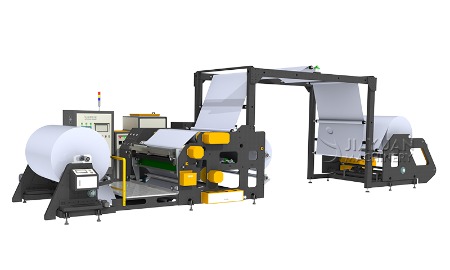
Adhesive coating machine
Thermal curing is the most traditional method and is often integrated with the drying oven in solvent-based lines. After drying, the coated web passes through a high-temperature zone (the curing section) where the crosslinking reaction occurs. The temperature and residence time are critical; insufficient curing leads to low cohesive strength, poor solvent resistance, and temperature sensitivity, while over-curing can cause embrittlement or discoloration. Typical cure conditions for acrylic PSAs with isocyanate crosslinkers are 80-120°C for 1-3 minutes. For epoxies, temperatures may be higher (150-200°C) with longer times. Thermal curing ovens are similar to drying ovens but often operate at higher temperatures and with tighter control, as the reaction kinetics are highly temperature-dependent. In some lines, the curing oven is a separate module after the drying oven, allowing independent control of drying and curing profiles. The oven may use infrared heaters for rapid heating or convection for uniform temperature distribution. Temperature profiling along the oven length ensures that the adhesive reaches the required cure temperature for the necessary time without overheating the substrate.
UV curing systems have gained popularity due to their high speed, low energy consumption, and ambient temperature operation. A typical UV curing station consists of one or more UV lamps mounted across the web width, with reflectors to focus the radiation onto the coating. The lamps emit UVA (320-390 nm) or UVV (390-450 nm) light, depending on the photoinitiator used. The required dose (mJ/cm²) and irradiance (mW/cm²) depend on the adhesive formulation and coating thickness; typical doses range from 200 to 1,000 mJ/cm². The curing is nearly instantaneous (0.1-2 seconds), allowing line speeds up to 600 m/min. However, UV curing is limited to transparent coatings (because pigments absorb UV) and requires photoinitiators that may generate byproducts. LED UV systems are replacing mercury lamps due to longer life, lower heat emission, and instant on/off capability. EB curing uses a high-voltage electron beam (typically 150-300 keV) to generate radicals directly, without photoinitiators, enabling curing of opaque and thick coatings. EB systems are more expensive and require shielding but offer the fastest curing and excellent penetration. Both UV and EB curing are considered environmentally friendly because they produce no VOCs and consume less energy than thermal ovens.
Moisture curing is a slower process, often used for construction adhesives or sealants, but in coating lines, it may involve a humidification tunnel or chamber where the coated web is exposed to controlled humidity (e.g., 40-80% RH) and temperature for a period, sometimes extending to several hours. This is less common in high-speed roll-to-roll lines because it limits line speed and requires significant floor space. However, for certain high-performance products (e.g., moisture-curing polyurethane PSAs), it is essential. Process control for moisture curing involves controlling the humidity, temperature, and residence time to achieve the desired degree of crosslinking without over-curing or under-curing.
The integration of curing systems with the coating line requires careful coordination. The curing system must be synchronized with line speed; if the line speed changes, the power or temperature must adjust to maintain the required cure dose or time. For UV/EB systems, dose control is achieved by varying lamp power or by using multiple lamps with selective shut-off. For thermal curing, the oven temperature profile may be adjusted based on speed. Inline curing monitors (e.g., IR sensors for temperature, or spectrometers for degree of conversion) can provide real-time feedback to ensure consistent cure. After curing, the coated web often passes through a cooling section before rewinding, to prevent blocking or thermal degradation. The cured adhesive exhibits improved shear strength, heat resistance, solvent resistance, and durability, enabling applications in automotive, aerospace, electronics, and medical devices where high performance is required. Therefore, the selection and control of the curing system are critical to product functionality and are tailored to each adhesive formulation and application.