custom coating machine
A custom coating machine is a specially engineered coating system designed and built to meet specific production requirements that cannot be satisfied by standard off-the-shelf equipment. Custom machines are tailored for unique substrate materials, adhesive formulations, coat weight ranges, line speeds, environmental conditions, or integration with existing production lines. This article provides a comprehensive technical overview of custom coating machine design, engineering considerations, typical customization parameters, and the process of developing a bespoke coating solution.
Custom coating machines are essential for manufacturers with niche applications, such as coating ultra-thin films, high-viscosity pastes, reactive adhesives, or temperature-sensitive substrates. They are also required for integration into existing production environments with space constraints, specific web path requirements, or the need to combine coating with other processes like printing, lamination, or slitting. Customization can range from minor modifications to standard models (e.g., wider coating width, additional drying zones) to completely novel designs that incorporate multiple coating methods, specialized drying/curing systems (UV, EB, induction), or advanced automation features. The development of a custom coating machine typically involves close collaboration between the manufacturer and the customer, starting with a detailed feasibility study and process simulation, followed by engineering design, prototype testing (if needed), manufacturing, and commissioning.
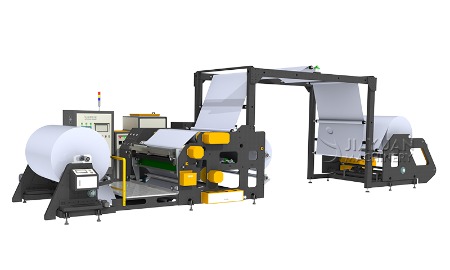
Adhesive coating machine
The engineering design of a custom coating machine begins with a comprehensive specification document that defines all process requirements: substrate type and dimensions (width, thickness, tensile strength), adhesive chemistry and rheology (viscosity, solids content, curing mechanism), desired coat weight and uniformity, line speed range, operating temperature, and environmental conditions (cleanroom, explosion-proof, etc.). The customer's existing facility constraints, such as floor space, ceiling height, power supply, and ventilation, are also critical inputs. The design team then selects the appropriate coating method (slot die, comma blade, gravure, roll, spray) based on the adhesive viscosity and precision needed. They design the web handling system with tension control zones, the drying or curing system (oven, UV, chill rolls), and any additional modules like corona treaters, laminators, or slitters. The control system architecture is specified, integrating PLC, HMI, sensors, and actuators. All components are sourced and matched to ensure compatibility and reliability. Finite element analysis (FEA) may be used to optimize structural strength and minimize vibration.
Key customization parameters include coating width, line speed, coat weight range, and automation level. Coating width can be increased beyond standard offerings, but this requires larger rolls, more powerful drives, and longer ovens, significantly impacting cost. Line speed customization involves selecting motors, drives, and control systems capable of the desired range. Coat weight range customization may require multiple coating heads or interchangeable dies. Automation can be tailored from basic manual control to fully automated with recipe management, automatic profile control, and remote monitoring. Custom drying systems are often required; for example, a combination of IR and convection heating for sensitive substrates, or high-velocity impingement for fast evaporation. Custom cooling systems, such as multi-roll chill stands, may be needed for hot melt coatings. The integration of inline measurement (coat weight gauges, thickness sensors, vision inspection) and closed-loop control is typically part of a custom design. Environmental considerations, such as solvent recovery or exhaust treatment, are also engineered to meet local regulations.
The development process for a custom coating machine typically follows a phased approach: concept design, detailed engineering, fabrication, assembly, factory acceptance testing (FAT), shipment, installation, site acceptance testing (SAT), and training. Throughout the project, regular communication between the manufacturer and customer is essential to manage scope, schedule, and budget. Prototyping or pilot testing is often recommended for novel applications to validate the design before full-scale construction. The manufacturer should provide detailed documentation, including operation manuals, maintenance guides, and troubleshooting guides. Post-installation support includes on-site commissioning, operator training, and a warranty period. Custom machines are generally more expensive than standard lines, but they offer the exact capabilities needed for the specific application, often resulting in higher yield, lower waste, and better product quality. In summary, a custom coating machine is a tailored solution that addresses unique production challenges, and its successful development relies on a strong partnership between the customer and an experienced engineering team capable of translating process requirements into a robust, efficient, and reliable coating system.