diaper coating
Diaper coating refers to the application of pressure-sensitive adhesives (PSAs) and construction adhesives onto various components of disposable diapers during the manufacturing process. These adhesives secure the elastic strands (leg cuffs, waistbands), bond the multi-layer laminate (topsheet, acquisition layer, backsheet), and provide fastening tapes for closure. Diaper coating is a high-speed, high-volume operation requiring precise application, consistent quality, and compatibility with sensitive skin. This article provides a comprehensive technical overview of diaper coating methods, adhesive types, process control, and quality assurance in the hygiene industry.
Modern disposable diapers are complex multi-layer structures, and adhesives are used at several critical points. Construction adhesives bond the nonwoven topsheet to the absorbent core, the core to the backsheet film, and the acquisition layer between them. These adhesives are typically applied in a spiral or slot coat pattern at low coat weights (1-5 gsm) to maintain breathability and softness while ensuring layer integrity. Elastic attachment adhesives secure the stretched elastic strands that form the leg cuffs and waistbands, requiring higher coat weights (5-15 gsm) and often applied in continuous or intermittent lines to anchor the elastics. Fastening tape adhesives are applied as a full coating (20-40 gsm) on a carrier film or nonwoven tab, providing the PSA for diaper closure. The coating equipment is integrated into the diaper converting machine or operates as a standalone module feeding pre-coated tape. The line speed for diaper production ranges from 200 to 600 m/min, with some modern lines exceeding 800 m/min, demanding extremely fast adhesive application and setting.
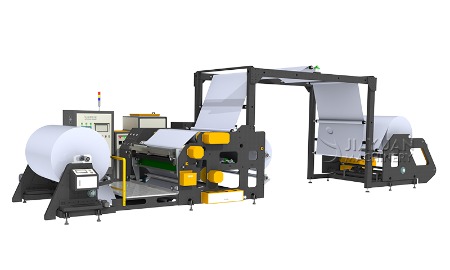
Adhesive coating machine
Hot melt adhesives are the exclusive choice for diaper coating due to their fast setting, solvent-free nature, and excellent adhesion to nonwoven and film substrates. The primary polymers are styrenic block copolymers (SBC, e.g., SIS or SBS) combined with tackifying resins and plasticizers. For construction adhesives, the formulations are designed for low viscosity and open time to allow penetration into the nonwoven. For elastic attachment, higher cohesive strength and heat resistance are needed to hold the elastic under tension. For fastening tapes, the PSA must have high tack and peel adhesion but also removability. The application temperature for these hot melts ranges from 140°C to 180°C, and viscosity is maintained between 1,000 and 10,000 cP depending on the application method. The melt tank and hoses are heated and insulated to ensure consistent temperature; any temperature drift causes viscosity changes that affect coat weight and pattern.
Application methods for diaper coating include spiral spray, slot die, and meltblown. Spiral spray is the most common for construction adhesives; it uses a multi-hole nozzle that creates a helical pattern of adhesive fibers, achieving good coverage at low coat weights with minimal stiffness. The spray pattern width and density are controlled by air pressure and adhesive flow rate. Slot die coating is used for elastic attachment when a continuous strip of adhesive is needed to anchor elastic strands; it provides a uniform bead with sharp edges. Meltblown application uses multiple fine filaments to create a random web pattern, used for some construction adhesives where high coverage is desired. The choice of method depends on the substrate, coat weight, and line speed. For fastening tapes, a slot die or comma blade applies a full coating onto the carrier, which is then laminated with a release liner and later slit into tape tabs. All application systems are equipped with precise pump metering (gear pumps) and closed-loop control to maintain constant flow relative to line speed.
Process control in diaper coating is essential to avoid defects that could compromise diaper performance. Coat weight is monitored using inline gauges (e.g., NIR or beta) and corrected by adjusting pump speed. Spray pattern cameras inspect for misses, streaks, or asymmetric patterns. Temperature control throughout the adhesive delivery system is critical; even a 2°C change can cause pattern distortion. Web tension is carefully managed to prevent stretching or wrinkling of the nonwoven, which would cause adhesive application errors. The adhesive application is typically followed by a nip roll that presses the layers together to ensure intimate contact. The coated elastic strands must be held in place until the adhesive cools; cooling is achieved by ambient air or chill rolls. Fastening tape coating requires precise alignment of the release liner and subsequent slitting; misalignment leads to defective tabs. Data from all sensors are logged for each batch, enabling traceability and continuous improvement. Regular cleaning of nozzles and dies is necessary to prevent adhesive build-up that causes streaks or clogging.
Quality control for diaper coating involves testing the adhesive performance in the final product. Peel adhesion of the fastening tape to the diaper backsheet is measured, both initially and after aging. Elastic attachment force is tested by measuring the tension retention of the elastic after bonding. Construction bond strength is evaluated by delamination tests. Additionally, the adhesive must pass skin safety tests (irritation and sensitization) and must not migrate through the layers to contact skin. The diapers are also evaluated for comfort and fit, where excessive adhesive stiffness is undesirable. Manufacturers work closely with adhesive suppliers to optimize formulations for each application and production conditions. The trend in diaper coating is toward lower coat weights to save materials and reduce cost, while maintaining or improving performance. Also, there is increasing demand for bio-based and recyclable materials, prompting research into new adhesives that are compatible with recycling processes. Inline sensors and machine learning are being adopted to predict and prevent defects, further improving efficiency. In summary, diaper coating is a high-speed, precision adhesive application process that is fundamental to the production of reliable, comfortable, and safe disposable diapers, with ongoing innovations driven by sustainability and performance requirements.