die gap adjustment
Die gap adjustment is a fundamental operation in slot die coating that sets the distance between the upper and lower die lips—the narrow opening through which the coating material exits onto the substrate. This gap directly controls the initial coating thickness and influences the pressure distribution within the die manifold, which in turn affects the cross-web coat weight profile. Proper die gap adjustment is essential for achieving uniform coating, preventing defects, and maintaining product quality. This article provides a comprehensive technical overview of die gap adjustment principles, procedures, and best practices for slot die coating systems.
The die lip gap is the distance between the upper and lower die lips at the exit of the slot die. It is typically set using die body shims—metal or plastic spacers that are placed between the upper and lower die bodies. The shim thickness directly determines the lip gap; for a given adhesive viscosity and pump flow rate, the coating weight is approximately proportional to the die lip gap. However, the relationship is not purely linear because the pressure drop through the slot and the die swell behavior of the fluid also play roles. The die gap must be set uniformly across the full width of the die to achieve a flat coat weight profile. A gap that is narrower on one side will produce a thinner coating on that side, while a wider gap will produce a thicker coating. The goal is to have the same gap width across the entire length of the slot die, typically achieved by using precision-ground shims and careful assembly.
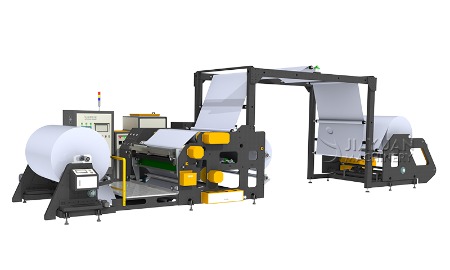
Adhesive coating machine
The procedure for adjusting the die gap with shims begins with cleaning the slot die lips thoroughly—any debris or dried material will throw off gap measurements. The die is disassembled by separating the upper and lower bodies, and the existing shim is removed. The correct shim thickness is selected based on the desired coat weight and the fluid properties; typical shim thicknesses range from 0.1 mm to 1.0 mm depending on the application. The new shim is installed, and the die is reassembled with the upper and lower bodies aligned using precision dowel pins. The body bolts are torqued in the specified sequence and torque values engraved on the die to ensure even pressure across the die face. After assembly, a feeler gauge is used to check the gap at multiple points along the slot die—left, middle, right, and several spots in between. If one side is narrower, the die bolts are gently adjusted to widen it; if wider, the bolts are tightened slightly. Make small adjustments (1-2 thousandths of an inch at a time) and recheck with the feeler gauge. For automated slot die systems, the control panel can be used to adjust the gap, but manual verification is still recommended.
Beyond the basic lip gap set by shims, fine-tuning the lip offset may be necessary to correct overbite or underbite conditions—where the upper and lower lip faces are not perfectly aligned. Offset shims can be inserted to shift the upper body relative to the lower body, adjusting the relative position of the lip faces. A typical starting offset shim thickness is 0.010 inch (0.254 mm). The offset adjustment affects the coating bead geometry and can improve coating contact and uniformity. The profiling of the lip gap adjusts the pressure inside the manifold to add more or less resistance to flow. With a larger lip gap, the pressure decreases and the melt flows heavier to the center; with a tighter lip gap, the pressure increases and redirects the flow to the ends. Because the adjustment changes pressure, it takes time for the distribution to stabilize—typically 30 seconds up to a few minutes, depending on the amount of adjustment and fluid properties. The full change may not show immediately on the gauging scanner; it may take 10-15 minutes to see the full change given that the scanner takes a composite of several scans.
Key considerations for die gap adjustment include the fluid viscosity, the desired coat weight, and the line speed. Thicker fluids need a wider die gap or higher pressure to flow smoothly. For a given adhesive viscosity and pump flow rate, the coating weight is approximately proportional to the die lip gap. However, the fine distribution of the fluid is determined by the land length and lip gap. The manifold design and land length are based primarily on rheology (how the material flows), and secondarily on process conditions. The preland distributes the coating material evenly prior to the lip land. In general, the overall thickness/weight of the coating is mostly based on the combination of flow rate and line speed, while the fine distribution is determined by the land length and lip gap. Regular inspection and adjustment of slot die shims should be part of any preventative maintenance program. As coating requirements evolve or materials change, small shim adjustments can restore performance without requiring major die modifications. Proper die gap adjustment, combined with precise temperature control and flow metering, is the key to achieving the ±1-2% coat weight uniformity that makes slot die coating the gold standard for precision adhesive applications.