dry coat weight
Dry coat weight is the mass of adhesive solids deposited per unit area of substrate after all volatile components (solvents, water) have been removed, typically expressed in grams per square meter (gsm). It is the most critical specification for adhesive products because it directly determines the adhesive performance and material cost. This article provides a comprehensive technical overview of dry coat weight, including its measurement, relationship to wet coat weight, factors affecting it, and its importance in quality control and product design.
Dry coat weight is the net adhesive mass that remains on the substrate after drying or cooling, representing the effective adhesive layer that provides bonding. For pressure-sensitive adhesives, typical dry coat weights range from 15 to 40 gsm for tape and label applications, with 20-25 gsm being the industry standard for general-purpose acrylic PSAs. Low-tack products (e.g., removable notes) may have 5-10 gsm, while high-performance structural tapes may require 40-100 gsm. For hot melt adhesives, which are 100% solids, the dry coat weight equals the wet coat weight (since no volatiles are removed). For solvent-based and water-based adhesives, the dry coat weight is the product of the wet coat weight and the solids fraction (e.g., a 50% solids solution coated at 50 gsm wet gives 25 gsm dry). The dry coat weight is specified on the product data sheet and is the basis for performance testing and customer acceptance.
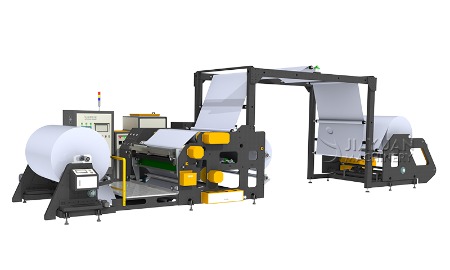
Adhesive coating machine
Measurement of dry coat weight can be performed destructively or non-destructively. The most accurate method is gravimetric analysis: a sample of known area is weighed, the adhesive is removed using a solvent (for soluble adhesives) or by peeling the adhesive layer, and the substrate is reweighed; the difference is the dry coat weight. Alternatively, the sample can be weighed before and after drying if the substrate does not absorb or lose mass. Non-destructive online measurement is typically done by beta-ray or X-ray gauges that measure the total mass per unit area of the coated web; the dry coat weight is obtained by subtracting the known substrate weight (measured before coating). For hot melt coatings, a single gauge reading suffices because there is no solvent. For water-based and solvent-based systems, the gauge can be placed after the drying oven to measure the dry coat weight directly. The accuracy of online gauges is typically ±0.1-0.5 gsm, depending on the gauge type and calibration. Regular calibration using gravimetric samples is essential to maintain accuracy and compensate for changes in adhesive density or substrate weight.
The relationship between dry coat weight and product performance is well-established. For a given adhesive formulation, increasing the dry coat weight generally increases peel adhesion and tack up to a plateau, beyond which the adhesive may fail cohesively or ooze. The optimal dry coat weight is determined by balancing performance requirements against cost and processability. For example, a typical acrylic PSA may achieve its maximum peel adhesion at around 25 gsm, with further increases giving only marginal improvement. Shear resistance often decreases with higher coat weight because the thicker adhesive layer deforms more under load. Therefore, the specification must be carefully selected through performance testing. Additionally, the dry coat weight affects converting operations: too high a coat weight causes adhesive squeeze-out during slitting, while too low a coat weight leads to insufficient bonding. Manufacturers often use design of experiments to define the acceptable range of dry coat weight that meets all performance criteria, and then set the target at the lower end of that range to minimize material cost while ensuring a safety margin for process variations.
Factors that affect dry coat weight stability include adhesive solids content, coating flow rate, line speed, and substrate porosity. The solids content of the adhesive must be precisely controlled, as even a 1% variation in solids changes the dry coat weight by 1% if the wet coat weight remains constant. For this reason, adhesive suppliers often provide certificates of analysis for solids content, and manufacturers may measure solids content in-line using NIR sensors. The flow rate to the coating head must be accurately metered, typically using gear pumps with precision drives. Line speed variations must be compensated by corresponding flow rate adjustments to maintain constant dry coat weight. Substrate porosity can absorb some adhesive, reducing the surface coat weight; this effect must be accounted for, especially for paper and nonwoven substrates. Drying conditions (temperature, airflow) affect the evaporation rate but not the final dry coat weight, as long as all volatiles are removed; however, incomplete drying leaves residual solvent that overestimates the dry coat weight if measured by non-destructive gauging. Therefore, drying ovens must be properly sized and controlled to ensure complete volatile removal.
Dry coat weight is the basis for material cost calculation and is a key parameter for process optimization. For a line running at a given speed and width, the adhesive consumption rate (kg/h) is directly proportional to the dry coat weight and the production rate. Reducing the dry coat weight by even 1 gsm on a 1,600 mm wide line at 300 m/min can save over 50 tons of adhesive per year, translating to significant cost savings. However, the reduction must be validated by performance testing to ensure that the product still meets customer requirements. Therefore, many manufacturers continuously work to reduce their target dry coat weight through formulation improvements (e.g., higher tack at lower coat weight) and process control enhancements (e.g., improved uniformity to run closer to the minimum). Statistical process control (SPC) charts for dry coat weight are standard in quality control, with upper and lower control limits typically set at ±3 standard deviations from the target. When the process drifts, corrective actions are taken. In summary, dry coat weight is not just a specification but a key performance indicator that links quality, cost, and productivity in the adhesive coating industry.