drying oven
A drying oven is a critical subsystem in solvent-based and water-based adhesive coating lines, designed to evaporate the volatile carrier (solvent or water) from the applied wet coating, leaving a solid adhesive layer on the substrate. The drying process significantly impacts line speed, energy consumption, product quality, and environmental compliance. This article provides a comprehensive technical overview of drying oven design, operation, key parameters, and best practices for adhesive coating applications.
The primary function of a drying oven is to supply sufficient heat and airflow to evaporate the volatile components of the coating without damaging the substrate or the adhesive. The oven consists of a tunnel through which the coated web passes, with heating elements (gas burners, electric heaters, or thermal oil radiators) and air circulation systems that direct hot air onto and through the web. The oven is typically divided into multiple temperature zones (e.g., 3-8 zones) to allow a controlled temperature profile that ramps up gradually to avoid blistering or skinning, and then ramps down before exit. The total oven length can range from 10 meters for water-based coatings on thin films to over 60 meters for solvent-based coatings with high solvent loads. The drying process is governed by heat and mass transfer principles, where the rate of evaporation depends on the temperature, air velocity, humidity, and the solvent's vapor pressure. The oven must be sized to achieve complete evaporation at the maximum line speed while keeping the substrate temperature below its distortion or degradation point.
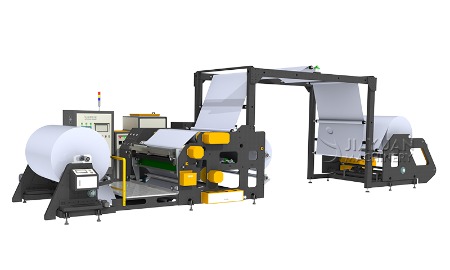
Adhesive coating machine
Oven design involves several critical parameters: the temperature profile, air impingement velocity, exhaust rate, and solvent concentration. The temperature profile is set to dry the coating efficiently without causing defects. For water-based adhesives, the oven temperature typically ranges from 40°C to 150°C, with a gradual increase to prevent water from boiling within the coating, which would cause pinholes. For solvent-based adhesives, temperatures range from 60°C to 180°C, depending on solvent volatility and substrate heat sensitivity. Air impingement (nozzles or slots that direct hot air onto the web) increases the heat transfer coefficient and enhances evaporation. High impingement velocities (10-30 m/s) are common, but they must be balanced against substrate flutter and potential web breakage. The exhaust rate must be sufficient to keep the solvent vapor concentration below the lower explosive limit (LEL) for safety, typically at 25-50% of LEL. Solvent recovery or thermal oxidation systems (e.g., regenerative thermal oxidizers, RTOs) are often integrated to capture VOCs and comply with environmental regulations. The oven's energy consumption is substantial; for a 1,600 mm wide line at 150 m/min, the oven may consume 500-800 kW, making energy efficiency a major design goal.
Drying defects are common challenges that must be addressed. Blistering occurs when the solvent or water is heated too quickly, causing bubbles that burst and leave pits or craters. This is prevented by using a gradual temperature ramp and by controlling the initial drying rate. Skinning happens when the top surface dries too quickly, trapping solvent underneath, which later causes blisters or poor adhesion. To prevent skinning, the initial oven zones are often set at lower temperatures with higher air velocity to evaporate surface solvent more slowly. Webbing or mottle refers to uneven drying patterns that result from non-uniform airflow or temperature across the web, leading to local variations in coating gloss or adhesion. Proper airflow distribution and temperature profiling are essential to avoid such defects. Incomplete drying leaves residual solvent in the adhesive, which can cause adhesion failure, plasticization, or migration, and may create odors or health hazards. Moisture or solvent residue is measured by inline sensors (e.g., NIR) or offline by gravimetric or GC methods. The drying oven must be tuned to ensure complete removal of volatiles under all operating conditions, with safety margins for process variations.
Control and automation of the drying oven are integral to modern coating lines. Each zone has independent temperature control using PID loops that adjust burner output or electric power. The exhaust fans and air supply fans are often variable-speed controlled to match the solvent load and line speed. The oven is also interlocked with the coating head and rewind systems: if the line slows down, the oven temperature may be reduced to prevent overheating; if the line stops, the oven may go into a standby mode to avoid substrate damage. Advanced systems use model-based control that predicts the solvent evaporation rate based on wet coat weight, solvent composition, temperature, and airflow, adjusting setpoints in real-time to maintain optimum drying conditions. Additionally, pressure sensors monitor the oven interior to maintain a slight negative pressure relative to the production hall, preventing solvent fume escape. Maintenance of the oven includes regular cleaning of nozzles and filters, checking of burner and fan bearings, and calibration of temperature and pressure sensors. Proper maintenance ensures consistent drying performance and reduces the risk of fires or explosions, especially with solvent-based adhesives. In summary, the drying oven is a complex but essential component whose design and operation must be carefully engineered to achieve high line speeds, product quality, and environmental compliance.