edge guide
An edge guide is a device used in coating lines to maintain the lateral position of the moving substrate web, ensuring that it remains properly aligned with the coating head, drying oven, and rewind station. Precise edge control is essential for achieving consistent coating width, preventing edge damage, and ensuring uniform product quality. This article provides a comprehensive technical overview of edge guide systems, including their types, working principles, control strategies, and importance in adhesive coating.
The edge guide is typically located at the unwind station and often at intermediate points along the line, especially before the coating station and before the rewind. Its primary function is to detect the lateral position of the web edge and to correct any deviation by moving the web laterally using a steering roll or a pivoting frame. Without an edge guide, web wander (caused by roll eccentricity, tension variations, or substrate curvature) would cause the coating to be misaligned, leading to uncoated edges on one side or coating beyond the substrate on the other side, both of which create waste and quality issues. In adhesive coating, the coating head is fixed in position, so the web must be guided to ensure that the coating is applied within the desired area. Similarly, the rewind edge guide ensures that the finished roll has straight edges for subsequent slitting or customer use.
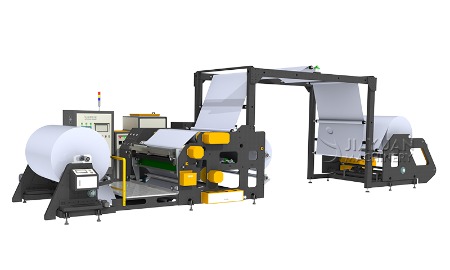
Adhesive coating machine
Edge guide systems use various sensors to detect the web edge. Photoelectric sensors (LED or laser) are common: they emit a beam across the web edge and detect the reflected or transmitted light; the shadow of the web indicates the edge position. Ultrasonic sensors can also detect edges by measuring the time of flight of sound waves, useful for opaque or highly reflective webs. Air gauge sensors (pneumatic) use a stream of air and measure the backpressure, which changes as the web covers the sensing orifice. The sensor output is sent to a controller that compares the actual position with the setpoint (desired edge position). If there is a deviation, the controller outputs a signal to an actuator that moves the web. The actuator is typically a mechanical frame that pivots a steering roll (a roll with a crowned or grooved surface that rotates to steer the web) or a lateral translation of a roll. The response time and accuracy of the system are critical: for high-speed lines, the guide must correct deviations quickly (within milliseconds) and with high precision (±0.5 mm or better).
The placement of edge guides along the line is strategic. The primary edge guide is at the unwind, where the web enters the line; it ensures that the web is centered before it enters the coating station. A second edge guide is often placed immediately before the coating head to fine-tune the position, compensating for any lateral drift that may have occurred during the initial travel. Some lines also have an edge guide after the drying oven and before the rewind to ensure that the finished roll is wound with straight edges. In multi-ply or laminating lines, edge guides are used to align multiple webs before they are combined. The control system may use a master-slave arrangement where the coating station edge guide is the master, and the unwind guide follows to maintain a consistent alignment relative to the coating head.
The performance of the edge guide is influenced by several factors. Web tension variations can cause the web to shift laterally if the guide is not responsive; therefore, tension control and edge guiding are often integrated. The guide's mechanical components (steering roll, bearings, frame) must be precise and free of play to avoid hysteresis. The sensor must be clean and properly calibrated; dust, adhesive residue, or condensation can affect sensing accuracy. The control algorithm must be tuned to the specific web width and line speed; too aggressive correction can cause the web to oscillate (hunting), while too slow correction allows deviations to grow. Advanced guides use PID control with adaptive gain that adjusts to speed changes. Some systems also use dual sensors to measure both edges and center the web, which is useful for webs with variable width or for maintaining a specific coating offset from the edge.
Troubleshooting edge guide issues is important for maintaining production quality. Common problems include sensor drift (causing the web to shift gradually), mechanical wear in the steering mechanism, and air pressure fluctuations in pneumatic systems. If the edge guide fails or loses control, the web will wander, often leading to coating edge defects or web breaks. Therefore, operators monitor edge position indicators and alarm systems. Many modern edge guides have self-diagnostic features that alert to sensor contamination or actuator faults. Regular maintenance includes cleaning sensors, lubricating bearings, and checking mechanical alignment. In summary, the edge guide may seem like a simple component, but its precise and reliable operation is essential for achieving consistent coating width, minimizing waste, and ensuring that the finished product meets customer specifications. It is a critical enabler of automated, high-speed coating production.