film coating
Film coating refers to the application of adhesive layers onto plastic films (e.g., PET, BOPP, PE, PVC, PA) to produce pressure-sensitive tapes, labels, laminating films, flexible packaging, and protective films. Film substrates are non-porous, smooth, and often heat-sensitive, requiring careful control of coating conditions. This article provides a comprehensive technical overview of film coating technologies, adhesive types, application methods, process parameters, and quality considerations.
Plastic films are widely used as backings for adhesive tapes and labels, as well as the primary web in flexible packaging laminations. Film coating machines are roll-to-roll systems that apply a uniform adhesive layer onto the film, which is then dried (for solvent/water-based) or cooled (for hot melt), and often laminated to a release liner or second film. The film substrate must be clean and may require corona or flame treatment to increase surface energy for better adhesive adhesion. Coating methods include slot die, gravure, comma blade, and roll coating, chosen based on the adhesive viscosity, coat weight, and precision needed. Line speeds range from 50 to 600 m/min, with web widths up to 2000 mm. Film coating lines are designed with precise tension control to avoid stretching, especially for thin films (e.g., 12 µm PET). The drying or cooling sections are optimized to handle the film's thermal sensitivity; hot melt lines use chill rolls, while solvent/water lines use ovens with controlled temperature profiles to prevent film deformation.
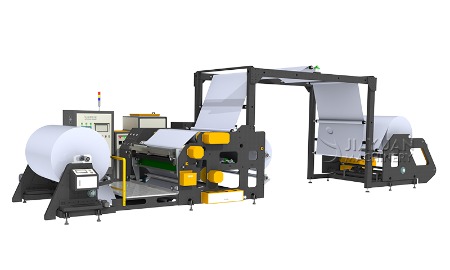
Adhesive coating machine
The adhesive types for film coating depend on the end-use. For pressure-sensitive tapes and labels, PSAs (acrylic, rubber-based, or silicone) are applied at 10-50 gsm using slot die or comma blade. For flexible packaging, laminating adhesives (polyurethane, acrylic) are applied at 1-10 gsm via gravure or roll coating. For protective films, low-tack PSAs are applied at 5-15 gsm. For heat-seal coatings, hot melt or water-based formulations are used. The adhesive must have good wetting on the film surface, which may be non-polar (e.g., PE, PP), often requiring primers or corona treatment. The coat weight uniformity is critical to avoid optical defects (e.g., haze) and performance variations. Inline gauges (beta, X-ray, NIR) provide real-time coat weight feedback, with cross-web profile correction actuators. The coating head must be precisely aligned to avoid streaks from die lip scratches or roll imperfections. Temperature control for hot melt is essential to maintain viscosity; for water-based, the viscosity must be controlled by solids content and temperature.
The drying or cooling section is tailored to the film and adhesive. For solvent-based adhesives, the drying oven must evaporate solvents efficiently without overheating the film; typically, multiple zones with ascending temperatures and air impingement are used, with solvent recovery systems. For water-based adhesives, the oven uses high airflow and moderate temperatures; the film may need to be constrained to prevent wrinkling from moisture absorption. For hot melt adhesives, cooling is achieved by passing the coated film over chilled rolls (5-15°C) which rapidly solidify the adhesive; this eliminates ovens and reduces line length. In some lines, a lamination station follows the drying/cooling to combine the coated film with a second substrate or a release liner. The lamination nip applies pressure and often heat (for heat-activated adhesives) to ensure intimate contact. The finished laminate is rewound with precise tension and lay-on roller pressure to produce rolls without blocking or telescoping. Edge trimming and slitting may be integrated to produce customer-ready rolls.
Process control in film coating emphasizes coat weight, film temperature, and tension. The film's temperature must be maintained within its glass transition and melting ranges; excessive heat causes shrinkage or elongation. Tension must be low enough to prevent stretching but high enough to avoid flutter; tension zones are individually controlled. The adhesive supply system (pumps, hoses, and dies) must be free of contamination and gels that cause coating defects. Inline vision systems inspect for pinholes, streaks, and contamination. Film surface cleanliness is maintained by ionized air cleaners or vacuum systems. Quality testing includes peel adhesion (to specified surfaces), tack, shear, and optical properties (haze, clarity, color). For packaging films, seal strength and coefficient of friction are tested. The line includes automatic splicing for continuous operation and waste removal systems. Data acquisition systems record all parameters for each roll, enabling traceability and process improvement.
Applications of film coating are extensive. In the tape industry, BOPP packaging tapes, masking tapes, and double-sided tapes are produced on film coaters. In labels, film labelstock (clear or white) is coated with PSA and laminated to a release liner. In flexible packaging, film coating and lamination produce multi-layer structures for food and medical packaging. In protective films, PE and PET films are coated with low-tack PSA for surface protection during transport and installation. In electronics, PI films are coated with silicone adhesives for high-temperature masking tape. The trend toward thinner films and higher performance adhesives drives the need for more precise coating technologies, such as slot die, and for inline surface treatments. Sustainability concerns push for recyclable film/adhesive combinations and water-based adhesives. Automation and Industry 4.0 features are being integrated to monitor and optimize coating processes in real-time. In summary, film coating is a high-precision, high-speed manufacturing process that is critical to many adhesive product categories, requiring careful material selection, equipment design, and process control to achieve consistent quality and performance.