foil coating
Foil coating refers to the application of adhesive layers onto metallic foils (e.g., aluminum foil) or metallized films (e.g., vapor-coated PET) for packaging, insulation, decorative laminates, and electronics. Coating foils provide barrier properties, heat sealability, and adhesion for lamination to other substrates. This article provides a comprehensive technical overview of foil coating technologies, adhesive types, application methods, process challenges, and quality control.
Foil substrates are thin, non-porous, and often delicate, posing challenges for adhesive coating. Aluminum foil, typically 6-30 µm thick, is widely used in pharmaceutical and food packaging for its excellent barrier to oxygen, moisture, and light. Metallized films (e.g., vacuum-metallized PET or OPP) have a thin metal layer (typically 20-100 nm) on a plastic film, offering similar barrier at lower cost and weight. Coating foils with adhesives enables lamination to other films (e.g., PE, PP) for heat-sealable pouches and blister packs, or for creating decorative foils for labels and gift wrap. The adhesive must provide strong bond to the metallic surface, which has low surface energy, and must be compatible with the metal's limited elongation. Coating methods include gravure, reverse roll, and slot die, often using solvent-based or solventless adhesives. Line speeds range from 50 to 300 m/min, with web widths up to 1600 mm. Foil coating lines require careful tension control to avoid tearing or stretching the delicate metal.
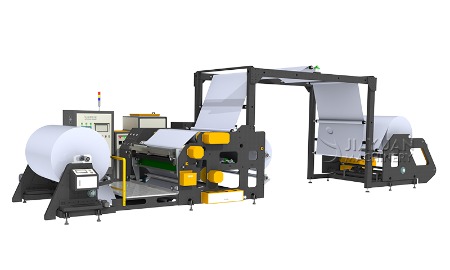
Adhesive coating machine
The adhesives used for foil coating are selected based on the final laminate's requirements. For food packaging, the adhesive must comply with FDA and EU regulations for direct food contact (if the foil is the inner layer) or indirect contact. Polyurethane adhesives (solvent-based or solventless) are common for lamination, providing good bond strength and resistance to heat and chemicals. Water-based acrylic adhesives are used for less demanding applications and lower VOC. Hot melt adhesives are used for heat-seal coatings on foil, where the adhesive is applied and then activated by heat during packaging. For decorative foils, pressure-sensitive adhesives are applied onto the foil backing for label applications. The adhesive coat weight typically ranges from 2 to 10 gsm for laminating, and 10-30 gsm for PSA applications. The coating must be applied uniformly to avoid pinholes or streaks that compromise barrier properties. In addition, the adhesive must not react with the foil or cause corrosion over time.
The coating process for foil requires specialized equipment to handle the non-porous, low-stretch substrate. Gravure coating is widely used for solvent-based adhesives on foil, as it applies a very thin, uniform layer (1-5 gsm) at high speeds. Reverse roll coating is also used for medium-viscosity adhesives, providing good coat weight control. Slot die coating is becoming more common for precision applications, especially for solventless adhesives, as it minimizes waste and provides excellent uniformity. The coating head must be precisely aligned to avoid scratching the foil. The drying oven for solvent-based lines must be designed with gentle airflow to prevent foil flutter and wrinkles; the oven length is typically 20-40 m. For solventless adhesives, no drying is needed; instead, the coated foil is immediately laminated and then cured in a heated section or at room temperature. Tension control is critical: low tension prevents stretching but must be sufficient to keep the foil flat. Web cleaning (e.g., ionized air) is often used to remove dust and static electricity that cause coating defects. The lamination nip applies pressure to bond the foil to the second substrate, with careful pressure and temperature settings to avoid crushing the foil.
Quality control for foil coating includes checking the adhesive coat weight, barrier integrity, and bond strength. Coat weight is measured online by beta or X-ray gauges; the metallic nature of the foil can interfere with measurement, so proper calibration is required. Pinholes in the coating are detected by inline vision systems or by electrical conductivity tests (for conductive foils). Bond strength is measured by peel tests on laminated samples; the failure mode must be cohesive within the adhesive, not adhesive failure at the foil interface, which would indicate poor wetting or contamination. The foil's appearance must be free of scratches, wrinkles, and oxidation. The adhesive must also be tested for migration through the foil, especially for food contact, using gas chromatography or other analytical methods. Data logging ensures traceability. The coating line often includes an unwind and rewind with turrets for continuous operation, and edge trimming to remove uncoated or damaged edges. Maintenance includes regular cleaning of rolls and dies to prevent adhesive build-up, and inspection of foil handling rollers for any damage that could mark the foil.
Applications of foil coating are numerous. In pharmaceutical packaging, foil coated with heat-seal adhesive is used for blister packs. In food packaging, foil laminates with PE or PP provide shelf-stable pouches for dry foods, liquids, and pet food. In decorative foils, coatings include PSAs for labels and transfer foils for hot stamping. In electronics, foil-coated films are used for flexible circuits and EMI shielding. In construction, foil-faced insulation uses adhesive lamination for vapor barriers. The trend toward sustainability drives the development of recyclable foil laminates and water-based adhesives, as well as thinner foil gauges to reduce material use. Additionally, high-barrier coatings (e.g., silicon oxide or aluminum oxide) are being applied via vacuum deposition, but adhesive coating remains essential for lamination. Automation and inline quality systems are improving the efficiency and reliability of foil coating lines. In summary, foil coating is a specialized process that demands precise control over adhesive application, tension, and drying to achieve defect-free, high-barrier composites for critical packaging and industrial applications.