full width coating
Full width coating is the application of adhesive uniformly across the entire width of the substrate web, from one edge to the other, without any uncoated areas or intentional gaps. This is the most common and fundamental coating method for adhesive tapes, labels, packaging laminates, and many other web-based products where complete adhesive coverage is required for bonding, sealing, or surface protection. This article provides a comprehensive technical overview of full width coating, including its principles, methods, equipment requirements, process control, and quality considerations.
In full width coating, the adhesive layer covers 100% of the usable web width, typically with a slight uncoated margin (5-15 mm) on each edge that is later trimmed away to remove edge bead or to create a clean edge for handling. The coating must be uniform across the entire width, with coat weight variation typically within ±2-5%, depending on the application. The key coating methods used for full width application include slot die, comma blade, gravure, and roll coating. Slot die is the most precise, offering coat weight uniformity within ±1-2%, and is the preferred choice for high-performance hot melt PSAs. Comma blade is widely used for water-based and solvent-based adhesives on paper and film, providing good uniformity at moderate speeds. Gravure coating is used for very thin, uniform layers such as silicone release coatings. Roll coating, including reverse roll, is versatile for medium to high viscosities. The choice of method depends on the adhesive viscosity, coat weight, required precision, and line speed. The coating head must be set to the correct gap and alignment to achieve full coverage without streaks or edge defects.
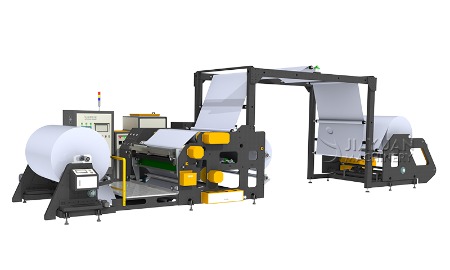
Adhesive coating machine
The equipment for full width coating must be precisely engineered to ensure uniform flow across the entire width. For slot die coating, the die manifold must be designed to deliver equal pressure across the width, and the lip gap must be uniform within microns. The shim must be cut to the exact width of the desired coating, with edge dams to prevent flow beyond the intended area. The die gap (distance from lip to substrate) is set uniformly across the width; any tilt or misalignment will cause one side to be coated thicker or thinner. For comma blade coating, the blade must be straight and parallel to the backup roll, with a uniform gap set by micrometer screws across the width. The blade's surface must be flawless to avoid streaks. For gravure coating, the engraved cylinder must have uniform cell geometry across the width, and the doctor blade must be straight and apply uniform pressure. The backup roll must be true and have a consistent surface. In all cases, the substrate must be fed with correct tension and edge guidance to ensure it remains centered and wrinkle-free.
Process control for full width coating focuses on maintaining coat weight uniformity and edge quality. Online gauges (beta, X-ray, or NIR) scan across the web to provide a profile of the coat weight. The gauge data is used in a closed-loop control system that adjusts the pump flow (for slot die) or the gap (for blade or roll coaters) to maintain the target average coat weight. For cross-web profile correction, advanced slot dies have thermal actuators that can locally adjust the lip gap based on the profile data, correcting center-thick or edge-thick patterns. For comma blade coaters, the blade gap can be adjusted at multiple points using motorized micrometers to flatten the profile. Edge bead control is a common challenge in full width coating; edge air knives, edge guides, or die lip relief are used to reduce the thicker adhesive deposit at the edges. The edge bead is typically trimmed off after coating; the trim width is kept as narrow as possible to minimize waste.
Quality control for full width coating includes visual inspection, coat weight measurement, and adhesive performance testing. Visual inspection detects streaks, skips, and contamination. Coat weight is measured both online (continuously) and offline (gravimetric samples) to verify accuracy and uniformity. The coat weight profile is analyzed for standard deviation and range; a process capability index (Cpk) of >1.33 is typically required. The edge trim is checked to ensure it is free of edge bead and consistent in width. The adhesive's final properties (peel, tack, shear) are tested on samples from the coated roll to ensure they meet specifications. Full width coating is the foundation of many adhesive products, and its reliability is essential for customer satisfaction. The trend in full width coating is toward even tighter tolerances, higher speeds, and improved edge control to reduce waste. Inline sensors and machine learning are being deployed to predict and correct coat weight variations in real-time. In summary, full width coating is the workhorse of the adhesive coating industry, providing reliable, uniform coverage for a vast array of products, and its continuous improvement drives productivity and quality in the converting sector.