gravure coating machine
A gravure coating machine is a precision industrial system that uses an engraved cylinder to apply a uniform layer of coating material onto a substrate. The engraved cylinder contains thousands of tiny cells (dimples) that pick up the coating from a pan, with a doctor blade removing excess coating so that only the fluid in the cells is transferred to the substrate. This method offers exceptional coat weight uniformity and is widely used for applying adhesives, varnishes, primers, and functional coatings in the packaging, label, and converting industries. This article provides a detailed technical overview of gravure coating machine technology, including working principles, process parameters, advantages, and application considerations.
The working principle of a gravure coating machine is based on the transfer of coating material from the engraved cells of a rotating cylinder to a moving substrate. The cylinder is partially immersed in a coating pan, and as it rotates, the cells fill with fluid. A doctor blade (typically a flexible steel blade) contacts the cylinder surface, scraping off any excess coating from the lands (the smooth surface between cells), leaving only the fluid in the cells. The substrate is pressed against the cylinder by a rubber-covered backup roll, and the coating is transferred from the cells to the substrate via capillary action and pressure, typically achieving 60-80% transfer efficiency. The coat weight is determined by the cell volume (depth, width, and pattern), the number of cells per inch (line screen), and the fluid rheology, making gravure coating one of the most repeatable coating methods.
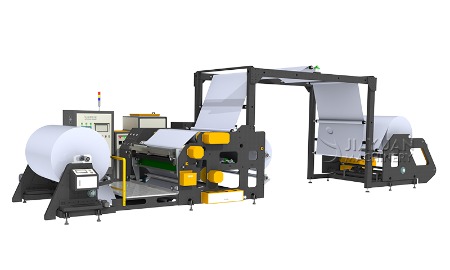
Adhesive coating machine
Gravure coating machines offer several distinct advantages. They provide extremely uniform coat weight across the full web width, with variation typically within ±2-3%, and can achieve very thin coatings from 0.5 to 10 gsm. The process is highly repeatable because the engraved cylinder geometry defines the coating amount, independent of viscosity variations within a reasonable range. Gravure coaters can operate at high speeds (up to 300-600 m/min) and are suitable for both solvent-based and water-based coatings. They also enable pattern coating, as the engraved cells can be designed to create specific patterns (e.g., grid lines, dots) for decorative or functional purposes. Additionally, gravure coating produces a smooth, defect-free surface with excellent optical properties, making it the preferred method for high-quality printed and coated products.
However, gravure coating machines also have limitations. The engraved cylinders are expensive to manufacture, typically costing $1,000-5,000 per cylinder, and each cylinder is custom-made for a specific coating weight, limiting flexibility. Changing the coat weight requires changing the cylinder, which is time-consuming and costly. The coating process is sensitive to substrate surface properties, and poor substrate wetting can cause pinholes or skips. The doctor blade must be precisely set to avoid streaks or excessive wear. The cells can become clogged with dried coating material, requiring regular cleaning and maintenance. Gravure coating is generally not suitable for high-viscosity fluids (>2,000 cP) or for very heavy coatings (>20 gsm) due to limited cell volume. Despite these limitations, gravure coating remains a dominant technology for many applications where precision and uniformity are paramount.
Typical applications of gravure coating machines in the adhesive industry include the application of solvent-based pressure-sensitive adhesives for tapes and labels, silicone release coatings on liners, and various laminating adhesives for flexible packaging. In the packaging sector, gravure coaters apply primers, heat-seal coatings, and cold-seal adhesives on films and foils. The graphic arts industry uses gravure coating for applying varnishes and protective coatings on printed products. Other applications include optical films, medical products (e.g., transdermal patches), and specialty papers. Modern gravure coating machines incorporate automated roll loading, quick-change doctor blade systems, and closed-loop coat weight control using gauging sensors. The trend toward solvent-free and water-based coatings is driving innovation in gravure cylinder design and doctor blade materials to handle more demanding fluids. Gravure coating remains an essential technology for high-precision, high-speed coating operations across numerous industrial sectors.