high speed coating
High speed coating refers to the operation of adhesive coating lines at elevated substrate speeds, typically above 300 m/min for hot melt PSAs and above 100 m/min for solvent-based and water-based systems, with some advanced lines exceeding 800 m/min. High speed coating is a key strategy for maximizing production throughput, reducing unit costs, and meeting the growing demand for adhesive tapes, labels, and packaging materials. This article provides a comprehensive technical overview of high speed coating, including its requirements, enabling technologies, challenges, and best practices for achieving consistent quality at elevated speeds.
The primary driver for high speed coating is economic: running a coating line at higher speeds increases the output per hour, reducing the cost per square meter of coated product. For a given line width and coat weight, doubling the line speed doubles the production rate, potentially halving the conversion cost. However, high speed operation imposes stringent requirements on every component of the coating line. The coating head must maintain uniform coat weight at high shear rates; the drying or cooling system must have sufficient capacity to remove solvents or solidify the adhesive at the elevated speed; the web handling system must keep the substrate stable without flutter or breaks; and the control system must respond quickly to any perturbations. Achieving high speed coating requires a holistic design approach that considers material, machine, and process interactions.
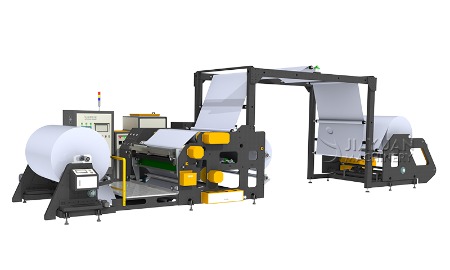
Adhesive coating machine
Enabling technologies for high speed coating include advanced coating heads, high-capacity drying/cooling, and sophisticated control systems. Slot die coating is the preferred method for high speed due to its stable bead and precise metering; it can operate at speeds up to 600 m/min for hot melt PSAs and even higher for solventless systems. The die gap and lip geometry are optimized to prevent air entrainment at high speeds; vacuum boxes upstream of the die are often used to remove the boundary layer of air that would otherwise be trapped. For drying ovens, high speed requires longer ovens or higher temperatures and airflow to achieve the required residence time; impingement air with velocities of 20-30 m/s is common. For hot melt coating, chill rolls must be sized to provide adequate cooling contact; multiple chill rolls with large diameters are used. The web handling system must have high-accuracy tension control with fast response; servo-driven rolls with low inertia and high torque are essential. The control system must have high-speed communication (e.g., EtherCAT) and fast PID loops to adjust parameters in milliseconds.
At high speeds, several coating defects become more pronounced. Air entrainment is the most critical; the boundary layer of air dragged by the substrate can cause pinholes or incomplete coating. Solutions include reducing the die gap, increasing the vacuum, or using a die with a specially designed lip profile. High shear rates at the coating bead can cause non-Newtonian viscosity changes; the adhesive must be formulated to be shear-stable and to have a viscosity that remains within the coatable range at high shear. Edge bead and edge stringing become more severe; advanced edge air knives and die lip treatments are needed. Web flutter, especially in the drying oven, can cause scratches or coating skips; tighter tension control and air flotation ovens (where the web floats on a cushion of air) are used to stabilize the web. The substrate itself must have sufficient strength to withstand the increased tension and speed without breaking; thicker or stronger substrates are preferred. Splice integrity is paramount; high-speed splices must withstand the tension and not cause a break.
Best practices for high speed coating include careful material selection, rigorous machine maintenance, and continuous process optimization. The adhesive's viscosity and solids content should be optimized for high-speed application; lower viscosities generally allow higher speeds. The substrate should have low elongation to prevent stretching. The coating line must be kept in top condition; worn die lips, rolls, or bearings cause defects that are magnified at high speed. Regular cleaning and condition monitoring are essential. The process parameters (temperature, gap, flow rate) should be fine-tuned using design of experiments (DOE) to find the maximum speed without quality degradation. Machine learning algorithms can analyze historical data to predict optimal settings and detect early signs of defects. High speed coating lines also benefit from automatic splicing and turret rewinders to enable continuous operation, maximizing the uptime. In summary, high speed coating is a key competitive advantage in the adhesive industry, enabling high-volume production at low cost. It requires a robust machine design, precise process control, and diligent maintenance, but the rewards in productivity and profitability are substantial for manufacturers who master this capability.