high viscosity coating
High viscosity coating refers to the application of adhesives and coating fluids with viscosities typically above 10,000 centipoise (cP), often ranging up to 100,000 cP or more, including pastes, mastics, and highly filled systems. These materials are used for structural adhesives, sealants, thick PSA layers for mounting tapes, and protective coatings where high bond strength, gap-filling capability, or durability is required. Processing high viscosity materials presents significant challenges in flow delivery, coating uniformity, and equipment design, requiring specialized pumps, heating systems, and coating heads. This article provides a comprehensive technical overview of high viscosity coating, including applicable methods, equipment modifications, process parameters, and typical applications.
The primary challenge in high viscosity coating is achieving a uniform, defect-free layer at acceptable production speeds. High viscosity fluids resist flow, requiring high pressures to pump and distribute them through the coating head. They also tend to have non-Newtonian behavior, often exhibiting shear thinning (viscosity decreases with increasing shear rate) or yield stress (requiring a minimum stress to start flowing). Understanding the rheology of the adhesive is essential for designing the coating system. For instance, at the high shear rates in the coating bead or die slot, the viscosity may drop significantly, which can improve flow but also affect the coating thickness. The coating method must be selected to handle the high viscosity; roll coating (especially reverse roll) is commonly used because the shearing action of the rolls can help meter thick fluids. Slot die coating can also process high viscosities, but requires high-pressure pumps and robust die construction to avoid deflection. Comma blade coating is suitable for paste-like materials, provided the blade is rigid and the backup roll is sufficiently hard. Spray coating is generally not feasible for high viscosity materials without dilution.
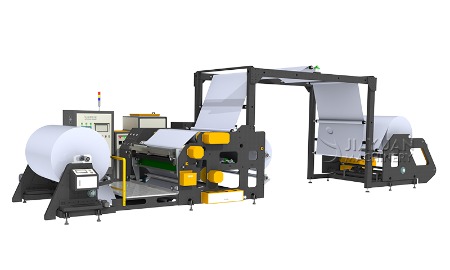
Adhesive coating machine
Equipment modifications for high viscosity coating include the use of heavy-duty gear pumps with large gear teeth and tight clearances, often with heating to reduce viscosity to a pumpable range. The piping and hoses must be short and of large diameter to minimize pressure drop, and they must be heated (for hot melt or warm adhesives) to maintain fluidity. The coating head, whether a slot die or a roll coater, must be stiffer and more robust to withstand the high pressures; slot dies may require thicker bodies and bolted construction to prevent distortion. The die lip gap must be wider to accommodate the high flow rate without generating excessive pressure; typical gaps for high viscosity are 0.5-2.0 mm. The backup roll must be hard (e.g., chrome-plated steel) to resist deflection under high nip pressures. In some cases, the coating is applied by extrusion, where the material is forced through a die at high pressure and then smoothed by a roller or blade. For very high viscosities (paste-like), a screw extruder may be used as the pump, providing both pressure and mixing.
Process parameters for high viscosity coating must be carefully optimized to avoid defects. The temperature is a critical parameter; heating the adhesive reduces viscosity and improves flow, but excessive heat may cause thermal degradation or crosslinking. A typical temperature range for high viscosity hot melts is 150-200°C, while for structural adhesives it may be 50-80°C. The coat weight for high viscosity materials is often high, typically 50-200 gsm or more, which reduces the relative sensitivity to coat weight variations but requires more material and longer drying or curing times. The line speed is generally slower than for low viscosity fluids, often 10-100 m/min, due to the longer residence time needed for drying or curing. The coating gap (between die lip and substrate) must be set precisely; a larger gap reduces pressure but may lead to sagging or dripping. Edge control is especially challenging for high viscosity fluids because they tend to form thick edge beads; edge air knives or edge guides are essential. The drying or curing system must be capable of removing solvents or crosslinking the thick layer; for hot melt, chill rolls must provide adequate cooling to solidify the thick layer completely.
Defects common in high viscosity coating include streaks (due to die lip contamination or uneven flow), edge beads (thick edges), orange peel (poor leveling), and air entrapment (bubbles). Streaks can be mitigated by frequent die cleaning and using filters to remove gels and particles. Edge beads are controlled by edge air knives, die lip relief, or by trimming the edges. Orange peel is reduced by optimizing the coating gap and temperature to improve leveling; adding leveling agents to the formulation may also help. Air entrapment is prevented by degassing the adhesive before coating and by using a vacuum chamber or by ensuring the feed system is airtight. The substrate must be strong enough to withstand the high tension and pressure; thick films or paper are preferred. Quality control includes coat weight measurement (using beta or X-ray gauges, but with calibration for high density), visual inspection, and peel/shear testing. In summary, high viscosity coating is a specialized area that requires robust equipment, careful process design, and a thorough understanding of fluid rheology. When properly executed, it enables the production of high-performance adhesive products that offer superior bond strength, gap filling, and durability for demanding applications in construction, automotive, and heavy-duty industrial uses.