hot melt adhesive coater
A hot melt adhesive coater is an industrial machine that applies 100% solid thermoplastic adhesives in a molten state onto substrates, with the adhesive solidifying upon cooling to form a strong bond. These coaters are widely used in the production of pressure-sensitive tapes, labels, packaging, nonwoven hygiene products, and medical dressings. This comprehensive article covers the working principles, machine configurations, process parameters, and application considerations for hot melt adhesive coaters.
The fundamental principle of a hot melt adhesive coater is straightforward: solid thermoplastic adhesive is heated to a molten state (typically 100-200°C), applied to the substrate through a coating head, and then cooled to solidify. Unlike solvent-based or water-based systems, hot melt coaters require no drying step because the adhesive is 100% solids—there is no carrier to evaporate. This results in several significant advantages: compact machine footprints (no drying ovens), high production speeds (300-600 m/min), low energy consumption, and zero VOC emissions. The adhesive solidifies within seconds upon contact with a chill roll or at ambient temperature, enabling immediate downstream processing.
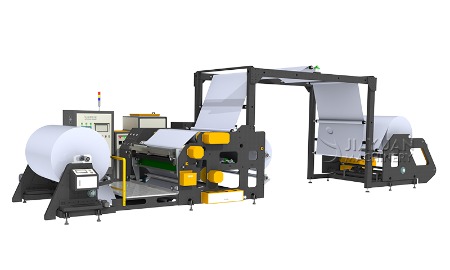
Adhesive coating machine
Hot melt adhesive coaters employ various coating methods, each suited for specific applications and adhesive properties. Roll coating is the simplest method, using counter-rotating rolls to transfer adhesive from a reservoir to the substrate through a film-splitting process. Gravure coating uses an engraved cylinder to apply a patterned or uniform coating, with a doctor blade removing excess adhesive from the roll surface. Slot die coating is the most precise method, using a closed die assembly with a narrow slot to apply molten adhesive with thickness uniformity within ±1%. Spray coating applies adhesive as a fine mist, suitable for low coat weights and non-contact applications. The choice of coating method depends on the required coat weight, precision, speed, and adhesive rheology. Slot die coating is preferred for high-precision applications such as PSA tapes and labels, while roll coating is often used for heavier coatings and less demanding applications.
A typical hot melt adhesive coater consists of several key subsystems. The melt system heats the solid adhesive to the application temperature, typically using a grid melter or tank melter with precise temperature control. The adhesive is pumped through heated hoses to the coating head using a gear pump that provides precise volumetric metering. The coating head applies the molten adhesive to the substrate, with the specific design varying by coating method. For slot die coating, the die includes an internal manifold that distributes adhesive uniformly across the web width. After coating, the substrate passes over a chill roll (typically 5-15°C) that rapidly cools and solidifies the adhesive. The machine also includes unwind and rewind stations with tension control systems, and may include laminating stations for combining multiple layers.
Process control is critical for hot melt adhesive coaters to maintain consistent product quality. Temperature must be precisely controlled at every point from the melt tank through the hoses to the die, with variations of even a few degrees affecting adhesive viscosity and coat weight. Coat weight is controlled by adjusting the gear pump speed relative to line speed, with closed-loop systems using beta or X-ray gauges for real-time feedback. The coating gap between the die and substrate must be precisely set and maintained, as gap variations directly affect coat weight. For slot die coating, the die lip gap must be adjusted to achieve uniform flow across the web, with die lip flatness lapped to within 0.2 µm per 100 mm. Hot melt adhesive coaters are used across numerous industries including packaging (tapes, labels, carton sealing), hygiene (diapers, feminine care), medical (dressings, patches), automotive (interior components, sound deadening), and construction (insulation, membranes).