hot melt coating vs solvent coating
Hot melt coating and solvent coating represent two fundamentally different approaches to applying adhesives and coatings onto substrates. Hot melt coating uses 100% solid thermoplastic polymers that are melted and applied as a liquid, then solidify upon cooling. Solvent coating dissolves the polymer in an organic solvent to reduce viscosity, applies the solution, and then evaporates the solvent in a drying oven, leaving behind the solid coating. The choice between these technologies impacts production line design, energy consumption, environmental compliance, product quality, and operating costs. This article provides a comprehensive technical comparison to help manufacturers decide which system suits their needs.
The equipment footprint and line configuration differ dramatically between the two technologies. In a hot melt coating machine, the adhesive is melted in a heated tank, pumped through a heated hose, and applied via a slot die, roll coater, or spray head. The coated substrate passes over chill rolls to solidify the adhesive. The entire line is compact—typically 5 to 15 meters in length. In a solvent-based coating machine, the coating solution is prepared in a mixing tank, pumped to a coating head (usually reverse roll or gravure), applied to the substrate, and then the web travels through a long drying oven (often 20 to 60 meters) with multiple heated zones and exhaust air systems to remove and recover or incinerate solvent vapors. The line also requires solvent recovery or abatement equipment (carbon adsorbers, thermal oxidizers), increasing floor space significantly (up to 100 meters total). This difference in footprint has major implications for factory layout, capital cost, and installation complexity.
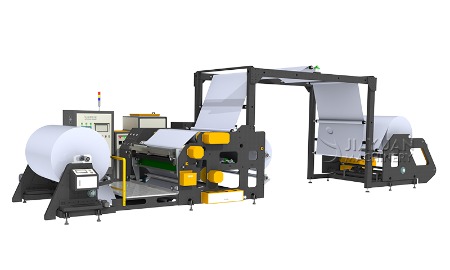
Adhesive coating machine
Key performance and quality differences between hot melt and solvent coating are substantial. Hot melt can achieve coat weights from 2 to 200 gsm, while solvent-based can achieve thinner layers (0.5-50 gsm) due to dilution. However, solvent-based coatings can suffer from "solvent popping" if drying is too fast, and solvent retention can be problematic for food or medical applications. Hot melt provides instant bond strength upon cooling, while solvent-based may require post-curing. In terms of line speed, hot melt can run 200-800 m/min, whereas solvent-based is often limited by drying capacity to 50-200 m/min. Hot melt slot die coating achieves thickness uniformity of ±0.001mm and coat weight variation of ±1-2% due to precise volumetric metering of gear pumps. Solvent-based coating, typically using gravure or roll coaters, has higher variation (±5-10%) because solvent evaporation can cause uneven solid deposition (coffee ring effect) and the adhesive solids content (20-50%) leads to inconsistencies if drying conditions fluctuate. For ultra-thin coatings (e.g., 1 gsm silicone release liners), solvent-based remains dominant, but for most PSAs (10-50 gsm), hot melt provides superior consistency.
Environmental and safety considerations are a major factor in technology selection. Solvent-based coating machines emit volatile organic compounds (VOCs), which contribute to air pollution and require expensive abatement systems (thermal oxidizers running at 700-900°C, consuming large amounts of natural gas). Operators are exposed to solvent vapors, necessitating explosion-proof electrical components, specialized ventilation, and personal protective equipment. Solvent waste disposal is costly. In contrast, hot melt machines are solvent-free, emit negligible VOCs, have no explosion risk (except for dust), and require only standard industrial ventilation. Many countries are tightening VOC regulations, making hot melt increasingly preferred. However, some high-performance coatings (e.g., certain silicones, fluoropolymers) are not available as hot melts, requiring solvent-based application. Substrate compatibility also differs: solvent-based coating machines can handle heat-sensitive films like LDPE and PVC because they operate at ambient to 80°C. Hot melt coating requires the substrate to withstand 100-200°C for at least 0.1-1 second; thin polyolefin films may distort, though paper is fine for both.
Energy consumption and operating costs show a dramatic difference between the two technologies. A 1600mm wide solvent-based coater running at 150 m/min with a drying oven consumes approximately 500-800 kW of energy (electrical + gas for heating air, plus exhaust fans). The same width hot melt coater at 300 m/min uses only 30-60 kW for heating and drives. Over 8,000 operating hours per year, this difference translates to annual energy costs of $40,000-80,000 for hot melt versus $400,000-640,000 for solvent-based. Furthermore, solvent-based machines require thermal oxidizers or solvent recovery systems, which add 30-50% capital cost and additional energy. Hot melt produces zero VOCs and has lower maintenance costs due to the absence of solvent-related corrosion and sealing issues. However, hot melt adhesives may have different performance characteristics: studies have shown that solvent-coated PSAs can have superior shear holding power, while hot-melt-coated PSAs perform better in tack and peel tests, due to differences in microstructure resulting from the quick cooling process. The choice between hot melt and solvent coating ultimately depends on the specific product requirements, regulatory environment, and economic considerations, with hot melt being the preferred choice for most new installations in regulated areas.