hygiene adhesive coating
Hygiene adhesive coating refers to the application of pressure-sensitive adhesives onto nonwoven and film substrates for disposable hygiene products such as diapers, adult incontinence pads, feminine hygiene products, and surgical drapes. These adhesives provide secure attachment of components (e.g., tapes, elastic strands, and acquisition layers) while remaining skin-friendly and compatible with high-speed production. This article provides a comprehensive technical overview of hygiene adhesive coating technologies, adhesive types, application methods, process parameters, and quality considerations.
In disposable hygiene products, adhesives are used for several functions: construction adhesives (bonding layers like topsheet, acquisition layer, and backsheet), elastic attachment (holding elastic strands for leg cuffs and waistbands), and fastening adhesives (for tape tabs and closures). Each application requires a specific adhesive formulation and coating method. Construction adhesives are typically applied in a spiral or spray pattern to provide open coverage with breathability. Elastic attachment adhesives are often applied as continuous or intermittent glue lines to hold stretched elastics in place. Fastening adhesives (PSA tapes) are coated onto film or nonwoven tabs for secure but adjustable closure. The coating equipment for hygiene adhesives is designed for high-speed production, typically 200-600 m/min, with web widths up to 1200 mm. The coating methods include slot die, spiral spray, and meltblown application, depending on the pattern and coat weight needed.
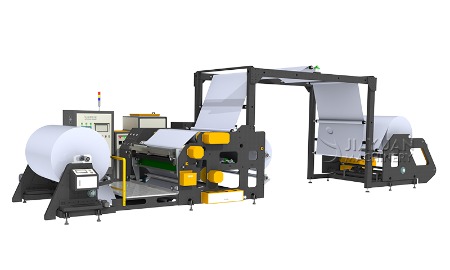
Adhesive coating machine
Hot melt adhesives are the predominant type for hygiene applications due to their 100% solids content, fast setting, and low VOC emissions. They are based on styrenic block copolymers (SBC), polyolefins, or blends, with tackifiers and plasticizers to achieve the desired balance of tack, peel, and shear. Application temperatures typically range from 140°C to 180°C, and viscosity is controlled within 500-5,000 cP for spray and slot die application. For construction adhesive, coat weights are typically 1-5 gsm, applied in spiral or Omega patterns to maximize coverage while minimizing adhesive usage. Elastic attachment requires higher coat weights (5-15 gsm) to secure the elastic strands, often with a continuous bead or slot coating. Fastening tapes use PSA with coat weights of 20-40 gsm, applied as a full coating onto a carrier film. The coating equipment must handle these varying coat weights and patterns efficiently, with rapid changeover capabilities.
The application methods for hygiene adhesives are specialized. Spiral spray uses a multi-hole nozzle that creates a spiral pattern of adhesive fibers, providing excellent coverage with low coat weight and breathability. It is commonly used for construction bonding of nonwoven layers. Meltblown application uses multiple nozzles to produce fine filaments that create a web-like pattern, suitable for high-coverage applications. Slot die coating is used for continuous film coatings, such as for fastening tapes, providing precise, uniform coat weight. In all cases, the adhesive is applied in a molten state and solidifies upon cooling, with the bond strength developing almost instantly. The substrate (nonwoven or film) passes over a chill roll or through a cooling section to set the adhesive and prevent blocking. The line speed is synchronized with the adhesive pump to maintain consistent coat weight; closed-loop control uses a gauge (e.g., NIR for coat weight) to correct variations. The coating heads are designed with quick-change features to switch between different adhesive formulations and patterns for different product types.
Process control in hygiene adhesive coating focuses on coat weight uniformity, pattern consistency, and web handling. Coat weight variations of more than ±5% can cause delamination or adhesive bleeding. Spiral spray pattern width and coverage must be consistent to avoid voids or excessive adhesive that stiffens the product. Web tension is kept low to avoid stretching nonwovens, but sufficient for stable transport. The adhesive supply system (melt tank, hoses, and applicator) must maintain temperature within ±1°C to prevent viscosity drift. Inline cameras monitor adhesive patterns and detect misses or irregularities. The coated substrate is then joined with other components (e.g., absorbent core, topsheet) in the diaper converting machine, which is often integrated with the coating line. Quality testing includes peel strength, shear adhesion, and creep resistance of the applied adhesive, as well as sensory evaluation for tack and skin feel. The adhesive must also resist migration, which can cause staining or skin irritation. For fastening tapes, the release liner must provide controlled release force.
Hygiene adhesive coating is a large-volume, cost-sensitive application, driving continuous improvement in adhesive formulation and coating efficiency. Manufacturers are reducing coat weights to save material costs while maintaining performance. Bio-based and biodegradable adhesives are being developed in response to sustainability demands. Additionally, the trend toward thinner, more breathable diapers requires adhesives that can be applied at even lower coat weights without compromising bond strength. The coating equipment is evolving with better temperature control, faster changeovers, and advanced process monitoring to minimize waste and downtime. Some lines now incorporate intelligent systems that adjust application parameters in real-time based on substrate variations. In summary, hygiene adhesive coating is a specialized, high-speed process that is essential for producing comfortable, reliable, and cost-effective disposable hygiene products, with ongoing innovation aimed at improving performance and environmental footprint.