inline coating
Inline coating refers to the integration of the adhesive coating process with upstream operations (such as printing, surface treatment, or substrate preparation) and downstream converting processes (such as lamination, slitting, or packaging) within a single, continuous production line. This integration eliminates intermediate handling and storage, reducing labor, minimizing defects, and significantly increasing overall production efficiency. This article provides a comprehensive technical overview of inline coating systems, their configurations, benefits, challenges, and applications in adhesive converting industries.
Inline coating systems are designed to perform multiple operations in one pass, from the unwinding of the raw substrate to the delivery of finished rolls. A typical inline coating line for labels or tapes may include: an unwind stand with automatic splicing, a corona treater (to increase substrate surface energy), a primer coating station (if required), a primary adhesive coating head (slot die, comma blade, or gravure), a drying oven or cooling section, a lamination station (for applying a facestock or release liner), an optional slitting station to cut the web into multiple narrower rolls, and a turret rewind. The entire line is controlled by a central PLC that synchronizes speeds, tensions, and temperatures across all modules. Inline coating is distinct from "offline" processes where coating is performed separately, and the coated rolls are stored and later converted. By eliminating intermediate roll handling, inline coating reduces the risk of contamination, scratches, and telescoping, while also saving floor space and labor.
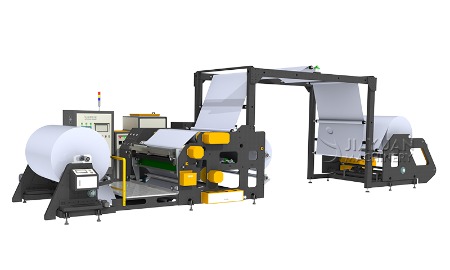
Adhesive coating machine
The primary benefits of inline coating are increased productivity, reduced waste, and improved quality. Because the web is not rewound between steps, defects caused by handling are minimized. The continuous nature allows for higher line speeds (up to 600 m/min or more) because there are no stops for roll changes at intermediate stages when automatic splicing is used. Quality is improved because in situ monitoring (coat weight gauges, vision inspection) can be applied at multiple points, with immediate feedback to adjust parameters. For example, if the coat weight gauge detects a deviation, the pump speed can be adjusted before the defective section reaches the lamination or rewind, reducing scrap. Inline lamination ensures that the adhesive is still active (for hot melt) or properly dried, leading to stronger bonds. Additionally, inline coating reduces the need for inventory of semi-finished goods, lowering working capital requirements.
Implementing an inline coating system requires careful engineering and integration. The coating head must be positioned precisely relative to upstream and downstream modules. Tension control across the entire line is critical; any tension difference between sections can cause web stretching, wrinkling, or misalignment. The drying or curing oven must be long enough to accommodate the required residence time at the maximum line speed; this often dictates the overall line length. The control system must coordinate all drives, with master-slave relationships to ensure that speed changes (e.g., during splicing) do not affect coat weight. The line must have adequate accumulation capacity (e.g., festoons) to allow splicing without stopping the coating process. Inline systems often incorporate advanced edge guides to ensure web alignment through multiple stations. The design also needs to accommodate product changeovers; quick-change features (e.g., removable die heads, interchangeable laminating rolls) are essential to minimize downtime when switching between different products.
Challenges of inline coating include higher initial capital cost, more complex operation, and increased risk of a single point of failure halting the entire line. Because all stations are linked, a problem in one section (e.g., a web break in the oven) stops the whole line, causing significant downtime and waste. Therefore, reliability and redundancy (e.g., spare pumps, quick-change dies) are essential. Operator training must cover the entire line, not just the coater. Maintenance scheduling must be coordinated across all modules. Additionally, changeover times can be longer because multiple adjustments (coating head gap, lamination nip pressure, slitter settings) may be required. Despite these challenges, the productivity gains often outweigh the drawbacks for high-volume products such as packaging tapes, labels, and flexible packaging laminates. Inline coating is also essential for "just-in-time" production, where custom orders are produced on demand. The trend in inline coating is toward full automation, with recipe management that automatically sets all parameters for each product, and real-time process control that adjusts for variations, achieving high yields and low waste.