intermittent coating
Intermittent coating is a process in which adhesive is applied to a substrate in discrete, separated segments rather than as a continuous uniform layer. This technique is used when the final product requires adhesive only in specific areas, such as for medical patches, diaper fastening tapes, packaging applications with glue-on-demand, or electronic assemblies with controlled adhesive placement. Intermittent coating allows precise control of adhesive positioning, length, and gap between coated segments, reducing material consumption and enabling functional designs. This article provides a comprehensive technical overview of intermittent coating technologies, methods, control strategies, and applications.
Intermittent coating can be achieved through several methods, depending on the coating technology and the desired pattern. For slot die coating, intermittent application is typically accomplished by modulating the flow of adhesive to the die using a fast-acting valve (e.g., a pneumatic or servo-driven shut-off valve) placed between the gear pump and the die manifold. When the valve is closed, the flow stops, creating an uncoated gap; when opened, the flow resumes, creating a coated segment. The timing of the valve, synchronized with the line speed and encoder signals, determines the length of the coated segments and the gaps. For gravure coating, intermittent patterns are achieved by engraving the cylinder with discrete cells only in the areas where coating is desired. For roll coating, a "patterning" roll with raised sections can transfer adhesive only where needed. For spray coating, intermittent spray can be achieved by pulsing the spray nozzle. The choice of method depends on the required precision, line speed, and adhesive rheology.
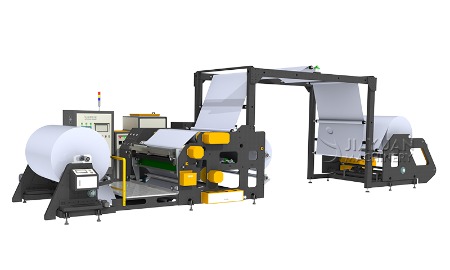
Adhesive coating machine
Key process parameters for intermittent coating include the segment length, gap length, registration accuracy (position of coated segments relative to the substrate or upstream features), and the transient behavior at the start and end of each segment. At the start of a segment, the flow must ramp up quickly to achieve the target coat weight without a "tail" or "drag" that would extend beyond the desired area. At the end, the flow must stop cleanly to avoid "stringing" or "weeping" that would cause adhesive bridging across the gap. The valve response time is critical; typical high-speed valves can open and close in 10-50 milliseconds. The adhesive's rheology also affects the transient: low-viscosity fluids tend to string, while high-viscosity fluids may have a slower response. To improve edge definition, many systems use a "snuff-back" or "suck-back" valve that momentarily reverses the flow at the end of a segment to pull the adhesive back into the die, preventing stringing. The controller must account for the line speed and the distance from the valve to the die lip to time the valve actuation precisely.
Control of intermittent coating is typically performed by a programmable logic controller (PLC) with high-speed counters and encoder inputs. The line speed is monitored via an encoder on a driven roll, and the valve actuation is synchronized with the web position. The target segment length and gap are entered as setpoints; the PLC calculates the valve open/close times. For applications requiring registration with printed marks or other web features, a vision system or a photocell detects the marks and provides a trigger signal for the valve, ensuring that the adhesive segments align correctly. Some advanced systems use a proportional valve that can vary the flow during the segment to create a tapered coat weight (e.g., heavier at the center, lighter at the edges). The coat weight of each segment is controlled by the pump speed, which is held constant during the segment; any variation in speed would affect coat weight. The control system must also manage the pressure in the die manifold; when the valve closes, the pump continues to run (with a bypass or recirculation) to avoid pressure fluctuations that would affect the next segment.
Intermittent coating is widely used in several industries. In the hygiene sector, diaper fastening tapes are coated with PSA in discrete patches that are later applied to the diaper chassis. The adhesive segments must be accurately placed to ensure secure closure and easy removal. In medical products, intermittent coating is used for wound dressings where adhesive is applied only on the edges, leaving the center pad adhesive-free to absorb exudate. In packaging, cold-seal adhesives are applied in intermittent patterns on film for 'pop' or 'peel' seal packaging. In electronics, adhesive is applied only where components will be placed. The benefits of intermittent coating include significant material savings, as adhesive is not wasted on areas where it is not needed. It also allows for functional designs, such as breathable areas or removable sections. However, intermittent coating adds complexity to the coating line and requires precise control to avoid defects. The trend is toward more sophisticated patterns with variable segment lengths and gaps, controlled by high-speed servos and vision systems, enabling on-the-fly changes for different product formats. In summary, intermittent coating is a valuable technique for targeted adhesive application, reducing cost and enhancing product functionality, and its adoption is growing with the demand for smart packaging and advanced medical devices.