kiss coater
A kiss coater is a type of roll coating machine where the substrate lightly touches (kisses) the applicator roll, receiving a thin, controlled layer of coating material without significant pressure or wrap. This gentle contact method is ideal for applying very thin coatings, typically from 0.5 to 10 gsm, onto delicate or porous substrates, making it widely used for primers, release coatings, and light adhesive applications. This article provides a comprehensive overview of kiss coater technology, including its design, working principles, process parameters, advantages, and typical applications.
The kiss coater operates on a simple principle: a rotating applicator roll picks up coating material from a pan or metering system, and the substrate passes over a backup roll, with the web just touching the applicator roll at the nip point. The contact pressure is minimal—just enough to transfer the coating film from the roll to the substrate. The amount of coating transferred depends on the film thickness on the applicator roll, the web speed, and the contact angle. Unlike other roll coaters where the substrate is wrapped around the rolls under significant pressure, the kiss coater applies only a light touch, resulting in minimal substrate stress and no penetration into porous materials. This makes it ideal for coating thin films, nonwovens, and other fragile substrates.
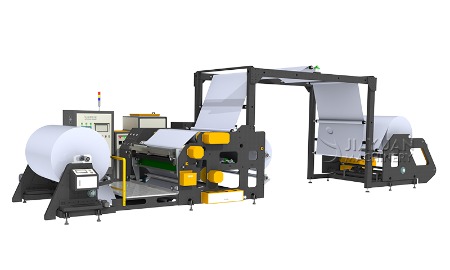
Adhesive coating machine
Kiss coaters offer several distinct advantages. The gentle contact minimizes substrate stretching, wrinkling, or breakage, making them suitable for delicate films, tissue paper, and lightweight nonwovens. The coating thickness is easily controlled by adjusting the film thickness on the applicator roll, which can be achieved through a metering roll, doctor blade, or gravure cylinder. Kiss coaters can apply extremely thin coatings (as low as 0.2 gsm) with good uniformity (±5%) and are very material-efficient because overspray and waste are minimal. The design is simple, robust, and easy to clean, allowing quick changeovers between different coatings. Kiss coaters also operate at high speeds (up to 400 m/min) and require less floor space than more complex coating systems.
However, kiss coaters also have limitations. The coating uniformity is generally less precise than slot die or reverse roll coaters, with variation typically ±3-5%. The coating weight depends on the rheology of the fluid and the contact angle, which can be affected by surface energy variations on the substrate. The process is sensitive to web tension and alignment; any flutter or misalignment causes uneven contact and coating defects. Kiss coaters are not suitable for high-viscosity coatings (>5,000 cP) or for heavy coatings (>20 gsm), as the transfer efficiency decreases with increasing viscosity. The backup roll must have a precise and uniform surface to ensure even contact across the web width, and roll runout must be tightly controlled.
Key process parameters in kiss coating include the film thickness on the applicator roll, the web speed, the contact angle (the angle at which the web meets the roll), and the nip pressure (which is typically very low, just enough to establish contact). The film thickness on the applicator roll is the primary control for coat weight, and is set by the metering system—for example, a gravure roll or a doctor blade. The web speed relative to the roll surface speed can also affect the coating thickness; typically, the roll surface speed is slightly higher than the web speed to create a drawing action that facilitates transfer. The contact angle (typically 5-15 degrees) influences the amount of fluid picked up; larger angles increase coating weight. The nip pressure is usually set below 1 bar to maintain the "kiss" condition. Environmental factors such as temperature and humidity affect the fluid viscosity and evaporation, requiring careful control for consistent results.
Kiss coaters are extensively used in the adhesive industry for applying release coatings (silicone or other release agents) onto paper and film liners, where the coating weight is typically very low (0.5-2 gsm). They are also used for applying primers and adhesion promoters onto films to enhance bonding for subsequent coating layers. In the packaging sector, kiss coaters apply cold-seal adhesives onto film substrates for food packaging. Other applications include applying anti-block coatings, slip agents, and water-based varnishes on paper and film. Kiss coaters are also used in the production of medical tapes and dressings where very thin adhesive layers are required. Modern kiss coaters feature automated roll gap adjustment, closed-loop coat weight measurement using beta gauges, and advanced tension control systems. The simplicity, cost-effectiveness, and substrate-friendly nature of kiss coating technology ensure its continued use in many specialty coating applications.