lamination machine
A lamination machine is a specialized piece of industrial equipment designed to bond two or more substrate layers together using adhesive, heat, or pressure, producing a composite material with enhanced properties. Lamination machines are essential in the production of packaging films, labels, tapes, medical devices, and many other multi-layer products. This article provides a comprehensive technical overview of lamination machine types, working principles, key components, process parameters, and selection criteria for various adhesive lamination applications.
Lamination machines vary in complexity from simple bench-top units to large-scale, high-speed roll-to-roll systems. The core function remains the same: to bring multiple webs into intimate contact under controlled conditions to achieve a strong, uniform bond. The basic configuration includes unwinds for each substrate, a coating station (if adhesive is applied inline), a laminating nip (the bonding zone), and a rewind for the finished laminate. In many coating lines, the lamination station is integrated after the coating and drying sections. The nip consists of a pair of rolls (typically a steel roll and a rubber-covered roll) that apply pressure to the layered webs. The pressure, nip gap, and roll temperature are adjustable to accommodate different substrates and adhesives. Some lamination machines also include pre-heating rolls, cooling rolls, and edge trimming stations to enhance the bonding and finishing process.
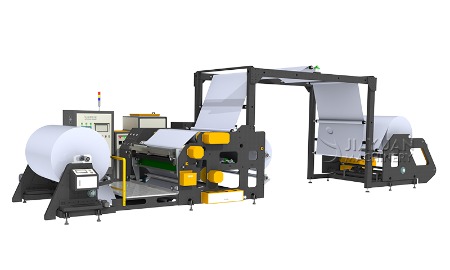
Adhesive coating machine
Lamination machines are classified by the lamination method. Dry lamination machines are the most common for adhesive coating lines: the adhesive is coated and dried on one substrate, then the second substrate is laminated with heat and pressure to activate the dry adhesive. These machines often have heated nip rolls (up to 150°C) and precise temperature control. Wet lamination machines apply the adhesive and immediately laminate before drying; they are simpler but limited to substrates that can tolerate wet adhesive and where the adhesive cures quickly. Solventless lamination machines use 100% solids adhesives (e.g., two-component polyurethanes) that are applied without solvents and cured at room temperature; they require precise metering and mixing systems. Thermal lamination machines use heat to melt a pre-applied adhesive layer (e.g., EVA or polyolefin) on one substrate, bonding to the other under pressure. These are often used in packaging and bookbinding. Each type has specific design features: dry laminators have long drying ovens, wet laminators have short nips, solventless laminators have mix-and-apply systems, and thermal laminators have heated rolls with precise temperature zones.
Key components of a lamination machine include the unwind stands, which must accommodate heavy rolls and provide tension control. The coating station (if integrated) applies the adhesive; for standalone laminators, the adhesive may be pre-applied. The laminating nip is the critical section, with rolls that must be precisely ground and balanced to avoid uneven pressure. The rubber-covered roll (typically 60-90 Shore A hardness) provides compliance to accommodate variations in web thickness and to expel air. The steel roll is often chrome-plated and may be heated via oil or electric heaters. The nip pressure is applied by pneumatic or hydraulic cylinders, typically ranging from 1 to 10 bar. The rewind station winds the laminate with tension control to prevent telescoping or blocking. Additional features may include edge guides for alignment, spreader rolls to prevent wrinkles, and inspection systems for quality monitoring. The machine control system coordinates all drives, tensions, temperatures, and pressures, often with a PLC and touchscreen HMI.
Process parameters for lamination machines must be optimized for each product. Nip pressure affects bond strength and air removal; too low pressure causes bubbles, too high may crush the substrate or squeeze out adhesive. Nip temperature determines the activation of heat-sensitive adhesives; for dry lamination, the temperature is typically set above the adhesive's softening point but below the substrate's distortion temperature. Line speed affects the residence time in the nip and the heat transfer; higher speeds may require higher temperatures or longer nips. Tension matching between the two webs is critical to prevent wrinkles and curl; tension differences cause one layer to stretch more than the other, leading to a curved or bowed laminate. The nip gap (distance between rolls) must be set to accommodate the total caliper of the laminate, with a small compression to ensure contact. The choice of rubber hardness and roll surface finish also influences performance; a fine surface finish (Ra < 0.4 µm) is needed for smooth laminates. Operators monitor these parameters and adjust them based on product trials and quality feedback.
Applications of lamination machines span diverse industries. In flexible packaging, they bond different films (e.g., PET/Al foil/PE) to create barrier packaging for food and pharmaceuticals. In the label industry, they laminate the face stock to the PSA-coated liner. In tape production, they laminate a release liner to the adhesive side of double-sided tapes. In medical, they laminate nonwoven fabrics to adhesive films for wound dressings. In automotive, they bond decorative or acoustic materials to interior trim. The selection of a lamination machine depends on factors such as web width (500-2000 mm), line speed (up to 400 m/min), substrate types (film, paper, foil, nonwoven), adhesive type, and required quality level. Many manufacturers offer custom solutions, including multi-station laminators for combining more than two layers, and reverse laminators for specialty products. Ongoing innovations include digital tension control, automatic splice systems, and in-line defect detection, making lamination machines more automated and efficient. In summary, the lamination machine is a versatile and essential tool for creating high-performance multilayer composites, and its design and operation must be carefully tailored to the specific adhesive and substrate combination.