line speed m/min
Line speed, expressed in meters per minute (m/min), is the velocity at which the substrate web moves through the coating machine. It is one of the most important operating parameters, directly determining production throughput and significantly influencing coating quality, drying or cooling capacity, and equipment design. This article provides a comprehensive technical overview of line speed in adhesive coating, including its typical ranges, impact on coating thickness and defects, relationship with drying, and considerations for setting optimal speed.
Line speed varies widely across different adhesive coating processes and product types. For hot melt pressure-sensitive adhesives (PSAs), which require no drying, speeds are typically the highest, ranging from 200 to 600 m/min, with some advanced lines exceeding 800 m/min for high-volume packaging tapes. Solvent-based adhesive lines operate at much lower speeds, typically 30 to 150 m/min, because the drying ovens have limited capacity to evaporate organic solvents; higher speeds would require impractically long ovens or excessive temperatures that could damage the substrate. Water-based adhesive lines fall in between, with typical speeds of 50 to 200 m/min, depending on the water content and drying efficiency. Specialty applications such as medical coatings or optical films may run at 10-50 m/min to achieve extreme precision and defect-free coatings. The choice of line speed is a balance between maximizing production output and maintaining product quality within the capabilities of the equipment.
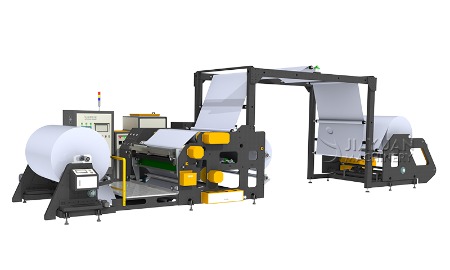
Adhesive coating machine
Line speed has a direct and inverse relationship with coat weight for a given adhesive flow rate. In slot die and gravure coating, the coat weight (gsm) is proportional to the flow rate (volume per time) divided by the line speed. Therefore, if the flow rate is fixed, increasing line speed reduces the coat weight. This relationship is used to control coat weight: a closed-loop system adjusts the pump flow rate to maintain the target coat weight as the line speed changes (e.g., during acceleration or deceleration). The response time of the pump and the gauge must be fast enough to compensate for speed changes without causing significant coat weight deviations. For roll coating and comma blade coating, the relationship is more complex because the hydrodynamic pressure and film splitting depend on speed; however, empirical models or lookup tables are used to correlate speed with coat weight for a given gap setting. In any case, precise speed control (typically within ±0.1% of setpoint) is essential for consistent coat weight.
Line speed also affects coating defects, particularly air entrainment. At higher speeds, the substrate drags a thicker boundary layer of air, which can be trapped under the coating bead, causing pinholes, bubbles, or incomplete coverage. The maximum speed without air entrainment depends on the fluid viscosity, surface tension, and the coating method. Slot die coating, with its close proximity and vacuum assist, can operate at higher speeds (up to 600 m/min or more) without air entrainment, while comma blade coaters are limited to about 200 m/min. Spray coating is typically slower due to the need for droplet deposition and settling. Additionally, high line speeds increase shear rates in the coating fluid, which can cause non-Newtonian behavior (e.g., shear thinning) that changes the effective viscosity and coating thickness. For heat-sensitive adhesives, high speed may cause frictional heating in roll coaters, leading to viscosity reduction or thermal degradation. Therefore, the maximum line speed is often constrained not by the coating head itself but by the acceptable shear and temperature limits of the adhesive.
Drying capacity is often the primary limiting factor for line speed in solvent-based and water-based systems. The drying oven must evaporate the carrier at a rate that matches the coating application. The required oven length (L) is proportional to line speed (v) and the time needed for drying (t): L = v × t. If the oven length is fixed, increasing line speed reduces the residence time, and the oven must be operated at higher temperatures or with higher airflow to maintain drying efficiency. However, there are limits: excessively high temperatures may degrade the adhesive or substrate; high airflow may cause substrate flutter or blistering. Therefore, the maximum line speed is determined by the maximum allowable drying rate without compromising quality. For hot melt coatings, cooling is required instead of drying; the chill roll temperature and contact time (which decreases with speed) must be sufficient to solidify the adhesive. If the line speed is too high, the adhesive may not cool completely, leading to sticking in the rewind or poor lamination. Thus, line speed must be matched to the thermal capacity of the cooling system.
The mechanical design of the coating line is heavily influenced by the maximum line speed. Higher speeds require more powerful motors, larger diameter rolls to reduce deflection and maintain proper tension, and more responsive tension control systems. The unwind and rewind stations must handle the higher throughput, often using turret rewinders for continuous operation. Web guiding systems must be faster to correct lateral wander. The noise and vibration levels increase with speed, requiring careful balancing of rotating components. Additionally, safety considerations become more critical at high speeds, as web breaks can cause whiplash and damage. Therefore, the design speed is typically set with a safety margin (e.g., 20% above the nominal operating speed) to allow for flexibility. However, operating at the maximum speed continuously may accelerate wear and increase maintenance frequency. The optimal line speed is determined through economic analysis that balances production output, quality, energy consumption, and equipment life. Manufacturers often use empirical data and process modeling to identify the speed range that gives the best cost-performance ratio for each specific product.