low viscosity coating
Low viscosity coating refers to the application of adhesives and coating fluids with viscosities typically below 500 centipoise (cP), often ranging from 1 to 200 cP, including diluted solvent-based solutions, water-based dispersions with low solids content, and certain silicone or UV-curable formulations. These low-viscosity fluids are used to produce very thin adhesive layers (0.5-5 gsm dry coat weight) for applications such as silicone release coatings, primers, low-tack PSA labels, and high-precision optical adhesives. Processing low viscosity fluids presents unique challenges, including dripping, edge bleeding, poor wetting, and non-uniform film thickness, requiring specialized coating methods and careful process control. This article provides a comprehensive technical overview of low viscosity coating, including applicable methods, equipment considerations, process parameters, and common defect prevention.
The primary challenge in low viscosity coating is achieving a uniform, defect-free thin layer without excessive spreading, dripping, or solvent evaporation causing viscosity increase in the coating bead. Because the fluid is thin, it tends to flow easily, and the coating bead between the applicator and substrate is unstable, leading to dripping or streaking. Additionally, low viscosity fluids often have high solvent content, which can evaporate rapidly, causing the fluid to thicken and form skin, leading to "drying in the bead" defects. The coating method must be selected to control the low viscosity effectively. Gravure coating is the preferred method for very thin, low-viscosity coatings because the engraved cells meter the fluid precisely and the doctor blade removes excess, making the transfer relatively independent of viscosity. Slot die coating can also be used, but requires a very narrow lip gap (0.05-0.2 mm) and a precise pump to maintain a stable bead. Roll coating (especially kiss coater) is used for low-viscosity primers and release coatings, with careful gap control. Spray coating is an option for non-contact application of low-viscosity adhesives, but overspray and low transfer efficiency are concerns. The coating head must be designed for low-viscosity fluids to prevent leakage; seals and gaskets must be tight, and the die or roll must have edge dams to confine the fluid.
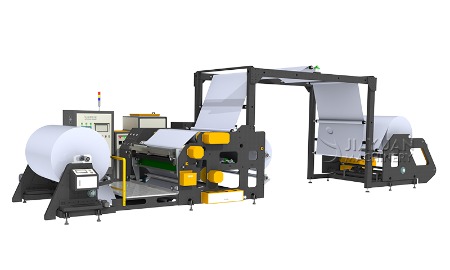
Adhesive coating machine
Equipment considerations for low viscosity coating include the use of precision gear pumps or piston pumps with very low pulsation to deliver a steady flow. The supply lines and coating head must be free of dead zones where fluid can stagnate and evaporate, causing residue buildup. For solvent-based low-viscosity systems, the equipment must be explosion-proof and have adequate ventilation. Temperature control is important; low temperatures reduce evaporation but may increase viscosity, while higher temperatures accelerate evaporation and may cause bubbles. The coating head, whether a gravure cylinder or slot die, must have a very smooth surface finish (Ra <0.1 µm) to avoid fluid adhesion or uneven transfer. The backup roll must have a release surface (e.g., chrome) to prevent the fluid from sticking and transferring back. For slot die coating of low-viscosity fluids, the die lip gap is often set by using very thin shims (0.05-0.15 mm) and the die gap (die-to-substrate distance) is maintained at a small value (0.1-0.3 mm) to create a stable bead. The pump flow rate must be low, requiring precise control at low RPM.
Process parameters for low viscosity coating must be carefully balanced to achieve the target coat weight and avoid defects. The coat weight is controlled by the pump flow rate and line speed; for low-viscosity fluids, the relationship is linear. The line speed is often moderate to high (100-400 m/min) to reduce the tendency of the fluid to pool or drip; however, high speed increases air entrainment risk, so a vacuum box may be needed. The coating bead stability is sensitive to the die gap and the fluid's surface tension; surfactants may be added to reduce surface tension and improve wetting. The drying or curing process is critical because low-viscosity fluids contain high levels of solvent or water; the drying oven must be set to remove the carrier rapidly without causing blistering or skinning. For UV-curable low-viscosity fluids, the UV dose must be sufficient to cure the thin layer quickly, as under-cure would leave a tacky surface. The viscosity must be monitored continuously to ensure it remains within the process window; inline viscometers are often used to provide feedback for temperature or solvent addition adjustments.
Common defects in low viscosity coating include dripping (fluid falling from the die), bleeding (fluid spreading beyond the desired coating width), pinholes (due to air bubbles or contamination), and uneven thickness (due to flow instability). Dripping is prevented by reducing the die gap, increasing line speed, or using a vacuum to stabilize the bead. Bleeding is controlled by edge dams or air knives that confine the fluid to the desired width. Pinholes are eliminated by degassing the fluid and filtering out particles. Uneven thickness is minimized by ensuring uniform gap and temperature across the die, and by using a high-quality gear pump with minimal pulsation. The substrate must be clean and have adequate surface energy to promote wetting; corona treatment may be needed. Quality control includes continuous coat weight measurement (using beta or NIR gauges), optical inspection for defects, and performance testing (adhesion, release force). Low viscosity coating is essential for producing ultra-thin adhesive layers that are cost-effective and provide specific functional properties. The trend is toward solvent-free low-viscosity systems (e.g., UV-curable and low-VOC water-based) to meet environmental regulations, while maintaining the precision required for high-tech applications.