nonwoven coating
Nonwoven coating refers to the application of adhesive materials onto nonwoven fabrics, which are engineered fibrous webs made from natural or synthetic fibers without weaving or knitting. Coating nonwovens is essential for producing hygiene products (diapers, feminine care), medical dressings, wipes, filters, and industrial materials, providing bonding, reinforcement, or functional properties. This article provides a comprehensive technical overview of nonwoven coating technologies, adhesive types, application methods, process parameters, and quality considerations.
Nonwoven substrates present unique challenges for adhesive coating due to their porous, fibrous, and often delicate structure. Unlike films or foils, nonwovens can absorb adhesive into their bulk, reducing surface tack and potentially stiffening the material. Therefore, coating methods must be carefully selected to achieve the desired adhesive distribution without excessive penetration or fiber damage. Common applications include construction bonding (layering nonwovens together), elastic attachment (securing elastic strands for leg cuffs and waistbands in diapers), and surface coating for medical tapes or labels. The adhesive is typically a hot melt PSA or construction adhesive, applied at low coat weights (1-10 gsm) to maintain softness and breathability. Line speeds for nonwoven coating in hygiene production range from 200 to 600 m/min, with web widths up to 1200 mm. The coating equipment is often integrated into converting lines, requiring rapid changeovers and precise pattern control.
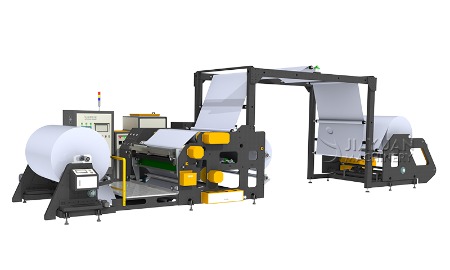
Adhesive coating machine
Several adhesive application methods are employed for nonwoven coating, each suited to specific product requirements. Spiral spray is the most common for construction bonding, using multi-hole nozzles that create a helical pattern of adhesive filaments. This pattern provides excellent coverage with low coat weight and minimal stiffness, while maintaining breathability. Slot die coating is used for continuous adhesive films, such as for elastic attachment or for applying a uniform PSA layer onto nonwoven tapes. Meltblown application generates fine adhesive fibers that form a random web, offering high coverage and softness, ideal for hygiene adhesives. Gravure coating is occasionally used for low-viscosity adhesives to apply thin, patterned coatings. The choice of method depends on the adhesive viscosity, coat weight, pattern resolution, and line speed. Spray systems require precise control of air pressure and adhesive temperature to achieve consistent fiber size and pattern width. Slot dies need accurate gap and temperature control to ensure uniform film thickness. All methods must avoid adhesive strike-through (penetration to the opposite side), which would cause sticking in the rewind or skin irritation.
Hot melt adhesives dominate nonwoven coating due to their 100% solids content, fast setting, and low VOC emissions. Common polymers include styrenic block copolymers (SBC), polyolefins, and ethylene-vinyl acetate (EVA), formulated with tackifiers and plasticizers. For hygiene applications, the adhesive must be skin-friendly, non-irritating, and resistant to migration. The application temperature typically ranges from 140°C to 180°C, with viscosity maintained between 1,000 and 10,000 cP depending on the method. Water-based adhesives are also used for some nonwoven products (e.g., wipes, medical fabrics) where lower temperatures are needed or where water-resistant bonding is required, but drying ovens are then necessary. Solvent-based adhesives are rarely used on nonwovens due to environmental and flammability concerns. The adhesive supply system includes melt tanks, heated hoses, and pumps with precise temperature control to ensure consistent viscosity. Closed-loop coat weight control, using NIR or beta gauges, adjusts pump speed to maintain target gsm. Inline vision systems monitor spray patterns and detect misses or irregularities.
Process control for nonwoven coating is critical to avoid defects that compromise product performance and comfort. Coat weight variations cause uneven bonding or stiffness. Spray pattern instability leads to stripes or voids, causing delamination. Web tension must be low to prevent stretching or tearing of the nonwoven, but sufficient for stable transport through the coating head and nip. The nip pressure (if used) must be optimized to ensure adhesive transfer without crushing the fibers. Temperature and humidity in the production area affect adhesive set time and fiber handling. The coated nonwoven is often cooled by ambient air or chill rolls to solidify the adhesive before further processing. Quality testing includes peel strength, bond integrity, and sensory evaluation for softness and tack. For medical nonwovens, additional biocompatibility tests are required. The line also includes edge guides and web cleaners to prevent contamination. Data logging of all parameters enables traceability and continuous improvement.
Applications of nonwoven coating span numerous industries. In hygiene, construction adhesives bond the topsheet to the acquisition layer and core, while elastic attachment adhesives secure leg elastics and waistbands in diapers and incontinence products. In medical, nonwoven tapes and dressings use PSAs for skin contact. In filtration, adhesives bond nonwoven layers in pleated filters. In wipes, adhesives may be applied for sealing edges or bonding layers. In automotive, nonwoven insulation and headliners require adhesive lamination. The trend toward lighter, more breathable nonwovens drives the development of lower-coat-weight adhesives and finer spray patterns. Bio-based and recyclable adhesives are gaining traction in response to sustainability goals. Additionally, intelligent coating systems with real-time pattern correction and predictive maintenance are being adopted to reduce waste and downtime. In summary, nonwoven coating is a versatile, high-speed process that requires careful selection of adhesive and application method to meet the specific performance and comfort requirements of each end-use product, with ongoing innovations in materials and process control enhancing efficiency and environmental performance.