packaging adhesive coater
A packaging adhesive coater is a specialized industrial machine designed to apply adhesives onto various packaging materials, including films, foils, paper, and cardboard, for the production of flexible packaging laminates, cartons, labels, and sealing tapes. These coaters are essential for creating multi-layer structures with barrier properties, strength, and sealability required for food, beverage, pharmaceutical, and consumer goods packaging. This article provides a comprehensive technical overview of packaging adhesive coater types, adhesive systems, process parameters, and quality control in the packaging industry.
Packaging adhesive coaters can be classified by the type of packaging they produce. Flexible packaging coaters apply adhesives onto thin films (e.g., PET, OPP, PE, PA) and foils to create laminates for pouches, sachets, and wrap films. These coaters often use solventless or solvent-based adhesives and operate at speeds of 100-400 m/min with web widths up to 2000 mm. Carton and box coaters apply adhesives (often water-based or hot melt) onto paperboard for folding cartons and corrugated boxes, typically at lower speeds (50-200 m/min) but with higher coat weights. Label coaters produce pressure-sensitive labelstock, using PSAs applied onto release liners, as discussed in previous sections. Tape coaters for packaging tapes (e.g., BOPP tape) use hot melt PSAs at high speeds. Each type requires specific coating heads, drying or cooling systems, and tension control tailored to the substrate and adhesive. The trend toward sustainable packaging drives demand for coaters that handle biodegradable films and water-based adhesives with lower VOC emissions.
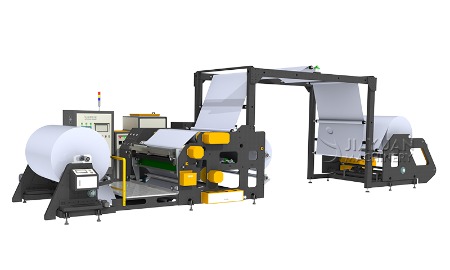
Adhesive coating machine
The adhesive systems used in packaging coating include solvent-based, water-based, solventless (100% solids), and hot melt. Solvent-based adhesives (e.g., polyurethane, acrylic) provide excellent bond strength and heat resistance but require long drying ovens and solvent recovery, increasing capital and energy costs. Water-based adhesives (e.g., acrylic dispersions, vinyl acetate-ethylene) offer lower VOC emissions and are suitable for many flexible packaging applications, though they require efficient drying to avoid moisture-related defects. Solventless adhesives (two-component polyurethanes) are gaining popularity because they require no drying, only curing at room temperature, reducing energy and floor space; they are applied via precise meter-mix systems and slot die or roll coaters. Hot melt adhesives (e.g., SBC, polyolefin) are used for carton sealing, label backing, and some flexible packaging; they set instantly upon cooling, enabling high speeds. The choice of adhesive dictates the coater configuration: solvent and water-based lines have drying ovens; solventless lines have mixing and curing stations; hot melt lines have melt tanks and chill rolls. Hybrid systems are also available for multiple adhesive types.
The coating head in a packaging adhesive coater is selected based on the adhesive viscosity and required coat weight. Slot die coating is preferred for precision applications, such as solventless laminating, offering uniform coat weight (1-5 gsm) with minimal waste. Gravure coating is common for low-viscosity adhesives, providing thin, uniform layers (1-3 gsm) at high speeds. Roll coating (including reverse roll) is versatile for medium to high viscosities and heavier coat weights (3-10 gsm). Comma blade coating is used for water-based adhesives on paper and film. For carton sealing, applicators (slot, spray, or wheel) apply hot melt in patterns (dots, lines, or spirals) onto the box flaps. The coating head must be designed for easy cleaning and quick changeover between adhesive types, as packaging plants often run multiple products. Temperature control is critical for hot melt and solventless systems to maintain viscosity and reactivity. Closed-loop coat weight control using gauges (beta, X-ray, or NIR) ensures consistent adhesive amount, which is vital for seal strength and material cost.
The drying or curing section is a major component of packaging adhesive coaters. For solvent-based lines, the drying oven is long (30-60 m) with multiple temperature zones, and solvent vapor is extracted and sent to a thermal oxidizer or recovery system. For water-based lines, the oven is shorter (10-25 m) with high airflow to evaporate water; energy efficiency is improved by using heat recovery systems. For solventless lines, the coated laminate passes through a curing tunnel (or simply stored to cure) at ambient temperature; no oven is needed, saving space and energy. For hot melt lines, cooling is achieved via chill rolls (5-15°C) that solidify the adhesive instantly. The lamination station, often integrated after coating, brings the second substrate (e.g., another film or foil) into contact under pressure. The nip pressure and temperature are adjusted to ensure full adhesive transfer and bond formation. Web tension and edge guides prevent wrinkles and misalignment. The finished laminate is rewound with tension control to avoid blocking or telescoping. Inline inspection systems detect bubbles, streaks, and delamination.
Quality control in packaging adhesive coating focuses on bond strength (peel and delamination tests), seal strength, and barrier properties (oxygen and moisture transmission). The adhesive must withstand filling, sealing, transportation, and storage conditions, including temperature and humidity variations. For food packaging, adhesive compliance with FDA and EU regulations for food contact is mandatory. The coat weight is measured and controlled to avoid weak bonds or adhesive oozing. Visual inspection checks for clarity, uniformity, and absence of bubbles or wrinkles. The laminate is also tested for heat sealability if it is used for form-fill-seal applications. Data logging of process parameters ensures traceability and supports quality audits. The packaging adhesive coater is often part of an integrated converting line that includes printing, laminating, and slitting. The trend toward sustainable packaging requires adhesives that are compatible with recycling streams, and coaters are being adapted to handle bio-based adhesives and thinner films. Automation and Industry 4.0 technologies, such as predictive maintenance and real-time process optimization, are improving efficiency and reducing waste. In summary, the packaging adhesive coater is a versatile, high-performance machine that plays a vital role in the production of modern packaging, balancing speed, quality, and environmental requirements.