paper coating
Paper coating refers to the application of adhesives, release coatings, or functional layers onto paper and paperboard substrates for products such as labels, tapes (masking tapes), packaging, and specialty papers. Paper is a porous, hygroscopic, and dimensionally unstable substrate, presenting unique challenges for coating, including absorption of coating liquids, fiber swelling, and curling. This article provides a comprehensive technical overview of paper coating technologies, adhesive types, application methods, process considerations, and quality control.
Paper substrates used in adhesive coating include various grades: kraft paper, crepe paper (for masking tapes), glassine paper (for release liners), coated paper (for labels), and paperboard (for cartons). The coating can be a pressure-sensitive adhesive (PSA) for tapes and labels, a silicone release coating for liners, a heat-seal coating for packaging, or a functional coating for barrier or printability. Paper coating machines are typically roll-to-roll systems with coating stations (comma blade, gravure, roll, or slot die), drying ovens, and rewinders. Line speeds range from 50 to 300 m/min for paper, with web widths up to 2000 mm. Unlike film coating, paper coating often involves absorption of the coating fluid into the fibers, which can reduce the effective surface coat weight and cause stiffness. Therefore, the coating formulation and application must be optimized to achieve the desired surface properties while minimizing penetration.
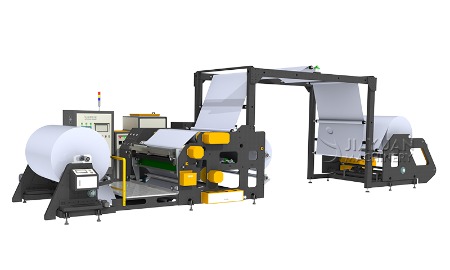
Adhesive coating machine
For pressure-sensitive adhesive (PSA) coating on paper, the adhesive is applied onto the paper backing (e.g., for masking tape) or onto a release liner (for label paper). Common coating methods for PSAs on paper include comma blade and roll coating for water-based adhesives, and slot die for hot melt adhesives. The coat weight for paper-based tapes is typically 20-40 gsm, while for label face paper it is 15-30 gsm. The paper must be surface-sized or coated to prevent excessive adhesive penetration that would reduce tack. For masking tapes, crepe paper is used, and the adhesive must have good anchorage to the stretchable paper. For release liners (glassine or supercalendered paper), a silicone coating is applied at 0.5-2 gsm using gravure or roll coating; the silicone must be cured (usually by heat) to achieve controlled release. The coating head for silicone often uses multi-roll systems to apply very thin, uniform layers. Drying ovens for paper coatings operate at moderate temperatures (80-150°C) to avoid scorching; for silicone, curing temperatures may be higher (up to 180°C). Paper's hygroscopic nature requires humidity control in the production area to minimize dimensional changes. Tension control must consider paper's lower tensile strength compared to films; excessive tension causes breaks, while low tension causes wrinkling. Web guiding and edge trimming are also important for paper due to slitting and converting needs.
Process control for paper coating focuses on coat weight uniformity, adhesive penetration, and web moisture content. Coat weight is measured by beta or NIR gauges; however, absorption can affect the reading, so the gauge must be calibrated for paper. The coating bead stability is critical; for comma blade, the blade angle and gap control the coat weight, while for slot die, the flow rate and speed ratio determine it. The paper moisture content should be maintained at 5-8% to avoid curling and dimensional instability; this is controlled by the drying oven's temperature and exhaust, and by preconditioning the paper before coating. The adhesive viscosity must be controlled, especially for water-based adhesives, as evaporation and temperature changes cause viscosity drift. Inline cameras detect coating defects like skips, streaks, and contamination. The coated paper is rewound with tension profiles to avoid telescoping; for release liners, the silicone coat must be fully cured before rewinding to prevent blocking. Quality testing includes peel adhesion (for PSA), release force (for silicone), and block resistance. The paper's tensile and tear strength are also monitored to ensure converting performance.
Paper coating applications are numerous. Masking tapes use crepe paper coated with rubber-based PSA. Label papers (both face and liner) are coated with PSA on one side and sometimes with a silicone release on the other. Transfer papers for heat-seal labels or decals require specialized coatings. Packaging papers may receive heat-seal or moisture-barrier coatings. Graphic arts papers are coated with adhesives for mounting and laminating. The trend in paper coating is toward sustainable, recyclable materials; water-based and bio-based adhesives are replacing solvent-based systems. Silicone release coatings are being optimized for lower coat weights and easier recyclability. Additionally, the development of linerless label papers (with a coating that acts as both adhesive and release surface) is gaining momentum. Paper coating machines are becoming more automated, with faster changeovers and improved energy efficiency. In summary, paper coating is a well-established but evolving process that requires careful consideration of substrate properties, adhesive chemistry, and drying conditions to produce high-quality adhesive papers and release liners for the label, tape, and packaging industries.